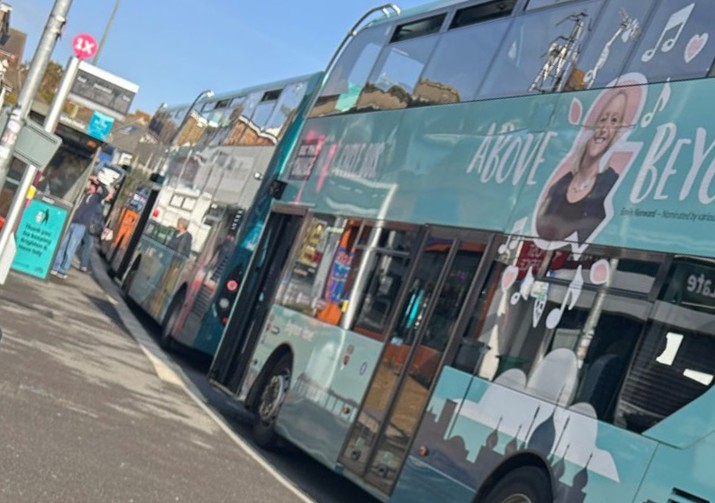
A year-long £500,000 study aimed at improving bus services throughout Sussex is to begin after a proposal was agreed by senior councillors today (Thursday 10 September).
It could lead to the first elected mayor of Sussex setting up publicly owned bus services or running franchised routes so that passengers have a more frequent and reliable service.
The study was approved by the Sussex and Brighton Strategic Authority board which is made up of half a dozen senior councillors, two of them from Brighton and Hove.
The board will work with the first mayor after an election in May 2028. The mayoral election had been due to take place in May this year but was postponed to allow time for a shake up of local councils.
The bus study has been funded with a £564,000 government grant, with £64,000 set aside to pay for an official to “support the study”.
Key officials and councillors had a meeting with the Department for Transport (DfT) last month and, a report said, they were told that “different approaches to bus reform might be suitable to some parts of the area and not others”.
The report, to the strategic authority board, said: “The DfT also emphasised that the feasibility study is intended to examine the full range of reform options available rather than assuming franchising is the eventual outcome.
“The proposed programme has been designed to place engagement at its core.
“Vital to the success of the study will be ensuring that input is sought, and integrated, from a wide range of stakeholders.”
These would include bus operators, council public transport officials, passenger groups, users, businesses, community groups, accessibility groups, education providers, health partners, non-bus users and others.
The report said: “This will help ensure the future vision is shaped by a range of voices and ensure that recommendations from the study are shaped based on both technical input but also user (and potential user) input from those who benefit or could benefit from bus travel.”
At the strategic authority board meeting, held at Shoreham Port Authority’s headquarters, the Labour deputy leader of Brighton and Hove City Council, Jacob Taylor, welcomed the study.
Councillor Taylor said: “Brighton and Hove, as a city, has very high bus usage but we know for the rest of the strategic authority buses are really important.
“We’re not going to get train lines absolutely everywhere in this county and the connectivity between our rural areas, villages and our towns and cities … is going to be really important.
“Buses are a key to that. We’ve already got a pretty good network in many places but obviously we will be thinking about how that can be improved in the decades to come.”
Councillor Taylor said that franchising was the model in Greater Manchester but he asked if the study could look at full public ownership such as setting up a new publicly owned bus company or even buying an existing bus company.
He was told that public ownership would be considered as an option.
West Sussex County Council cabinet member Nicholas Russell said that he had met several of those running private bus companies and most were owned by people from the county.
The Liberal Democrat councillor said: “They’re providing a lot of school services and the like so they are very much also an active participant in public transport provision in Sussex at the moment.
“I want us to be very clear that we are saying this is a neutral and objective study and we don’t have a preconception about how it will report.”
East Sussex County Council deputy leader Pete Morley said that he wanted the review to look into who currently could not use the network when they were trying to reach their workplace.
The Reform UK councillor was told that the review would engage with people who did not use buses and ask the public their views not just about routes but also about timetabling matters.
The Reform leader of East Sussex County Council, Andy Woolley, said that he lived in a rural area where using public transport was “very prohibitive”.
Councillor Woolley said: “I know that bus to college and bus to hospital is important. We’re having big discussions at the moment about moving staff to neighbourhoods as far as health provision is concerned.
“But there is still the need for people to move around using public transport which is very prohibitive in places like where I live. A missed appointment can be a nightmare.”
The Lib Dem leader of West Sussex County Council, Jay Mercer, said that the outcome of the review would need to be as relevant to Crawley as to the more agricultural areas of the county.
Councillor Mercer said: “Most of the issues I get as a councillor are around the services around very small communities.
“The point Andy (Woolley) made – don’t be ill except on a Thursday when you can get a bus to the doctor – it’s very real.
“We all smile about it but, for some people, that’s reality. And I do feel we need to take that picture into account.”
He said that a significant proportion of the county’s population was not well served by the network.






How extraordinarily encouraging.
Councillors of different political colours and persuasions, representing rather different parts of Sussex, appear to have gathered in the same room, acknowledged that they may approach the question from different directions, and nevertheless worked together in pursuit of a common objective.
One had almost forgotten such a thing was possible – nationally, certainly, but perhaps even more so in our wondrous city of Brighton & Hove.
There will, of course, be plenty to debate about ownership, franchising, routes and precisely how £500,000 ought to be spent. But beginning with the problem rather than the politics – and listening to those who actually use the services, as well as those who cannot – seems an eminently sensible place to start.
More of this, please.
Indeed, with the great Local Government Reorganisation adventure now apparently as lost as the number 20 bus on its way to Hollingdean, one cannot help feeling rather more regretful that Sussex was denied its mayoral election this year. A directly elected figure charged with looking across council boundaries at precisely these sorts of shared challenges might have proved rather useful after all.
Good government need not require everyone to agree. It merely requires them occasionally to remember that solving the problem in the interest of their constituents is rather more important than defeating the person or the party sitting opposite.
Lady Bracknell