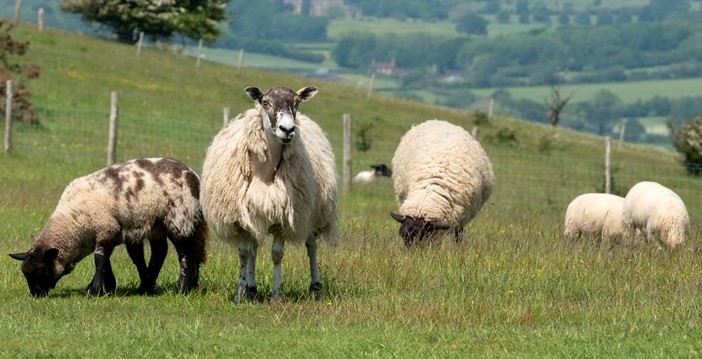
An animal rights activist who took three lambs from the King’s Sandringham estate told a court she hoped to “open his eyes” to the reality of sheep farming.
Rosa Sharkey, 26, wore a pink Animal Rising t-shirt as she took the sheep from Appleton Farm in Norfolk together with fellow activists Sarah Foy, also 26, and 37-year-old Rose Patterson in May 2023.
In a statement given to police, after attending Windsor police station, the defendants said the King “would have consented to the lambs’ rescue” and they had concerns for their welfare.
The trio deny the theft of the sheep and are on trial at Norwich Crown Court.
Defence barrister Sarah-Jane Ewart asked Sharkey: “Do you accept you went to Sandringham estate and you took three sheep?”
Sharkey, who gave her current address as Brighton, replied: “Yes.”
She agreed that they were not hers to take and that she had “no intention of giving them back”.
Sharkey, who works for a food distribution charity, said the King “says he’s an environmentalist and an animal lover”.
“The reality of sheep farming is quite hidden away, what they face in the slaughterhouse and the impact on the land are not things he would agree with,” she said.
She continued: “We hoped it would open his eyes to that.”
Sharkey said the King is an “influential person, he may be able to change”.
Questioned about what she meant by that, Sharkey said: “Change his own practices, have conversations, have a wider influence through that.”
She said that farming was “not his primary source of income”.
“One of the things we considered was the impact it would have on farmers,” said Sharkey.
She said she knew farmers’ lives were “not easy a lot of the time” and was “not wanting to vilify them”.
She said that taking the lambs was the “only way we could ensure any sheep were saved”.
Sharkey said they visited the farm on a previous occasion and saw a sheep with “quite a severe limp” and the “water trough was empty and it was quite a hot day”.
She said on the day they took the lambs, on May 24, 2023, they travelled to the farm and a driver joined them in a small van.
She said they got into the field over a “low electric fence, I think below your knee”.
They stayed for several hours from 8am “just sitting in the field, letting (the lambs) come close to us, being calm, trying to get them used to our presence”, Sharkey said.
She said they came back in the afternoon, could not find the sheep with the limp but loaded three lambs into the van and it eventually drove off with the animals at around 8pm.
She said the sheep were taken to a sanctuary and the van driver was a fourth person, who is not on trial.
“I don’t actually know the name of the sanctuary,” Sharkey said.
She said she “didn’t want to not be able to tell (police) everything I know” and that “I knew if I did know and I did tell them, the lambs would be taken back for slaughter”.
Sharkey, who said she grew up in a “sheep farming community” in Cumbria, said that afterwards she travelled to Windsor together with Foy, of Alfreton, Derbyshire, and Patterson, who said she lives in London.
“We wanted to be open about what we had done so that if an investigation was opened about sheep being taken that the facts were out there,” she said.
She said that they tried to speak to police outside Windsor Castle, one of the King’s residences, but “they didn’t respond to us” so they went to the police station instead.
Sharkey said the lambs were “still alive and well so we would say it was” successful.
Cross-examined by prosecutor Dingle Clark, Sharkey said: “It wasn’t a stunt, we rescued them so they wouldn’t be sent to slaughter.”
Patterson, who became tearful at points during her evidence, said: “I just wanted to save lambs that day and raise some awareness for the lambs we couldn’t save.”
She said that when they travelled to Windsor Castle there were “these police officers, armed guard type people – we tried to approach them and they basically ignored us”.
The trial continues.







They didn’t take the lambs, they stole them. And sheep farming is good for the land, just as cows are good for the land.
These activists need to learn something.
Very true. It’s through sheep grazing on the South Downs since Neolithic times that gives us the abundance of chalk grasslands and rare biodiversity across Sussex.
Let’s hope the sheep are ok after their kidnapping.
Sussex hills need sheep and cattle. Without them the diversity of nature will be suffocated by bramble.
Bramble and scrub is a precursor to the return of other flora…and fauna. Sheep, in particular, are damaging to biodiversity.
Perhaps this is something for you to ruminate upon Bobby as you spray insecticide all over the place or poison a bird of prey or three.
Not sure what world you live in. Bramble suffocates the landscape. The Sussex Downs only has its biodiversity due to the grazing. As others note above. Bramble would suffocate the unique grasslands we have here.
Not sure why you want your insecticide. Or accuse others of killing birds. I think you are getting a little confused with those of us who spend hours in these hills. And no I am not a farmer. I walk the land and learn of the unique nature we have in our unique hills. Maybe get up from your computer warrior desk and learn about the place you live. Go and sit on the Downs in the summer and appreciate the small stuff.
No. Bramble and scrub are what indicates a lack of grazing, as Bob’s said. They come back with too little animal grazing, and the chalk grassland flowers can’t compete and disappear .However, if we went back to properly using wool as a resource (instead of synthetics made from oil which are essentially plastics) we could maintain that landscape without eating meat.
Sadly, activists of this type never seem to understand beyond the obvious. Tik-Tok low attention span generation, I guess. This is what you get.
They illustrate very little intelligence and always appear to have an inability to look deeper and see what is happening several steps behind and several steps in front, resulting in the most simplistic knee-jerk reaction to something they can only understand at face value.
It’s odd that they are as old as they are, because I would expect it of young students, but not this 26-37(!) demographic. It looks a bit infantile and embarrassing.
“Trying to open the Kings eyes. …?”
More like trying to pull the wool over the jurors eyes.