
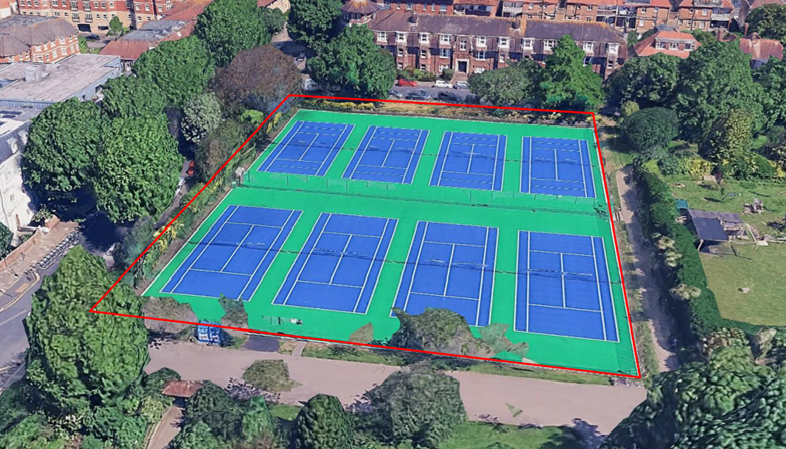
A tennis club has been granted planning permission to put up floodlights at its courts in St Ann’s Well Gardens.
But Brighton and Hove City Council’s Planning Committee added a condition requiring an “installation verification report” to confirm that the lights conformed with the submitted plans.
The Planning Committee approved plans to put up 15 lighting columns – 26ft or 8 metres tall – and two single-storey storage buildings at the tennis courts in the park by the corner of Nizells Avenue and Somerhill Road, Hove.
Neighbours and ward councillors objected to the application and some addressed the committee about the prospect of light pollution, the lack of consultation and the effect on wildlife.
Graeme Kerr, from the St Ann’s Well Residents Society, said: “I live in one of the six residential blocks where there are bedrooms barely 20 metres from the proposed floodlights.
“Our kids learn to play tennis there. We have, historically, a great relationship with the club.
“We’ve backed their proposal for a community interest company so we don’t understand why they didn’t consult us on these proposals.”
Fellow resident Caroline Davies said that no community site visit had taken place and this could give the residents’ society “a pathway” to lodge an appeal with the Planning Inspectorate.
At Hove Town Hall yesterday (Wednesday 5 August), she asked the committee to visit people’s homes and see the potential impact for themselves.
A third residents’ representative Mari Quashie said: “Spring, summer and autumn are busy and bustling and often noisy. Come to the winter, we get our hiatus by 6pm. It’s all quiet and tranquil.”
She told councillors that there were about 33 species of birds living in the park which can be heard in the winter.
Labour councillor Trevor Muten, one of the ward councillors for Goldsmid ward, said: “I’m not against the proposal for floodlighting but I do believe we need to make mitigations which are respectful of the hours and the night sky.
“I’d recommend that mitigation at 8pm and a reduced number of days per week.”
Green councillor Nadia Barton Ahmed, who won the recent Goldsmid by-election, said: “I would like, as the residents would, to have a site visit to their homes and they (the committee) can see how lovely and dark it is and how much nature and biodiversity they live next to.
“We would like to have the hours reduced to 8pm as it would be a substantial improvement and I would also be much happier with that.”

St Ann’s Tennis Community Interest Company (CIC) director Conrad Brunner said that working people liked to play tennis in the evening but in the winter they could not play after 4pm because it was too dark.
Mr Brunner said: “The lighting itself has been professionally designed using modern directional LED technology. Modern court lighting is amazingly directional, with minimal light spillage.”
Conservative councillor Ivan Lyons said that 9pm was a fair time and other tennis courts in parks around the city were open later, with lighting in use until 11pm.
Councillor Lyons said: “With the experience of Dyke Road Park, where residents were equally as close to the park and in the large blocks of flats, I’m satisfied with the lighting expert’s opinion that residents won’t be affected during the night-time.
“I don’t think there’s going to be much demand for playing tennis at 8pm to 9pm in December and January when it’s wet and windy anyway.”
Green councillors Sue Shanks and Kerry Pickett said that the committee should add a condition to reduce the hours when the floodlighting could be used to 8pm.
Councillor Pickett said: “The concerning thing here is that the CIC has not really consulted properly with the residents.
“They could have done a lot more to engage them so they would be happier with this happening. I think reducing the time to 8pm would be a more acceptable proposal.”
But they did not win the support of the rest of the committee.
Labour councillor Sam Parrott said she that hoped that the lighting would not distress people and urged the CIC to improve its relationship with its neighbours.
Councillor Parrott said: “I’m extremely disappointed that we don’t have a better conversation with residents. We get this all the time in planning. We are neighbours and we have to work together and live together.”
She said that conversations at an earlier stage in the process would mean that people were less anxious and less distressed and this could help prevent many of the objections heard by the committee.






The distance measurements Councillor Lyon mentions re Home Resident proximity to Dyke Road Tennis courts as ‘equally’ is around 250 metres to 500 metres from homes to 10 Floodlights.
For St Ann’s Well Residents, it is 22 metres to 25 metres distance to 15 Floodlights, evidencing the requirement for Planning Committee to conduct an on-site visit for accuracy!
Distance measurements Councillor Lyon’s mentions as ‘equally’ when referring to comparison of Residents close by to Dyke Rd tennis courts Floodlights (10) to St Ann’s Well Tennis courts proposed Floodlights (15);is around 10 times closer.
Dyke Rd Park Lodge is around 250 metres where St Ann’s Court and South Downs House are around 22 metres!
This further evidences the absolute requirement for a Planning Committee site visit and exact professional surveyor measurements
I agree Councillor Lyons needs to get to know the City he is supposed to be representing! The buildings directly opposite to the tennis courts at dyke road are The Booth Museum and The Queens Barracks I would like to know what residential buildings “he claims” are equally as close? With St Ann’s Wells, the application signs were posted facing the road so if there were parked cars a pedestrian would never notice them. A few notification letters were sent to 3 addresses in the area, interestingly no letters to the 2 blocks of flats the closest to the courts, I wonder why! The days allowed for flood lights increased mid application ( I was not aware that was allowed) and now they are erecting sponsorship banners which were not in the application. I am not surprised the way it is being handled as money talks but I am surprised it is so blatant.
The fact that there are so many things wrong about the execution of this application sadly reflects the true colours of the planning dept and twisted facts from interested parties to push it through.