
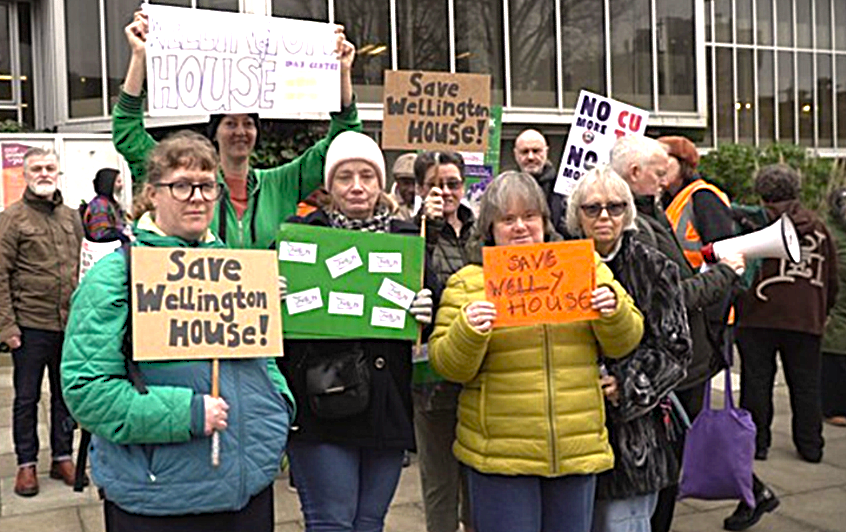
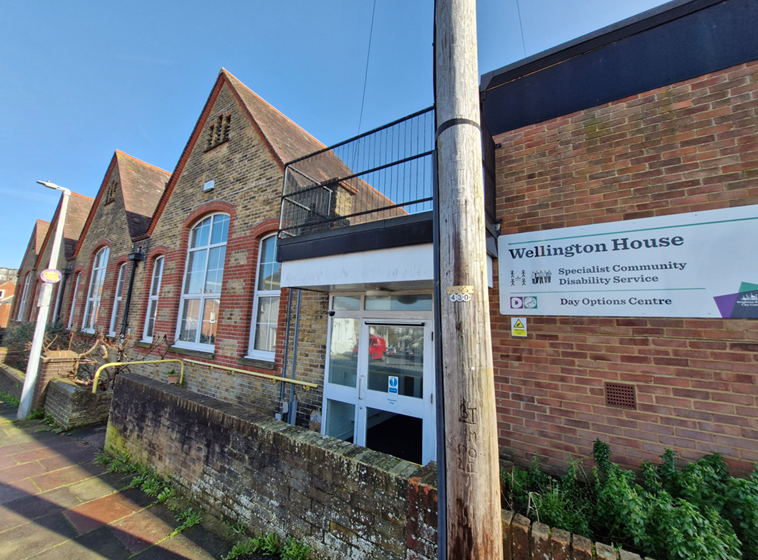
The council wants to sell the building that houses a day centre for some of the most vulnerable adults in Brighton and Hove.
The plan to sell Wellington House, in Brighton, is explained in a report which also said that the closure would save less than £340,000 rather than the £400,000 forecast in the budget.
But campaigners fear that the loss of the day centre, which provides valuable respite for families, could mean that some struggle to continue caring for their loved ones.
Even if the council had to fund full-time care for just two of the more vulnerable adults who use the day centre, it would wipe out any savings, potentially for many years.
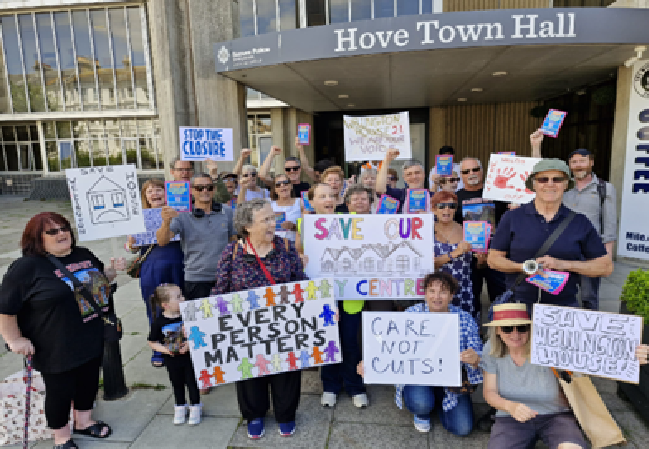
A consultation found that people were against the proposed closure, with more than 3,000 people signing a petition to save the day centre.
Among the reasons are that the proposed closure would break up a community whose learning difficulties mean that they are more socially isolated than most people.
Some campaigners said that the council justified the closure of another day centre, in Portslade, by pledging to provide care at Wellington House instead.
But the council believes that it has to break this promise because the old building that houses the day centre is expensive to run and in need of costly work.
The report said that the running costs were higher than those of other providers although the council also added in various extra costs and, a union said, had turned away families wanting to use the service, artificially the “unit costs”.
The report said: “Local authority costs are higher as they include central support services such as HR, finance, IT, legal and governance requirements. Also, higher pension contribution and staff policy benefits.
“External providers typically operate with leaner management structures, lower employment costs … with more flexible operating models.”
A 12-week consultation was carried out by Brighton and Hove City Council, with the findings included in a newly published report.
It said: “The feedback shows that Wellington House is highly valued as a familiar, specialist and trusted service for those that attend and the parents and carers that benefit from the service.
“Common themes included the importance of skilled and consistent staff, predictable routines, meaningful activities, concerns about the impact of change on service users, including increased anxiety and disruption to routines, concerns about whether alternative providers can meet individual needs.
“The importance of friendships, peer relationships and social connection, the need for reassurance for families and unpaid carers, as the service provides essential respite for them, was also a key concern.
“Respondents also raised significant concerns about uncertainty about the suitability of alternative provision, provider capacity, quality and staff skills, potential impact on families, unpaid carers and wider circles of support, transport arrangements and the need for careful transition planning and post-transition monitoring.”
The report said that the council believed that there was suitable alternative provision and that dozens of staff based in the building could be based elsewhere instead.
It added: “The decision to move people would only happen when the council is satisfied that every one of the 21 people who currently attend Wellington House can have their day opportunity needs met locally with at least the same quality of care.”
And it said that alternative providers would be required to demonstrate their ability to support and meet
- learning disability support needs
- autism-related support needs
- communication and interaction needs
- sensory support needs
- positive behavioural support needs
- physical disability, mobility, access, and personal care needs
- mental health and emotional wellbeing needs
- epilepsy, medication management, and other health-related support needs
- age-related, deteriorating, or changing support needs
The union that represents staff at Wellington House, Unison, warned of the financial risks, saying that if any relationships or future provision broke down, the council would be saddled with the cost of full-time care rather than just day care.
All 21 of the adults who currently use Wellington House are cared for at home by their families rather than the council – and the council had “allowed” Wellington House to decline.
Unison said: “(The costs of fulfilling) its statutory duty to provide residential care are considerable. Just one premature breakdown in home care would wipe out this saving in one year.”
The union also said: “There is considerable evidence that the potential of Wellington House has not been explored and that there has been neglect and decline in the management and support of the service.”
The union’s feedback reflected the repeated criticisms made by leading Labour councillors and the new Prime Minister Andy Burnham of vital services being provided by the private sector.
It warned the Labour-run council of “reputational damage at a time where insourcing and excellent provision of community owned services and provision is seen so favourably by the public.
“This is one of the most vulnerable and potentially isolated groups in society and the council has already experienced reputational damage around this suggested closure.
“We would ask that the council remember that once a building is sold it cannot be sold again. This would be a one-off saving and a short-term answer to a medium / long-term issue.
“There would also be the problem and cost of relocating staff when the few remaining main council buildings are already at or over capacity.
“Hove Town Hall is bursting at the seams and our members there continue to relay concerns around privacy, heat, overcrowding, accessibility and safety.”
The council’s integrity in approaching the closure of Wellington House was also called into question, with potential users turned away, artificially inflating the running costs per person.
The union said: “There is also evidence that parents who have expressed a desire for their children to attend the centre have had their requests not actioned raising serious questions around transparency and intent.
“While the workforce has become demoralised over time, their commitment and passion for the work they do has not dimmed and, if given the opportunity, they would be skilled and active participants in developing and growing the service and improving its efficiency.”
The proposal to close Wellington House is due to be discussed at a special People Overview and Scrutiny Committee meeting at Hove Town Hall at 2pm on Friday (4 September).
The council said that no decisions would be made on Friday but “the committee may make recommendations” to the council’s cabinet about the proposals.
The cabinet is due to decide whether to close the day centre at a meeting on Thursday 17 September.








The Council should be looking at how much money they will LOSE by closing Wellington House. Increased health and hospital admission/stay costs, increased social care costs, increased health costs for stressed family members who have lost their daily respite time to re-charge their batteries who start losing their own health and needing more services as a result. These will all amount to far more council money spent than any short-term savings the short-sighted closure of Wellington House will achieve. The only way to save money is to keep residents as independent and socially interactive as possible for as long as possible, and give as many respite and day centre facilities as possible to facilitate good health for users and their carers. Free carers are a massive resource who are abused by this council at its peril when they are given devastating closures which in some cases, could be the straw which broke the camel’s back. We know we have a current administration virtually devoid of human empathy, but even if they stick to the cold hard line of how much cash they will be saving by closing Wellington House, it will be vastly outweighed by all the increased costs which will result in other areas.
Reading the article, the estimated savings have been cited to be £340,000, reduced from £400,000 initially.
Even more scandalous to close it in that case.
Just pragmatic.
Monstrous and short-sighted actually. There is no shortage of money being spent in non-essential areas.
That’s whataboutism.
Wellington House is not surplus to requirements. It is still vitally needed. Labour are revealing themselves as nothing but cruel and ruthless asset strippers. And promise breakers since they promised Wellington House would remain when they closed the previous facility down.
The central issue here should be the people who provide, use and access this service. The meagre savings of £340k pa cannot be justified by this singular report. The cost implications means that there will be higher spending from other public budgets whilst severely disrupting the lives of the workers, clients and their families. What has become obvious is that the predetermined policy was to strip this asset from public ownership. The report really doesn’t investigate the ramifications but attempts to justify the disposal. It would therefore seem that the report is flawed and the Council cannot consciously rely on its conclusions. I am disappointed that Benjamin believes this to be pragmatism, I call it deceptive vandalism to the fundamental vision of a caring society. I am ashamed that anyone associated with the Labour movement could seek to defend closing this beloved establishment.
I do believe it to be pragmatic, because the closure is one combined with alternative provision, in the same way you change your electric supplier to get better value for money, but you still get power.
To be a caring society, I subscribe to utilitarianism approach. Best value for money has to happen. There is also a challenge that councils across the country should be given more by government, and the hyper rich should pay a more equal amount of tax, but that’s a national issue.
There is no equivalent provision for these vulnerable people. Any such statement is simply untrue. That may be a bitter pill for all the accountants and politicians to swallow. I believe in value for money and it will cost more to provide for these people and their families in terms of transport and treatment but also the costs inherent with staff relocation, responsibility allowances and duplication of roles. This is just a paper exercise in selling off a well-loved and well-used public asset to the detriment of the general public.
I kindly disagree – the article proves this as Wellington House was an alterative provision itself from Portslade; contradicts the assertion. If an alternative provision stepped into Wellington House tomorrow and took over the building, and ran as normal, that’s a closure, technically – really confusing term…
Still plenty of money for the council’s vanity projects
Again, we really have to repeat this same like, different accounts that cannot be spent on the same thing.
Benjamin, would you support a reorganisation of public finance whereby the Council is actually able to allocate £340k pa to keep this respected facility open? In the scheme of the overall budget, it seems penny-pinching from some of the most vulnerable in our Society. I’m sure those savings could be found elsewhere.
Sure, but ringfenced accounts are usually restricted for a legal or regulatory reason. ASC has the potential to overwhelm councils. ESCC is a really good example of that. You say savings could be found elsewhere, but what are you cutting to do that? I think it’s easy to say that, but much harder in practice.
For a start, they could have done without this report and conducted their own research. That would have gone some way to the savings they claim are essential. What is essential is the health and well-being of the vulnerable users and their families who are often unpaid primary carers. What little respite they get will now be compromised by selling-off of this public asset. Closing this facility just doesn’t make financial sense as it will increase and extend pressures on the public purse, regardless of which particular budget it comes from. The bottom line is that we all pick up the tab and this myopic report does not address that.
Do you think the public would accept an internal report? I’m reminded of people claiming that the council were “marking their own homework” last time they did that.
Ah, consultation – that charming Brighton & Hove ritual in which residents are invited to express their views at considerable length before the Council explains why it intends to do precisely what it proposed in the first place.
As our poor man’s Jacob Allen, young Master Taylor, once memorably reminded us: “a consultation is not a referendum.” Quite. Increasingly it appears to be performance art.
Here we have 12 weeks of consultation, 3,000 petition signatures and feedback overwhelmingly explaining why Wellington House matters – followed by a recommendation to close it anyway, for a saving already reduced to £340,000 and which may evaporate entirely if only a couple of family care arrangements break down.
Meanwhile Benjamin™ – I do adore the trademark; one must protect a premium brand – compares moving profoundly vulnerable adults from a trusted day centre to changing electricity supplier.
Lady Bracknell has encountered some curious applications of utilitarianism in her time, but even she might hesitate before comparing human beings with a tariff from Octopus Energy.
“Best value” normally requires establishing that the alternative is actually better value first.
Otherwise it is not pragmatism. It is selling the building and hoping for the best.
As always, people answer the question they want to answer during a consultation, not the one that is being asked. I really hate the term, it doesn’t reflect what the intention behind them are – at all – and just ends up upsetting people.
Who are you to decide ‘people answer the question they want to answer during a consultation, not the one that is being asked’. Do you have supportive evidence of this and if so surely it means all consultations are flawed and a waste of time & money.
I myself have found many consultation include response choices which are limited & worded in such a manner which means they are interpreted as giving support to a desired outcome. I often find the only time I can clearly give my actual response to the matter is in the ‘Any other comments box’ if one is included.
I can not confirm the above regarding this consultation as I did not participate.
So you are wanting to answer the question that you want to answer, instead of the one being asked, and frustrated that you can’t? Either way, it’s one of the reasons why I dislike statutory consultations, no-one feels good about them.
No, I answer the questions that are asked. I then make further comments if space provided.
And in that typically generic freeform section, you answer the question that you want to answer? I think coming form a data analysis point of view, you might get a few themes, but if those themes are answering the question that is being asked, they may get ignored…it’s one of the reasons I don’t like those open-ended sections. Too vague.
Benjamin, what ever you say I do answer the actual questions asked.on consultations usually by ticking the response I feel best reflect my view. My free notes are usually at end of consultation where they ask if I want to add any further information or comments so again I am responding to their question.
For a start, they could have done without this report and conducted their own research. That would have gone some way to the savings they claim are essential. What is essential is the health and well-being of the vulnerable users and their families who are often unpaid primary carers. What little respite they get will now be compromised by selling-off of this public asset. Closing this facility just doesn’t make financial sense as it will increase and extend pressures on the public purse, regardless of which particular budget it comes from. The bottom line is that we all pick up the tab and this myopic report does not address that.