

The first mental health hospital for poor women which opened in Brighton in 1905 has been commemorated with a blue plaque.
The 10-bed hospital in Round Hill Crescent, staffed by female medics, was only operational until 1912, when it moved to Hove.
But its pioneering treatment, under the management of Dr Helen Boyle, helped revolutionise the treatment of mental disorders.
Last week, a plaque to Dr Boyle and the hospital was unveiled by the Mayor of Brighton and Hove, Councillor Alan Robins.
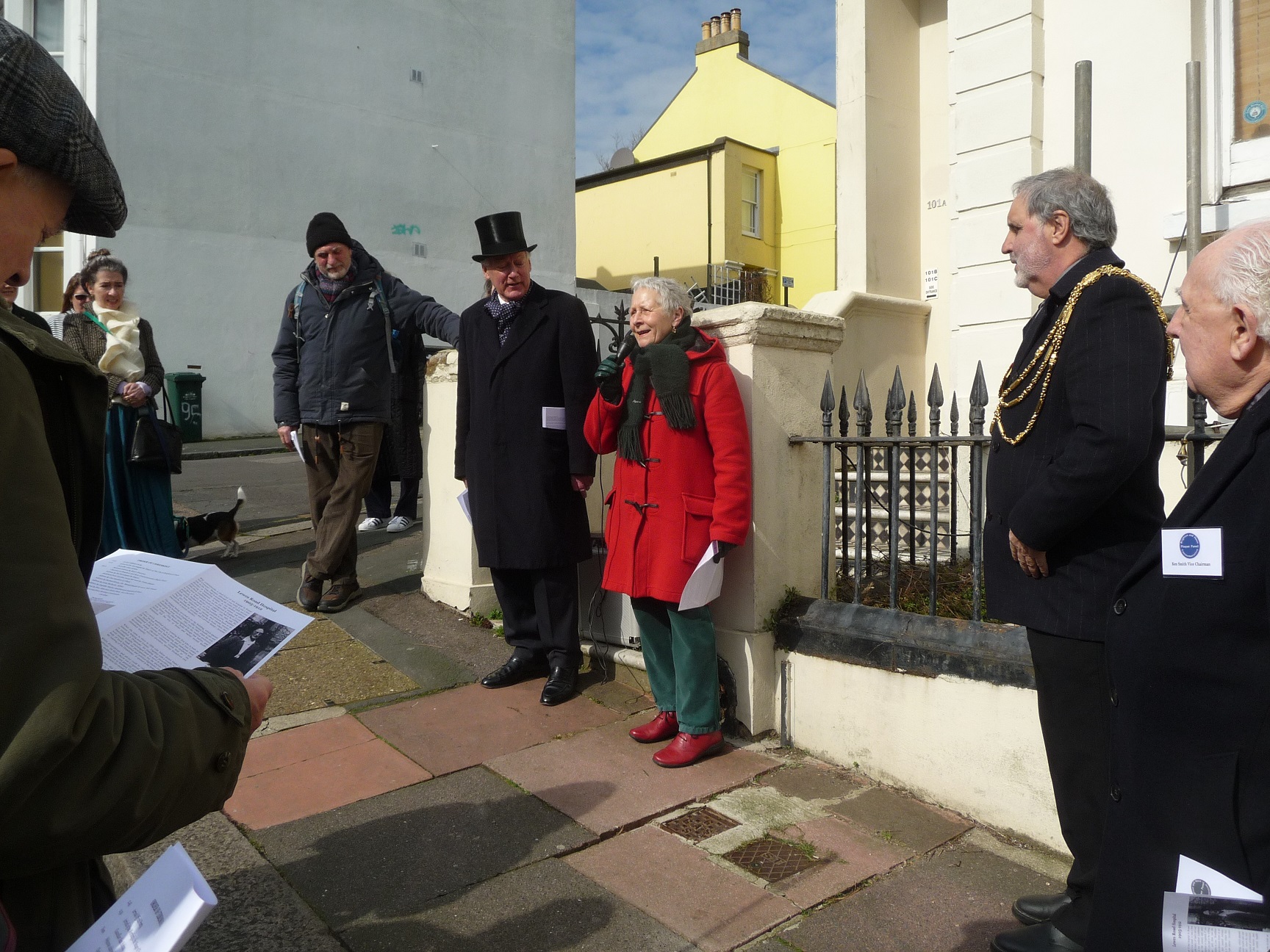
Speakers included Roger Amerena, who chairs the Brighton and Hove Commemorative Plaque Panel, Rachael Kenny, director of mental health at BHT Sussex, and cast members of local playwright Sam Chittenden’s play Clean, which features Dr Boyle.
Local resident Vivien Eliades read a speech on behalf of Brighton Pavilion MP Caroline Lucas.
Notes from the programme
Why commemorate a short-lived 10 bed hospital in Round Hill Crescent? Because, although it was small, it was a first step on the long road to accepting the reality of “early nervous disorder” or “borderline insanity” as real medical conditions deserving of treatment.
In the late 19th century and early 20th these conditions were not recognised in England. If you were poor and wanted medical support, you had to be willing to have a doctor declare you insane – only then was the publicly funded lunatic asylum available to you.
Wealthier folk could take a break in a private convalescent home as an escape from whatever was causing their mental stresses. They also had the privilege of staying at home where they could be attended by servants and a private doctor – luxuries unavailable to poorer families.
The plaque being unveiled is for the building, which opened as the first hospital in England to offer mental health care and treatment to poor women.
This was in 1905, when the only form of mental illness recognised by the medical profession was lunacy. This hospital broke through that barrier and, slowly, led the way to better and earlier mental health treatment.
As a newly qualified doctor working her first jobs in both an Essex asylum and a clinic in a poor district of East London Dr Helen Boyle saw how bad housing and inadequate food, combined with stresses of overwork, multiple childbirth and frequent minor physical ailments could lead to the development of nervous disorders, nervous breakdown and ultimately insanity.
When she came to Hove in 1898 with fellow doctor Mabel Jones to set up a private practice, she retained her interest in helping poor women.
Together with a wealthy widow called Mrs Louisa Martindale, they determined to establish a dispensary for treating and prescribing for poor women and children. It may be that Mrs Martindale actually encouraged them to move to Brighton and Hove with a dispensary in mind.
Small charges were usually made for prescriptions, but the doctors volunteered their time, and were active in establishing a body of local businessmen and political dignitaries (and often their wives) who could fundraise for and oversee the running of the dispensary. It opened at the bottom of Elm Grove in 1899.
While prescriptions and advice could be valuable in recovery, it offered no escape from oppressive domestic conditions. Dr Helen Boyle was a vigorous proponent of non-asylum treatment with outpatient facilities, which was the antithesis of the care generally available in England at the time because of the strict lunacy laws.
From 1904 Dr Boyle travelled to Scotland, Germany, France and Austria to explore the voluntary admission systems and clinics available there for mental health care.
It was no accident then, that in February 1905 the dispensary established an appeal for funds to open a residential hospital, and by April 1905 it had taken a lease on 101 Round Hill Crescent to open a 10-bed hospital right here, offering comprehensive residential health care. Dr Boyle had noted that the first step in improving mental health was often addressing physical ailments.
The first annual report from the hospital noted: “The cases to be treated are mainly a class not now admitted to any hospital in Brighton or indeed in England: cases of serious breakdown among poor women and girls.
“These patients cannot afford an expensive rest-cure, neither can they be properly treated at home, where worry, over-work, and insufficient food aggravate the trouble so that they fall out of the ranks of workers and so often end by becoming a burden on the rates.
“By the removal for a time from unsuitable and depressing environment and by the provision of skilled treatment, care, rest and good feeding, many such patients may be permanently cured and made fit to resume work.”
In the first six months of operation the hospital admitted 19 women for periods of treatment between one and five months.
The staff was a matron and two nurses, with Dr Boyle overseeing admissions and treatments, but within a year or so it became necessary to take on a house doctor, always a woman and probably newly qualified, employed for six months, to gain experience and no doubt to encourage them to take mental health treatment seriously.
By 1911 the hospital was successful, full and busy, taking patients from well outside of Sussex, and some women from more affluent backgrounds, seeking care for mental issues still not recognised, and preferring care at the hands of female medics.
This probably explains its lack of financial problems at the hospital, and its continued ability to take poor women without charge, and even to offer an ongoing outpatient service to discharged women, who could return to share in social, cultural and general conversational programmes.
But the lease was about to expire so new premises were sought.
In 1912 this groundbreaking hospital moved into a 35 bed building at 70 Brunswick Place. After a further expansion the hospital was taken into the NHS in 1948.






Well this is fabulous to find out about. I’ve moved to Roundhill crescent this May 2023 and have been struggling with CFS a nervous disorder syndrome so feel I’m in safe hands here. Thank you Dr Helen Boyle .