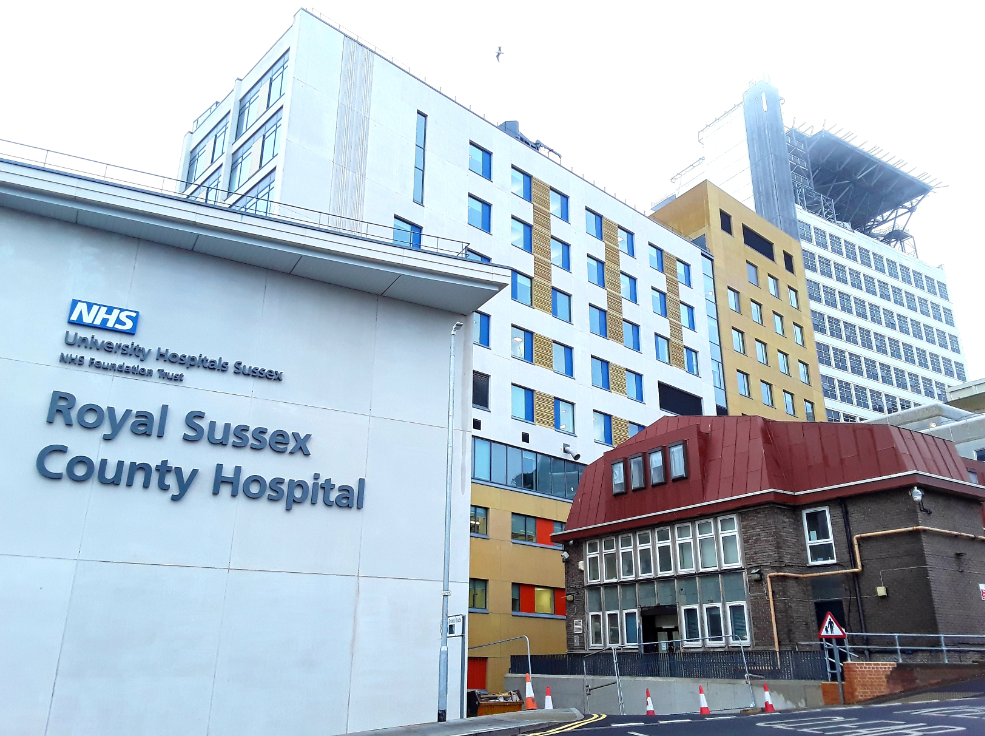
Inspectors have upgraded the maternity services at a Brighton hospital from inadequate to requires improvement, with the publication of a new report today (Wednesday 17 December).
But they downgraded the safety of urgent and emergency care services from “requires improvement” to inadequate, citing six incidents that “resulted in fatal harm” and five that caused “severe long-term harm”.
And the inspectors, from the Care Quality Commission (CQC), have threatened to take enforcement action after their visit to the Royal Sussex County Hospital, in Kemp Town, unless things improve rapidly.
Today, the CQC published a 107-page report which trust bosses shared with staff in a series of meetings yesterday.
Among the findings, the CQC said: “Staff did not manage or assess patient risk appropriately. For example, at the assessment we saw staff did not raise concerns about a patient who had very abnormal blood test results to the clinician in charge.
“The patient was situated in the temporary escalation space (on the emergency floor), with no access to enhanced monitoring of their condition.
“This was unsafe as the patient was at risk of a cardiac arrest and should have been monitored closely in the resuscitation area of the department.
“At the time of the assessment there was no resuscitation bed available due to overcrowding in the department.”
It also said: “During the assessment, 11 patients had been in the emergency department for more than 24 hours waiting for a bed in the hospital.
“Staff told us patients often spent more than 36 hours in the department and they were the ‘front door’ to the whole hospital.
“Staff told us that the flow of patients through the hospital would be improved if patients transferred to the hospital from other health care providers could be admitted directly to the ward that had accepted them.
“During our assessment we met a patient who had sustained multiple rib and spine injuries after falling down their stairs at home. They waited on a trolley for 36 hours for admission on to a ward.
“This caused an increase in their pain and an increase in the risk of skin damage as they were cared for on a hard trolley with no pressure relieving equipment such as a pressure-relieving mattress.”
In a statement, the CQC said: “The Care Quality Commission has upgraded the maternity service rating at the Royal Sussex County Hospital from inadequate to requires improvement.
“But (it) has told the trust that more work is needed to ensure maternity services are fully effective in meeting the needs of women and babies.
“The CQC has again rated urgent and emergency care services as requires improvement and downgraded four key question ratings after finding new concerns.
“Both services, which are run by University Hospitals Sussex NHS Foundation Trust, were inspected in February.
“The CQC carried out the inspection in urgent and emergency care in response to information of concern related to risks within the department.
“Maternity services were inspected to follow up on the progress of improvements CQC told them to make at previous inspections.
“Following this latest inspection, maternity services have improved from inadequate to requires improvement overall. Both ‘safe’ and ‘well-led’ improved from inadequate to requires improvement.
“However, the ‘effectiveness’ of the service, has been downgraded from outstanding to requires improvement. ‘Caring’ and ‘responsive’ have both been re-rated as good.
“Urgent and emergency care has been re-rated as ‘requires improvement’ overall as has the rating for how ‘responsive’ the service is.
“‘Safe’ has been downgraded from requires improvement to inadequate. ‘Effective’, ‘caring’ and ‘well-led’ have all declined from good to requires improvement.
“As a result of these service rating changes, the CQC has also re-rated the Royal Sussex County Hospital overall as requires improvement and for how ‘safe’, ‘effective’, ‘responsive’ and well-led they are. ‘Caring’ has been downgraded from outstanding to good.
“In urgent and emergency care, the CQC found two breaches of regulations regarding safe care and treatment and privacy and dignity.
“Due to these concerns, the CQC issued the trust with a letter of intent under the Health and Social Care Act 2008.
“This informed the trust that if the CQC didn’t see rapid and widespread improvements in these areas against an action plan they were told to submit, the CQC would take enforcement action.
“In maternity, while there was evidence of improvement, inspectors found five breaches of regulation.
“These related to the induction of labour and caesarean section delays, safeguarding, medicines management, the premises at Sussex House and how well the department was being managed.”
The CQC’s deputy director of hospitals, secondary and specialist care in Sussex, Amanda Williams, said: “During our inspection of the Royal Sussex County Hospital, we found several improvements in maternity services.
“Women and people using the service told us staff treated them with compassion and kindness and we observed strong teamwork between doctors, midwives and other healthcare professionals.
“However, we also found new concerns around the effectiveness of the service. The design and environment of the maternity unit didn’t fully meet the needs of women, people using the service and their babies.
“There was only one dedicated obstetric theatre which impacted the flow of the department. The trust ran a pilot in July last year to introduce a second theatre permanently.
“Staff told us the pilot had been successful and well received. Despite this, the pilot ended in August that same year and there was still no permanent solution in place.
“We found several concerns in the urgent and emergency department. Some people were being cared for in non-clinical areas, including corridors, which didn’t protect their privacy and dignity.
“We were particularly worried about temporary escalation areas that failed to support effective care, especially for people whose health was deteriorating.
“Some people told us they felt frustrated and weren’t always kept informed about their care.
“The department was severely affected by poor flow across the hospital, leading to delayed ambulance handovers and excessively long waits for admission.
“On the day of our visit, 11 people had been in the emergency department for more than 24 hours waiting for a bed.
“Senior leaders didn’t always take sufficient action during this overcrowding, as communication about operational pressures didn’t consistently reach them.
“Staff said they escalated concerns but didn’t always get timely responses to keep people safe.
“Following our inspection, we made clear to the trust where immediate action was needed to improve safety in the emergency department and mitigate the risks identified.
“We’re meeting regularly with senior leaders to monitor progress and make sure necessary improvements are made and to keep people safe while this happens.”
The CQC added: “During the inspection of maternity services, inspectors found leaders needed to address the delays women scheduled for elective caesarean sections and induction of labour faced.
“Data from October 2024 showed that 69 women had a delayed start time for their caesarean section. Twenty of these had a delay of one to three days.
“Women using the service were asked to be nil by mouth from 6am on the day of surgery which increased their discomfort when delays occurred.
“The department did not routinely undertake or embed audits and had no audit schedule. For example, sepsis cases were not audited, so data on case numbers or actions taken were unavailable.
“During the inspection of urgent and emergency services, inspectors found staff delivered care in temporary escalation areas that did not support effective treatment. They could not consistently monitor comfort or ensure people received adequate food and drink.
“Staff said the computer system was unfit for purpose and relied mainly on paper records. Using both paper and digital systems created communication risks, particularly during referrals or transfers to teams using different systems.
“Staff did not always report incidents appropriately. Although they understood the process, many stopped reporting because they saw no sustained action or improvement following their reports or safety concerns.”








According to friends who have road-tested the facilities, the disabled toilet in the new Martindale building is not suitable for wheelchair users as the side of the WC is too close to the wall and the MRI scanner won’t take anyone 17 stone or above, meaning they have to be transferred to Worthing hospital. And will that helipad ever be used? I don’t see it. Time to reopen the Brighton General for overflow and a ground-based helipad?
People get transferred for reasons like that all the time, Tracy! It’s not unique to RSCH by any stretch of the imagination. As for the helipad…every year is potentially the year – it’s become a bit of a meme at this point. Luckily, East Brighton Park does the job of a ground-based helipad in the meanwhile.
Having been to a&e today ( yes on the strike day) I cannot fault the staff from the cleaners to consultants.
It’s all very well these reports being submitted… But report it to the government not the staff at A&e it’s not their fault there isn’t enough bed spaces. It’s pressure they don’t need in my opinion
There are definitely some elements in there that are learning points for the staff. But yes, core pressures are more a national issue.
The answer is a simple one – they do not have enough beds. There are fewer people in hospital with flu than this time last year. Currently total bed occupancy over Univertsity Hospitals Sussex due to flu is 1%.
But we hear about bed shortages every year, and often alll year round. This has been going on for years. We built a shiny new larger hospital in Brighton, and yet still not enough beds. Hospitals point at council-run social care leading to bed-blocking, GPs push people to A&E depts, but still not enough beds.
We, the people, deserve better, we pay collectivley a lot of money for the NHS and we should get better service. We should not be in a situation where people are soiling themselves or even dying unnoticed in corridors. More beds !
Respectfully, I believe it is very much more nuanced than just more beds. Expanding treatments in the community so admission is not needed, expanding the role of pharmacy with a more variety of minor ailment that can be treated as part of the scheme, and community-based preventive care in partnership with Third Sector to identify early symptoms so they don’t degrade into more costly conditions.
A stitch in time; saves 999.
My 95 year old Mother was admitted to RSCH A&E after a fall. She spent all day on a trolley, had an xray as she hsd fallen kn her hip, was discharged the same day with no damage to her hip. Spent the weekending agony, and nobody could get hold of anyone to speak to over the weekend. Her GP contacted A&E on the Monday, and they rechecked the xray and had MISSED 2 cracks in her pelvis. She then spent 2 dreadful weeks on the frailty ward, almost totally immobile, and was discharged after 2 weeks of them doing nothing. The care was appalling and she had a grade 3 pressure sore (there are only 4 grades) as they failed to supply an air mattress. Despite personal care by nurses, nobody reported the pressure sore unril 3 days before her discharge, at which point they panicked and gave her an air mattress.
My Mum was totally traumatised, can barely walk 4 weeks after discharge, is still being treated for the pressure sore, and will probably never recover from her experience.
There is a CQC complaint going through, and a PALS complaint.
The most appalling lack of care. What’s the point of a new hospital is the treatment is as bad as ever.