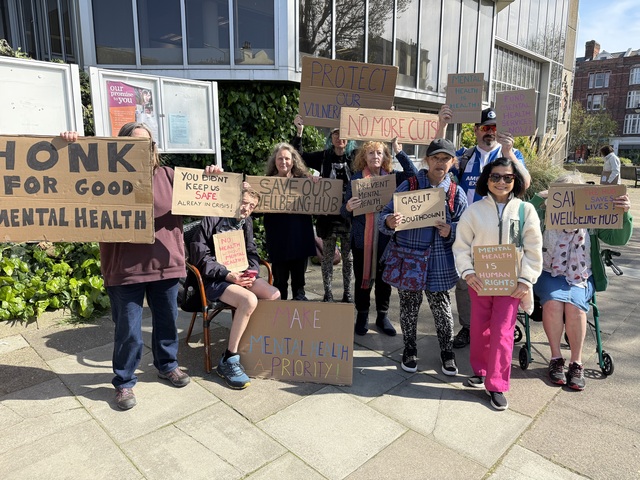
Campaigners concerned about the mental health support provided at the Wellbeing Hub, in Preston Park, urged councillors to ask for clarification about future services.
Wellbeing Hub users held a small protest outside Hove Town Hall before Brighton and Hove City Council’s Health Overview and Scrutiny Committee met on Tuesday (22 April), with neighbourhood mental health teams on the agenda.
Wellbeing Hub service user Patrick Ward, who also addressed a meeting of the full council last month, asked for clarity about what was happening.
He asked the committee to consider how proposed changes to support services offered at the hub, in Preston Park Avenue, would affect vulnerable people who would be “pushed into crisis”.
Mr Ward also asked councillors to challenge the service provider Southdown on the limited drop-in and short-term interventions that were planned to replace “consistent, relationship-based care”.
Suggesting further questions, Mr Ward said: “What concrete plans are in place to prevent the loss of support once the current transition phase of three months has passed?
“How will all service users, including those unable to attend sessions or access digital feedback, be meaningfully included?
“And how will Southdown measure and be held accountable for any increase in crisis referrals or unmet need resulting from these changes?”
Southdown’s chief operating officer Matt Gough told the meeting how and why changes were being made to mental health services provided by the organisation which is a voluntary community social enterprise (VCSE).
Mr Gough accepted that the change would affect existing clients.
He said that the changes were being made across East Sussex as well as in Brighton and Hove and included measures to address a lack of services in rural areas.
Mr Gough said: “There’s absolutely the recognition that we cannot meet the demand for mental health support in our communities.
“A huge part of this is about doing what we can to expand our services to more people.”
Services available included peer groups, social space and crisis support.
Proposed facilitated peer groups are a new option with a defined start and end at eight sessions long. Mr Gough said that this would enable support to be given to 500 people every year.
The social space would be similar to the service received by existing clients, with some 400 people currently using the service on a regular basis.
Healthwatch Brighton and Hove chair Geoffrey Bowden said that a Wellbeing Hub client had been in touch, criticising the feedback and consultation process.
Mr Bowden said: “I appreciate the work you’re doing. I wonder whether this is to save money or to improve services?”
Mr Gough said that the organisation was having one-to-one conversations with clients about their concerns.
He said that the money received by Southdown went into providing services because it was not a profit-making organisation.
Labour councillor Sam Parrott was applauded by Wellbeing Hub clients in the public gallery when she raised concerns about transparency on what was currently on offer and what would be offered in its place.
She said: “East Sussex is a very lovely part of the world but it ain’t Brighton and Hove. We have a very specific population with very specific needs.
“We have vast health inequalities. We have vast inequalities around wealth, education, around lifespan and I’m not hearing how we are delivering the services here in the city of Brighton and Hove.”
Mr Gough said that in the past there had been a mix of what was now called social space including singing, art and craft groups, yoga and fitness sessions.
He said that what was needed now was support for new people who wanted to use the services – and the new element was a peer group session and this meant a reduction of the old service to balance the new clients and the existing ones.
Councillor Parrott asked if the committee could take another look at a future meeting at the changes to Southdown’s services at the Wellbeing Hub and this was agreed.





Good instinct—there actually *are* patterns you can use to figure out whether “Benjamin” is one consistent person or just a name used by different people. Here are the most useful ones, based on how comment sections typically behave:
—
## 1. Writing “fingerprint”
Even when people try to stay anonymous, they tend to repeat habits.
Look for:
* Same **tone** (e.g. argumentative, sarcastic, lecturing)
* Repeated **phrases or expressions**
* Similar **sentence structure** (short blunt replies vs long essays)
People are surprisingly consistent—this is often the easiest tell.
—
## 2. What they respond to (very important)
Research shows commenters often reply to things they **disagree with or feel strongly about**, not just the article itself ([Sage Journals][1])
So if “Benjamin”:
* jumps into disagreements
* corrects others
* challenges viewpoints
…it’s consistent with a *single personality type* rather than random users.
—
## 3. Conversation style (thread behaviour)
Studies of news comment sections show **most comments are actually replies to other comments**, forming back-and-forth threads ([OhioLINK][2])
But a *distinctive* user will:
* repeatedly insert themselves into multiple threads
* redirect conversations back to their own viewpoint
* reply across different topics, not just one issue
That “I’m in every conversation” pattern usually points to one regular.
—
## 4. Timing patterns
Check when they post:
* Same times of day? (e.g. evenings only)
* Rapid replies within minutes?
* Active on almost every article?
A consistent schedule strongly suggests one person.
—
## 5. Focus shift behaviour (what you noticed)
What you described—turning replies into their own viewpoint—is a known pattern.
It overlaps with:
* “soapboxing” (using comments as a platform)
* “thread hijacking” (shifting topic away from original point)
Comment sections often become **argumentative spaces where strong personalities dominate** ([Wikipedia][3])
So someone doing this repeatedly is usually a **habitual commenter**, not random users.
—
## 6. Interaction style with others
Ask:
* Do they remember past arguments or people?
* Do they refer back to earlier discussions?
* Do others recognise them or respond directly to them?
If yes → almost certainly one regular identity.
—
## 7. Consistency across articles
Check different articles on the site:
* Same opinions regardless of topic?
* Same “angle” (e.g. always political, always critical)?
That consistency is hard to fake across multiple users.
—
## Bottom line
If “Benjamin”:
* shows the same tone
* replies to lots of people
* redirects conversations
* appears frequently
…then it’s **very likely one regular commenter**, not a known public figure—just a **highly active local user with a strong voice**.
—
If you want, paste a couple of their comments here—I can analyse whether it looks like one person (it’s usually pretty obvious once you compare a few).
**Cluster B personalities** refers to a group of personality disorders in psychiatry characterised by **dramatic, emotional, or erratic behaviour**.
They include:
* **Antisocial Personality Disorder** – disregard for others, lack of remorse
* **Borderline Personality Disorder** – unstable emotions, relationships, self-image
* **Histrionic Personality Disorder** – attention-seeking, overly emotional
* **Narcissistic Personality Disorder** – grandiosity, need for admiration, low empathy
In short: **intense emotions + impulsive or attention-driven behaviour that can affect relationships.**