
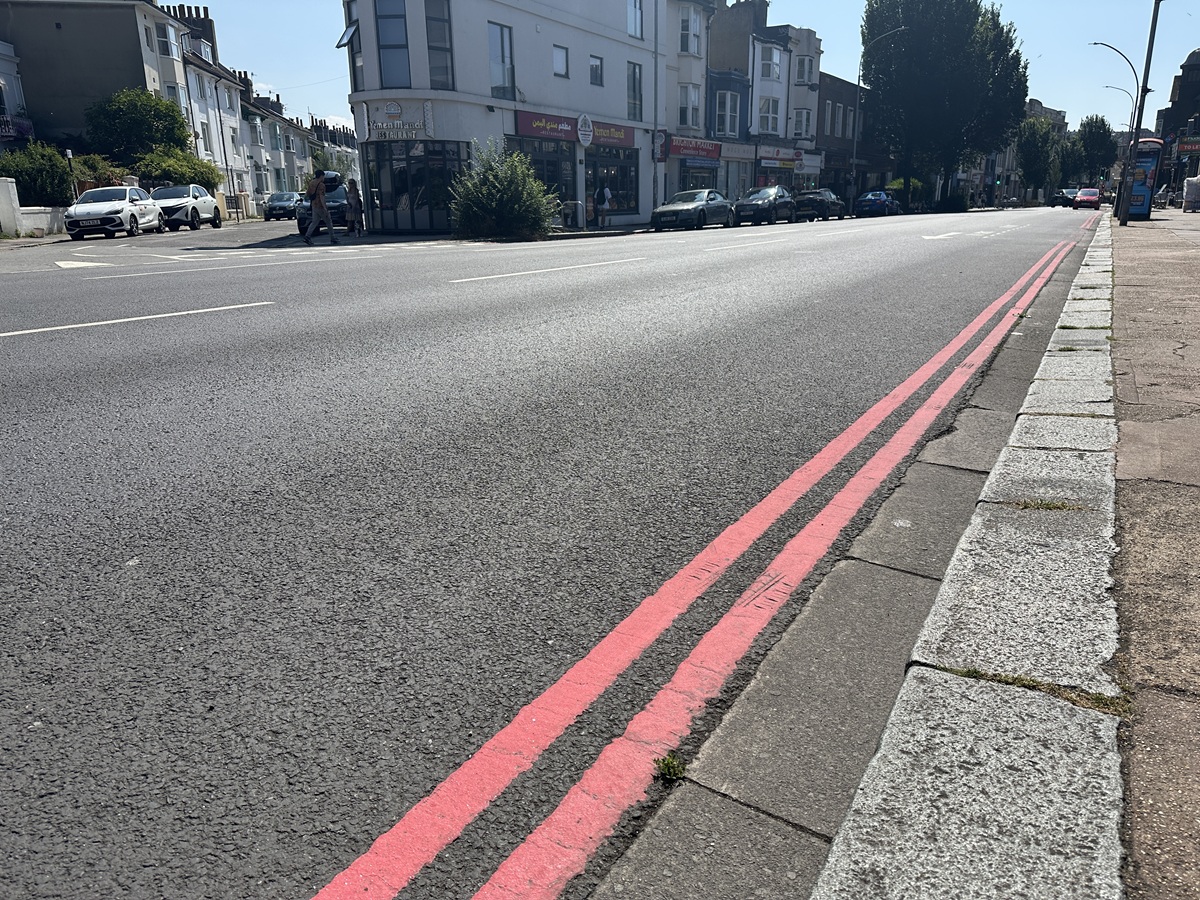
The number of injuries on two roads where red routes have been installed has almost halved, newly released figures show.
In the two years since double red lines were painted on Lewes Road and London Road, the number of injuries has fallen from 11 to three in Lewes Road, and from 15 to nine in London Road.
In Preston Road, injuries rose from five to seven in the first year, and then dropped back to five in the second – but this stretch has also seen changes to the road layout.
The lines prevent any vehicles stopping 24 hours a day – and crucially, can be enforced via CCTV which means getting a ticket is far more likely. This means far fewer vehicles have been parked in cycle lanes and bus stops.
In London Road, footfall has also gone up slightly. No figures are available for Lewes Road.
Brighton and Hove City Council’s cabinet member for transport Trevor Muten said: “It’s great to see the positive impact the red routes are having.
“Anti-social parking and stopping was a big problem on these roads, making them dangerous and causing congestion for other road users.
“We’ve had very positive feedback on the impact of the Red Routes, the data shows they’re a lot safer and we’ve also seen marked improvements in the air quality on these routes.
“We know one of the concerns from businesses about Red Routes is that it will discourage shoppers. But our data clearly shows there’s been no impact on the number of people using London Road which is great news.”
In London Road, there were more than 100,000 extra movements of people on the road in the 12 months after the red route was installed, going from 4.78 million from May 2023 to April 2024 compared to 4.89 million from May 2024 to April 2025.
Across both locations – and a section of Preston Road which was also included, the number of slight and serious injuries was 31 from April 2023 to April 2024, 19 from April 2024 to April 2025, and 17 from April 2025 to April 2026.
Enforcement began in April 2024.
Last March Brighton and Hove Buses, the city’s largest bus operator also reported an 85.7 per cent reduction in passenger injury incidents in those areas
Monitoring sensors also recorded a reduction in Nitrogen Dioxide levels in the six months after the scheme was introduced. This reduction continued in 2025.







Get the Western Road one rolled out asap please.
I’d like to see the route leading to and around the RSCH as Red Route, aligning with how many other hospitals are set up, to protect the route for emergency travel.
A ghost town probably will have fewer accidents. More to the point how many businesses have closed down in London Road and Lewes Road since the existing scheme has been introduced and how much compensation is the council going to pay them?
I believe we’ve discussed this point before, Tracy. I recall pointing to a series of pieces of evidence that show that not being able to park immediately outside has little to no impact on businesses.
And why would the council pay compensation?
Businesses have certainly closed down on London Road & Lewes Road since the scheme has been introduced but whether the two things are related is an entirely different matter.
Cannadines, the bathroom fitters, said that their closure was a direct result of the red route, which made it very difficult for customers to park and to receive deliveries. The premises is still empty after two years.
The adjacent cycle lane is badly designed, badly finished and – as many cyclists have reported – downright dangerous.
You would expect no less from BHCC
Cannadines, where the lease was expiring and the owner retired? The same Cannadines where the premises has a two-berth loading zone directly outside it to receive deliveries, and where customer parking on the same side of the street still exists (the red route is across the road….)?