Steven Edwards’ Hove restaurant etch. offers ambitious seasonal cooking, an exceptional wine programme and something increasingly precious in a restaurant: the feeling that the people looking after you genuinely care about your evening.
etch. by Steven Edwards, at 214–216 Church Road in Hove, is somewhere you go to spend an evening rather than simply to have dinner: a restaurant where the cooking, wine, setting and service come together to make the whole experience feel like an occasion.
This was my second visit to etch. My first was unfortunately curtailed by unexpected ill health. That might ordinarily have been the end of the matter, but the team were extraordinarily kind about it and invited me back so that I could experience the restaurant properly. I was very grateful for the opportunity, because one of the pleasures of etch. is that there is a real sense of a journey through the menu. The restaurant is built around seasonal tasting experiences changing every eight weeks, rather than an à la carte menu, so missing part of it means missing part of the story the chefs and sommeliers are telling.
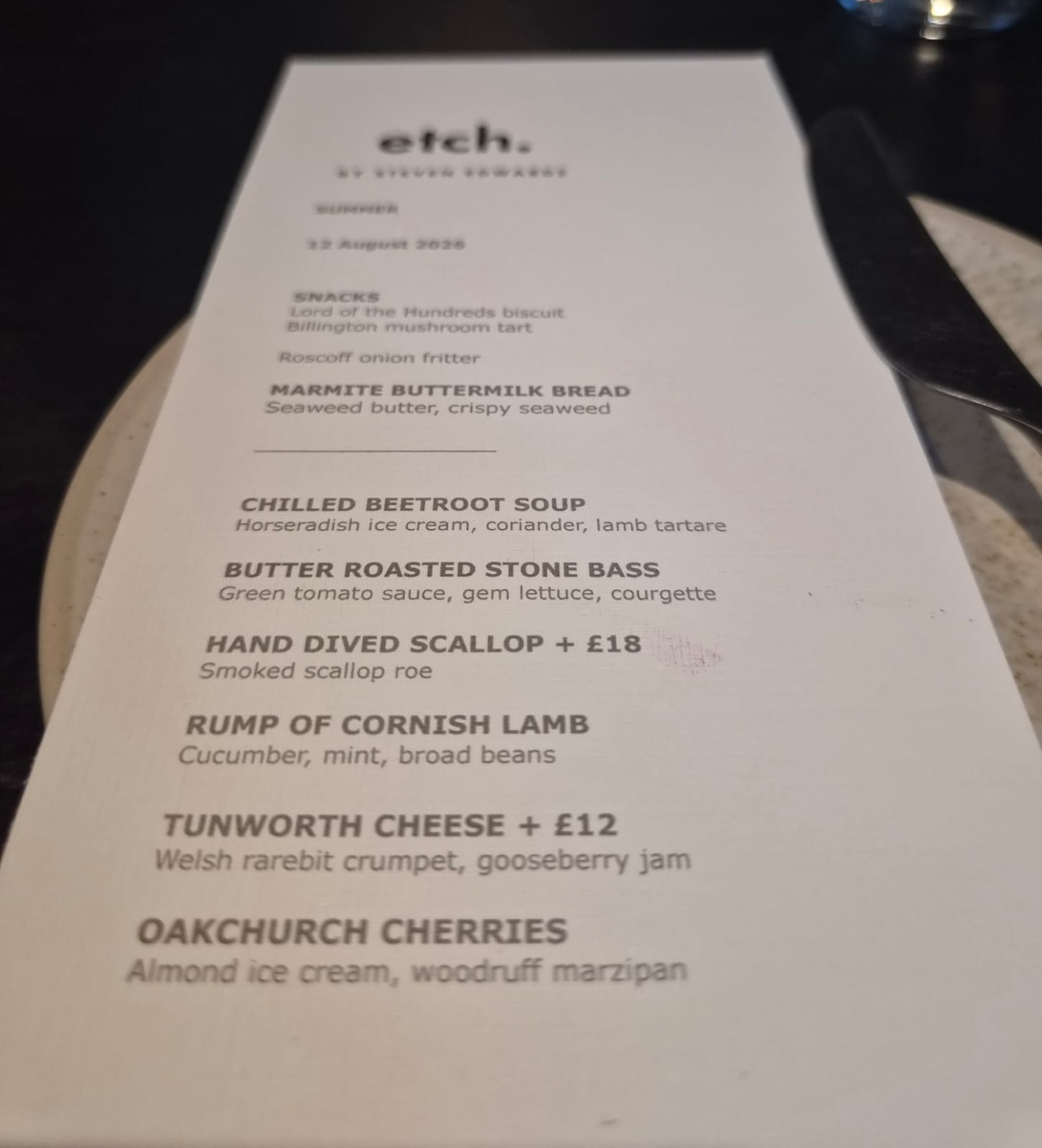
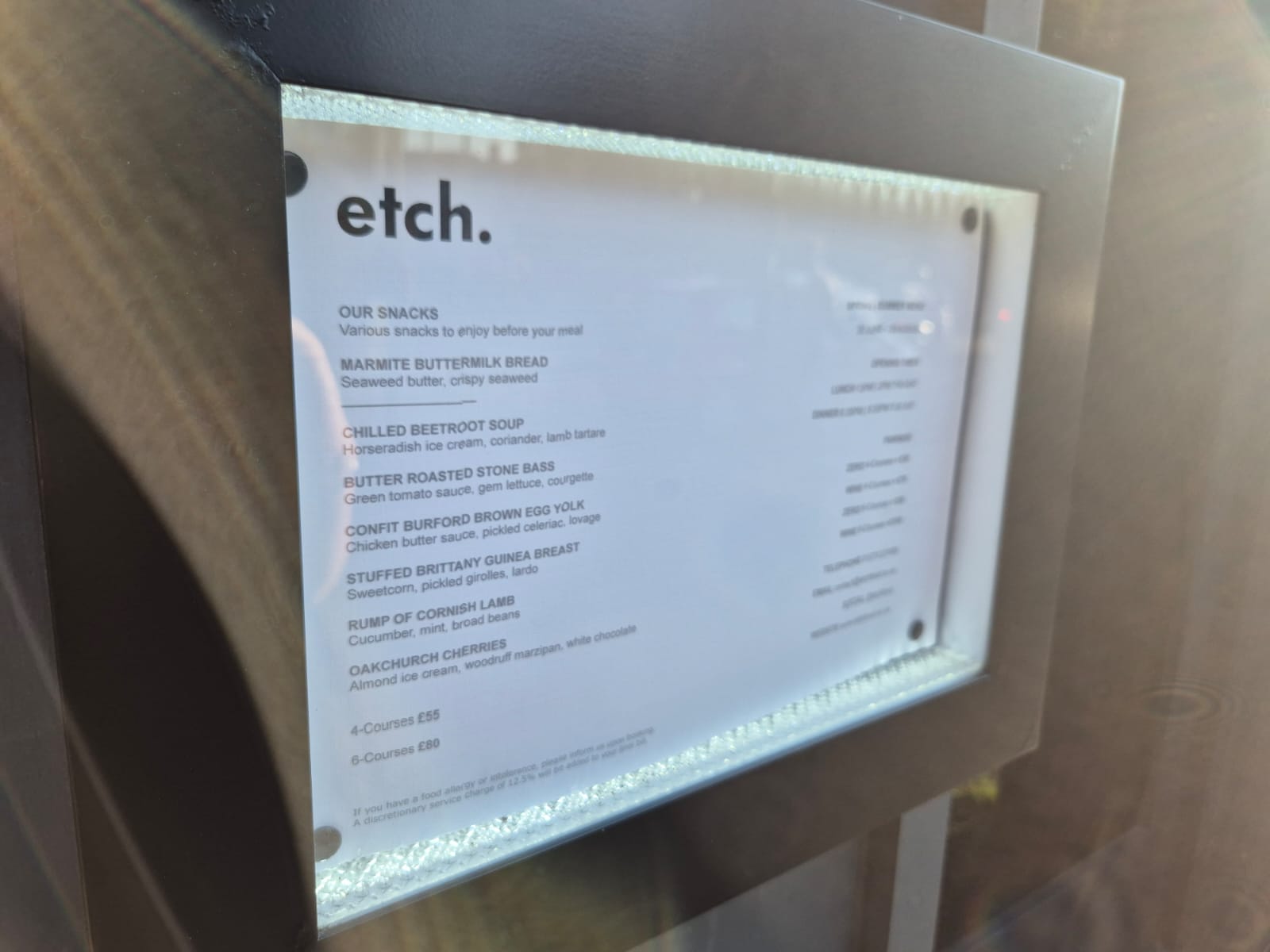
etch. summer menu 2026 – six courses
On this occasion, my companion and I experienced the six-course menu, but there is also a four-course menu to choose from instead. The restaurant’s menus change with the seasons every eight weeks, six times a year, so the experience is designed to evolve regularly rather than leaving the kitchen producing exactly the same dishes indefinitely. The current offer is a four-course tasting menu at £55 or six courses at £80, with wine and non-alcoholic pairings available. There are also pescetarian and vegetarian options available.
The restaurant itself is a beautiful setting for this kind of experience. Housed in a former bank, it has a contemporary interior with an open kitchen at its centre, allowing diners to see the chefs working and dishes being prepared and served. The Michelin Guide describes it as a lively modern restaurant with the open kitchen and bar taking centre stage, but there is another quality to the room that I found just as appealing: it feels discreet.
We were seated in a banquette and, despite being in a lively restaurant, had a proper sense of our own space. We could talk without having to compete with other tables, and without inadvertently hearing the intimate details of somebody else’s evening. There was none of that strange restaurant phenomenon where diners become unwillingly invested in the holiday plans or family arrangements of the people sitting beside you because the tables are six inches apart. So there’s no rubbernecking, and no listening to other people’s kind of lives. At etch., you can concentrate on the person you have come with, while still enjoying the atmosphere and the theatre of the open kitchen.
It is an unusually successful balance. The restaurant feels special without being intimidating, contemporary without being cold and sophisticated without becoming formal. The dress code is essentially smart casual, and the restaurant describes its style of service as informal and friendly despite the fine-dining food. That description is borne out by the experience.
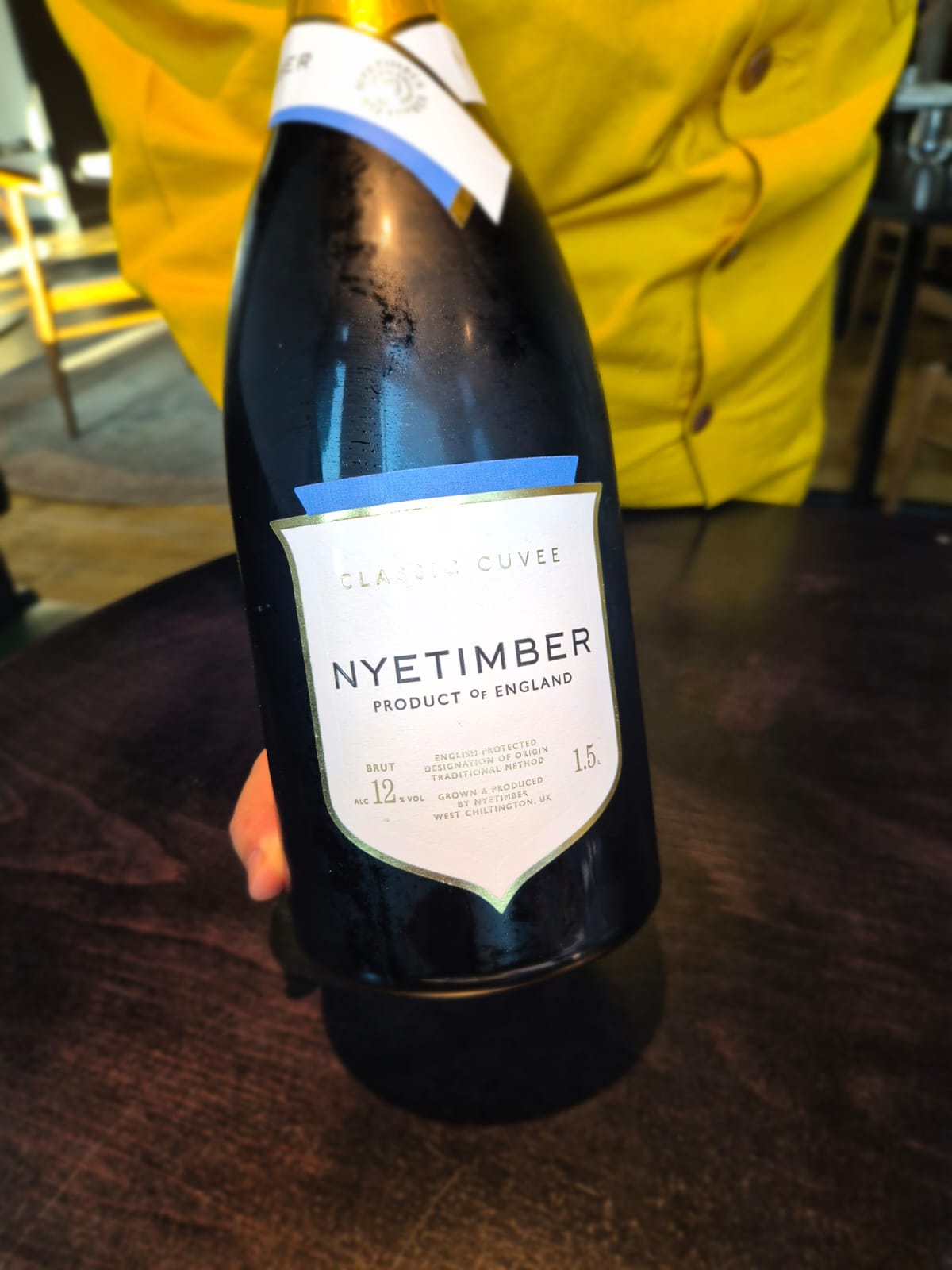
Nyetimber sparkling wine
The staff are fantastic, and one of the great strengths of this restaurant. They obviously love their jobs, and are really passionate about what they do, including their knowledge about food and wine. There is a palpable sense that they are a team rather than simply a collection of people working the same shift. They were all friendly without being intrusive, knowledgeable without being pompous and attentive without hovering. There is a pride in the restaurant which comes through naturally. All of which just made this visit a really beautiful experience.
We were greeted with sparkling wine, a classic cuvee from Nyetimber, a West Chiltington, Sussex sparkling wine from the same chalky soil as the wines from the Champagne region of France. Nyetimber has a short-term partnership with founder Steven Edwards, and this was a beautiful golden colour in the glass with a sharp brut at 12% vol. A very welcome arrival drink and accompaniment to the menu snacks, as well as allowing time for a gossipy catch-up with my companion.
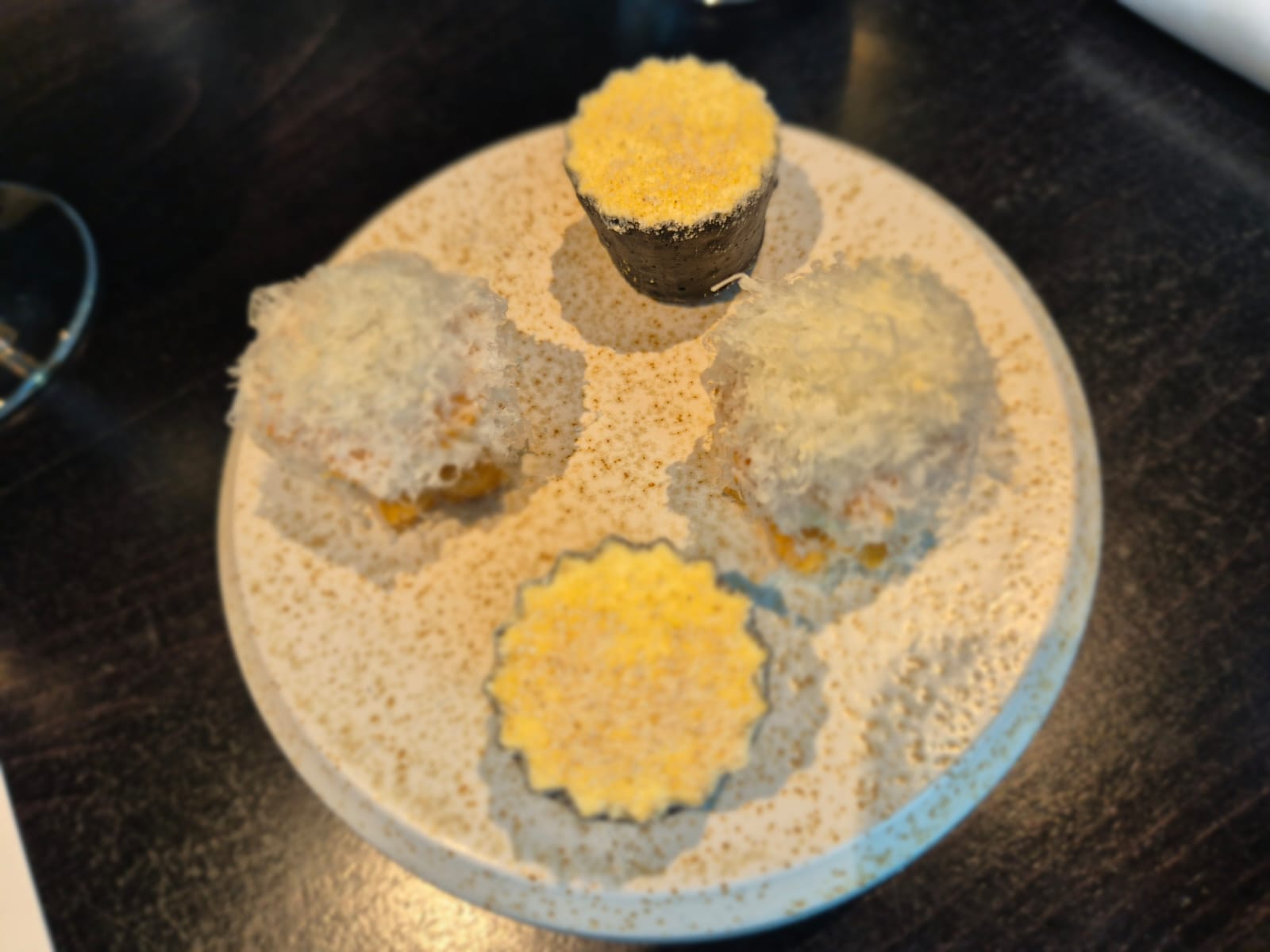
The sparkling wine was shared with a series of small dishes that the menu rather modestly calls ‘snacks’. If these are snacks, my understanding of the word clearly needs revising. The Lord of the Hundreds biscuit with cheese custard was an intensely savoury little mouthful. Lord of the Hundreds is an East Sussex sheep’s-milk cheese, a hard, naturally rinded cheese with a complex savoury character with a flavour hinting at caramelised hazelnuts. It’s a hard cheese originally based on a pecorino recipe.
etch. snacks to delight.
At etch. it is transformed into a delicate biscuit, with the cheese custard providing further layers of flavour, then finished with a fine dusting of the cheese itself. My companion described it as a posh Tuc biscuit, which is an irreverent but surprisingly useful description. Imagine a Tuc biscuit made in a parallel universe in which somebody has given exceptionally talented chefs access to outstanding handmade, seasonal and local ingredients.
The tiny Billington mushroom tart was even more remarkable. Oyster mushroom duxelles and truffle cream were enclosed in a delicate pastry shell, creating an intensely savoury morsel with a rich, almost pâté-like texture. It was small but extraordinarily concentrated. There is something particularly impressive about this kind of cooking because the size of the dish leaves nowhere for a weak flavour to hide. Every element has to work.
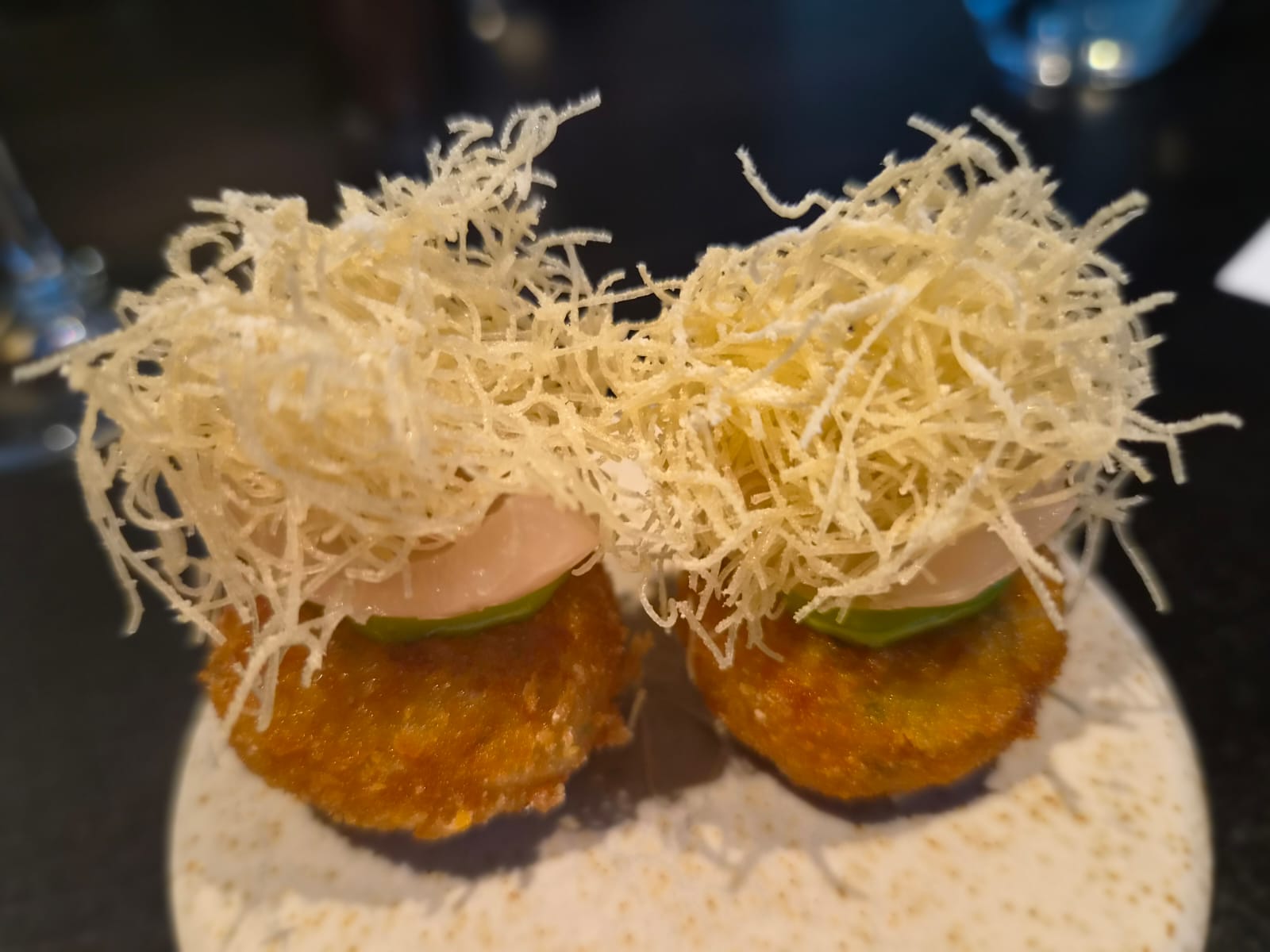
Roscoff onion fritter
The Roscoff onion fritter followed, a light fried onion preparation with pickled onion and chive emulsion and a delicate dried onion garnish. It had the comforting, familiar qualities of an onion bhaji but in an extraordinarily refined form. The sweetness and savouriness of the onion remained unmistakable, but the texture was light and crisp rather than heavy.
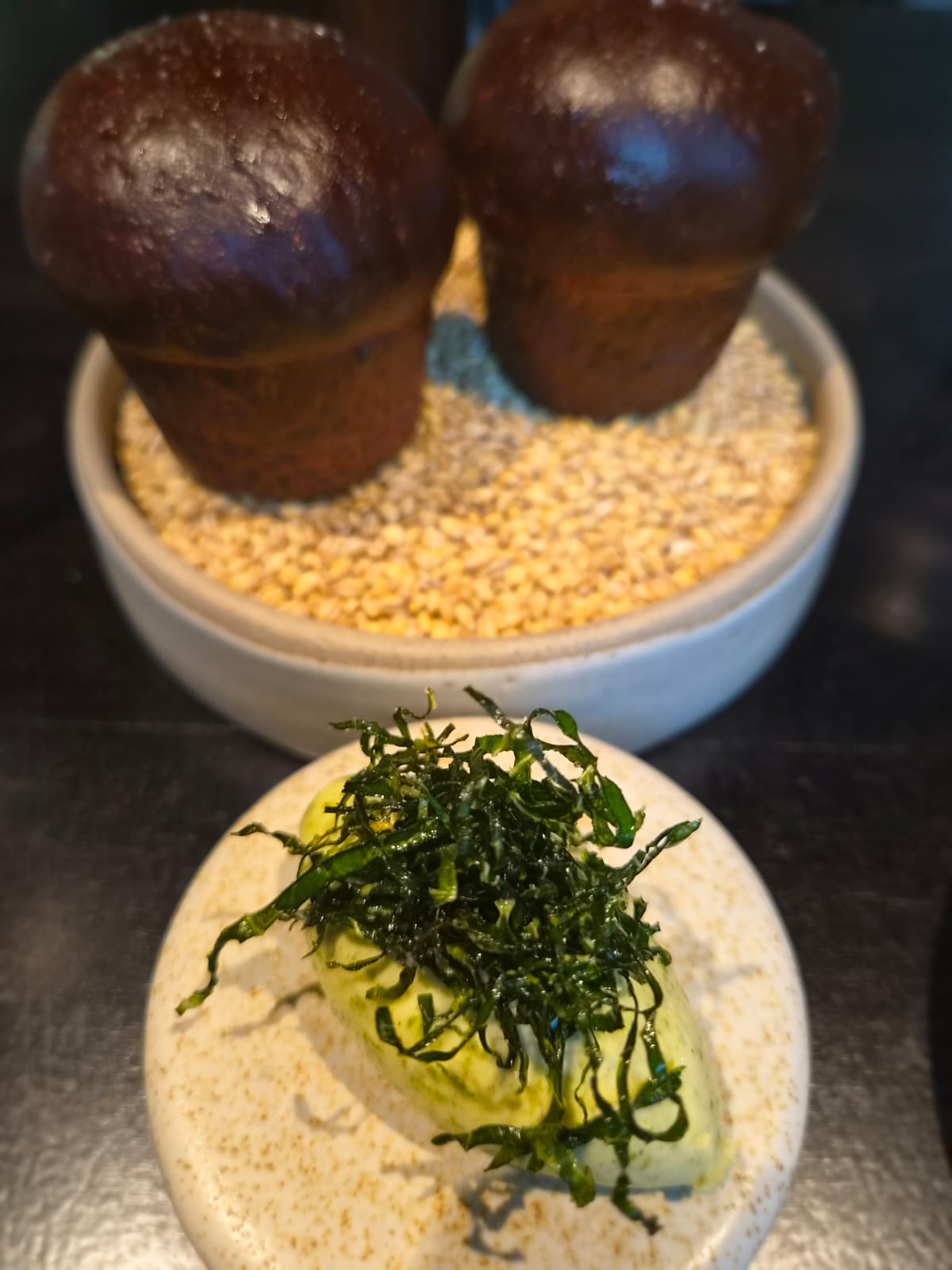
Then came the bread. The Marmite buttermilk bread deserves considerably more attention than its position on the menu might suggest. The handmade rolls have something of the richness and softness of brioche, although they are less sweet, and they are served with seaweed butter and finished with crispy seaweed. The combination is extraordinarily savoury without becoming overwhelming.
Marmite buttermilk rolls with seaweed butter at etch.
These were among the finest bread rolls I have encountered in a restaurant. The buttermilk gives them a wonderfully soft texture and richness, while the Marmite adds depth and the seaweed brings another layer of umami. They were presented beautifully and disappeared rather too easily. There is a danger with very good bread at the beginning of a tasting menu: you know that you should exercise restraint, but restraint is difficult when somebody has just put one of these in front of you. Etch is worth a visit for these rolls alone. I am assuming that the buttermilk rolls are made with the excess liquid from the homemade butter at the restaurant, and if so, it is a great way to ensure there is no waste, and the buttermilk makes this bread roll stratospheric.
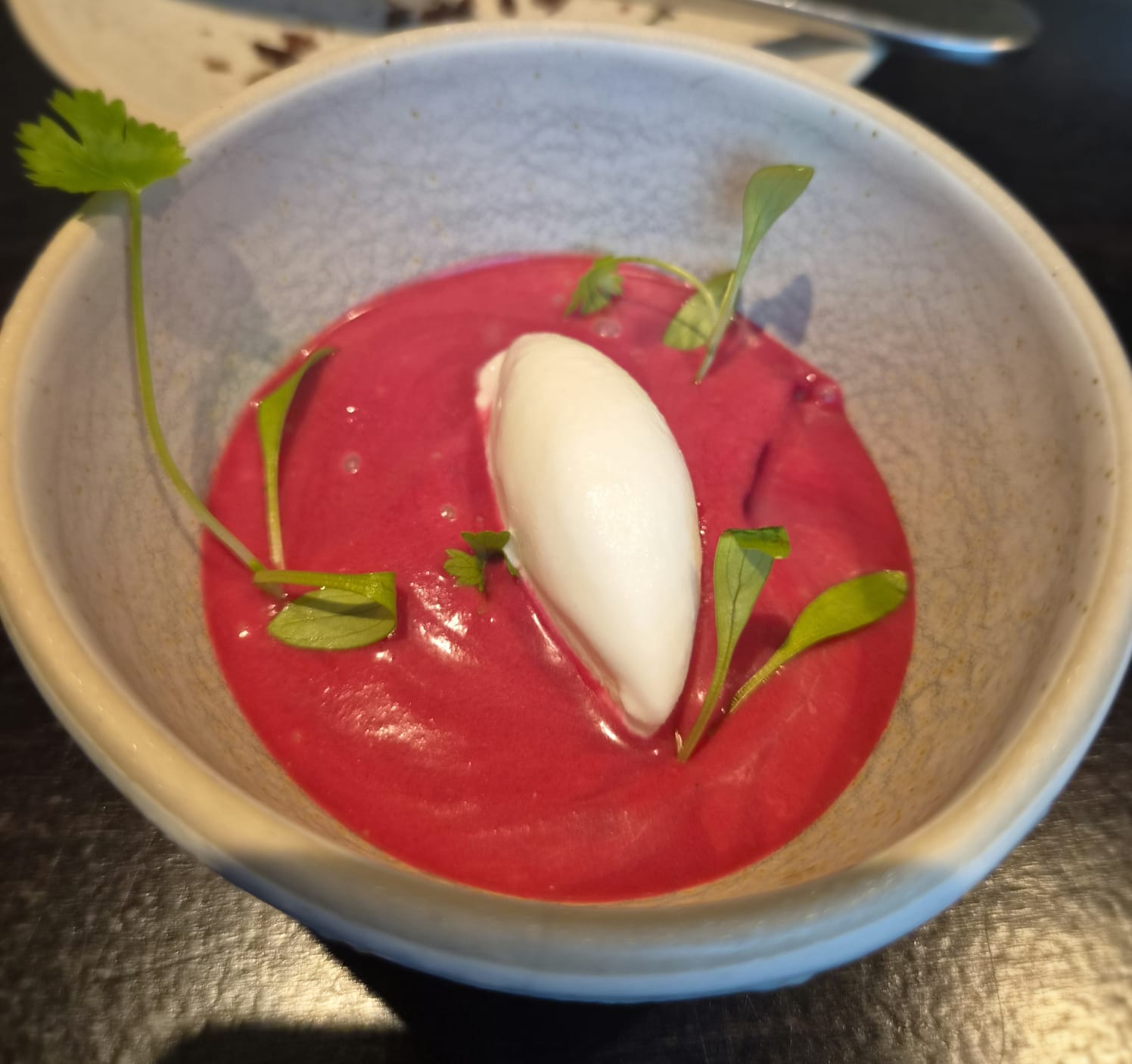
The first formal course was a chilled beetroot soup with horseradish ice cream and sprigs of coriander, accompanied by little lamb tartare tartlets decorated with edible flowers. Visually, it was striking: deep beetroot pink, white horseradish ice cream and flashes of green. It could almost have been designed as the colours of a new national flag.
chilled beetroot soup at etch.
There was some discussion about whether the soup constituted a kind of borscht, although it doesn’t contain the bone stock base associated with traditional versions. Whatever we call it, this was a wonderfully light summer dish. The beetroot retained its earthy sweetness but had a gentle vinegary tang, which kept it fresh rather than heavy, while the horseradish ice cream provided both coolness and heat.
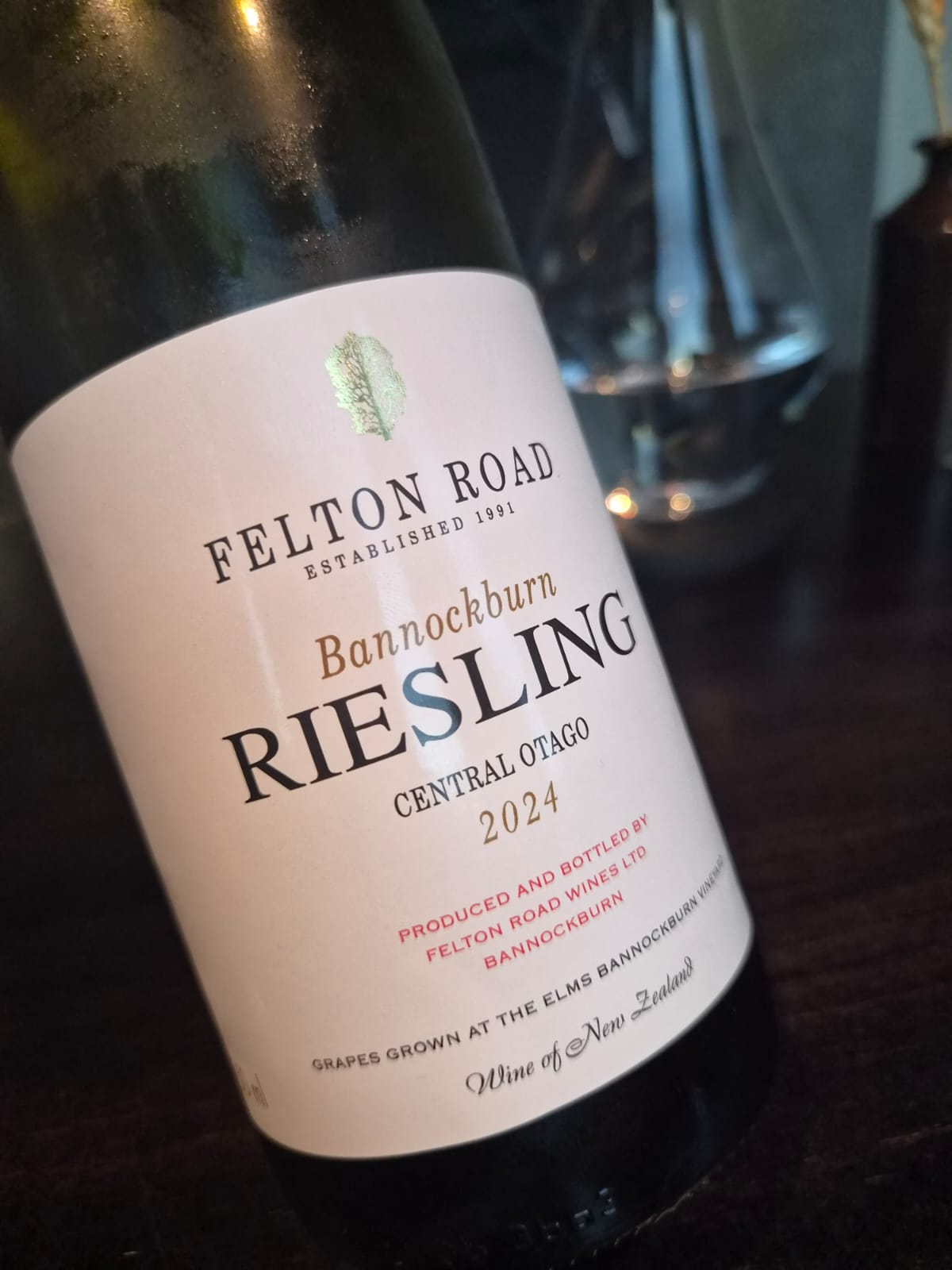
I am not the world’s greatest enthusiast for meat tartare, so my companion was extremely happy to take responsibility for both lamb tartlets, beautifully decorated with edible flower petals. The wine pairing was a Bannockburn Riesling from New Zealand’s South Island, with the 2024 vintage served on our second visit (2023 vintage on my first visit). It was an off-dry Riesling with crisp natural acidity, citrus and floral aromatics and relatively low alcohol. I found it almost had a green wine quality, not literally, but in the sense of freshness, acidity and vibrancy. It worked beautifully with the beetroot, providing another kind of tang, and preventing the sweetness of the vegetable from becoming dominant. The knowledgeable restaurant manager mentioned to us that he had trained for a degree in wine at Plumpton College, and now I want to leave my day job and do the same!
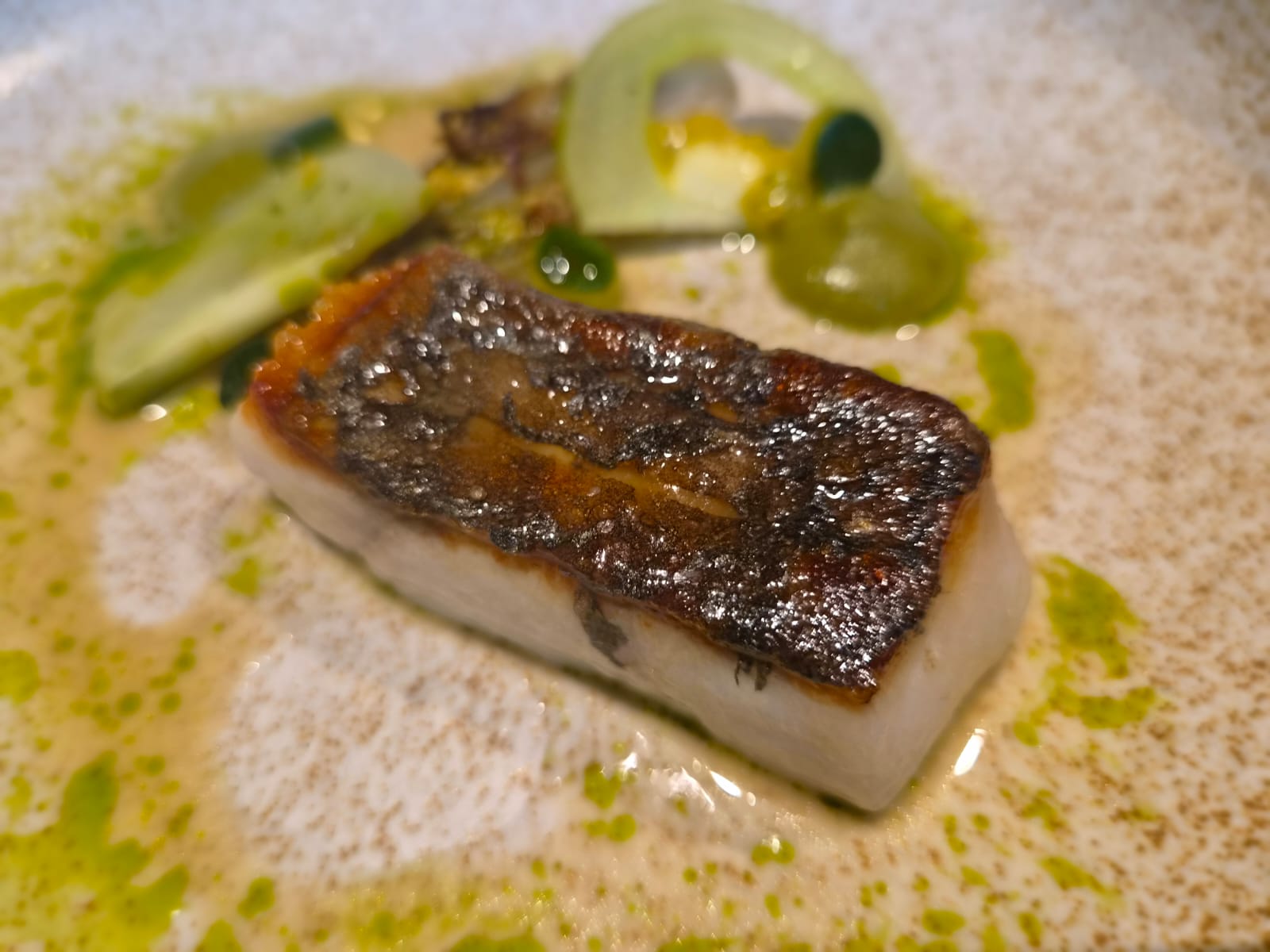
Butter-roasted stone bass with green tomato, charred gem lettuce, and buttons of courgette
The next course was butter-roasted stone bass with green tomato, charred gem lettuce, and buttons of courgette. The fish was beautifully cooked, rich from the butter but still delicate, while the vegetables provided freshness and texture. There was a wonderful aroma of basil around the plate, making the whole dish feel intensely summery.
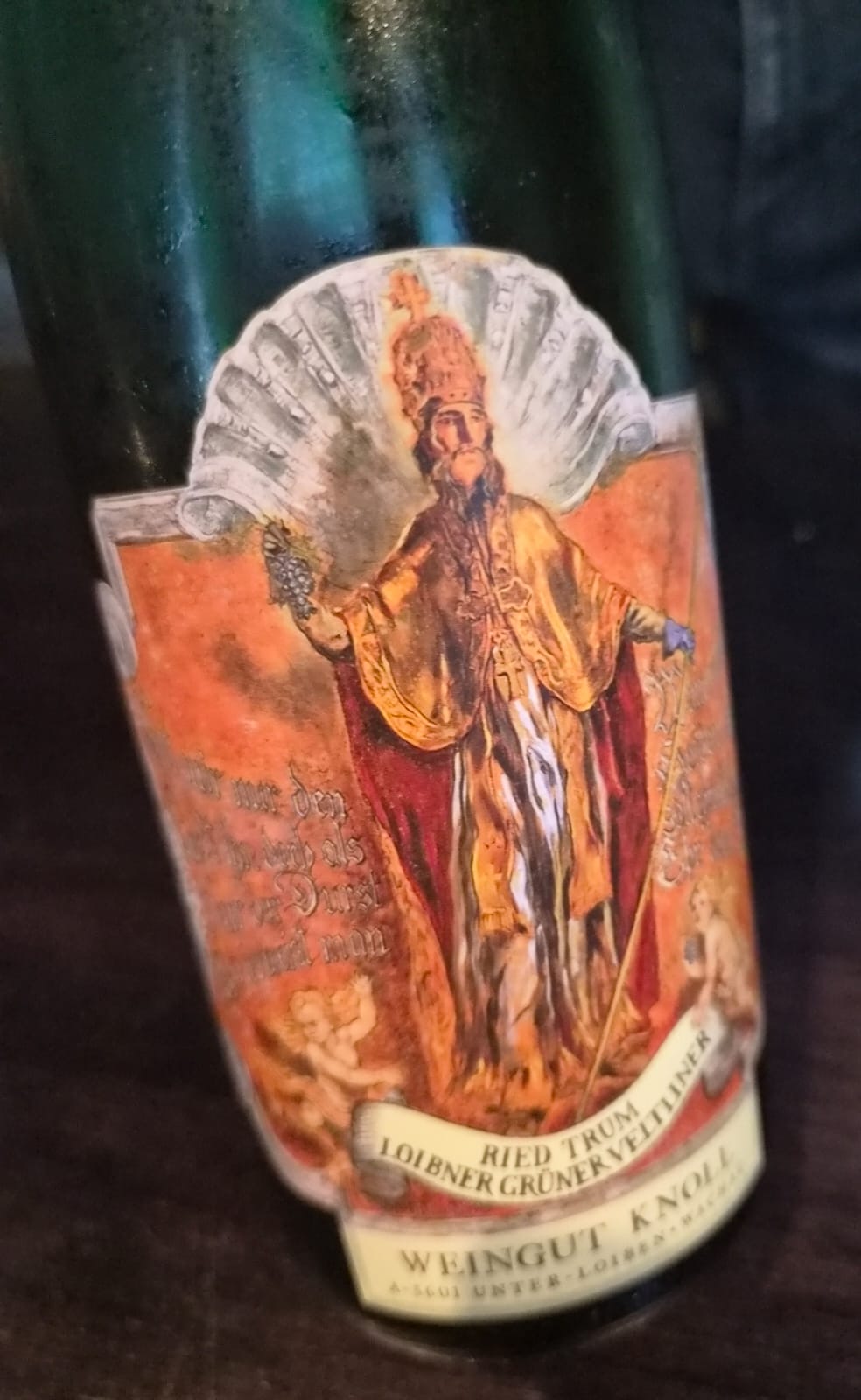
Austrian Grüner Veltliner wine from Weingut Knoll in the Wachau
The wine for this course was an Austrian Grüner Veltliner from Weingut (not wingnut as I pronounced it) Knoll in the Wachau, on the banks of the Danube. I don’t usually drink Austrian wines however this paired so well with the fish on this occasion and was presented with a beautiful label. It’s a 12.5 per cent wine from Unter-Loiben Wachau, bright, lively acidity, crisp citrus and fruit flavours. It made for an especially interesting pairing. It is one of the pleasures of being in the hands of a knowledgeable sommelier: To be introduced to something you would probably never have ordered for yourself and discover that it works brilliantly.
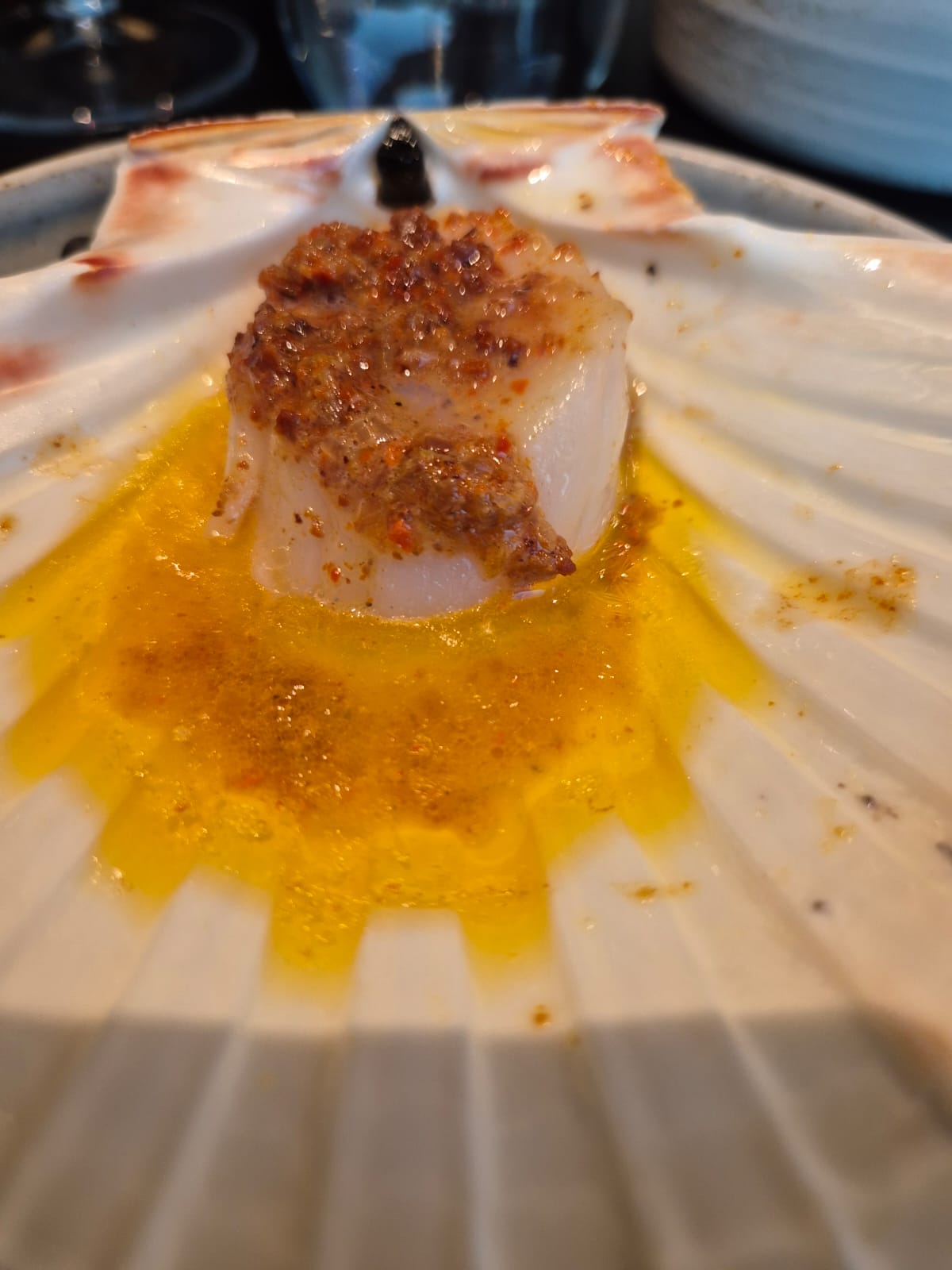
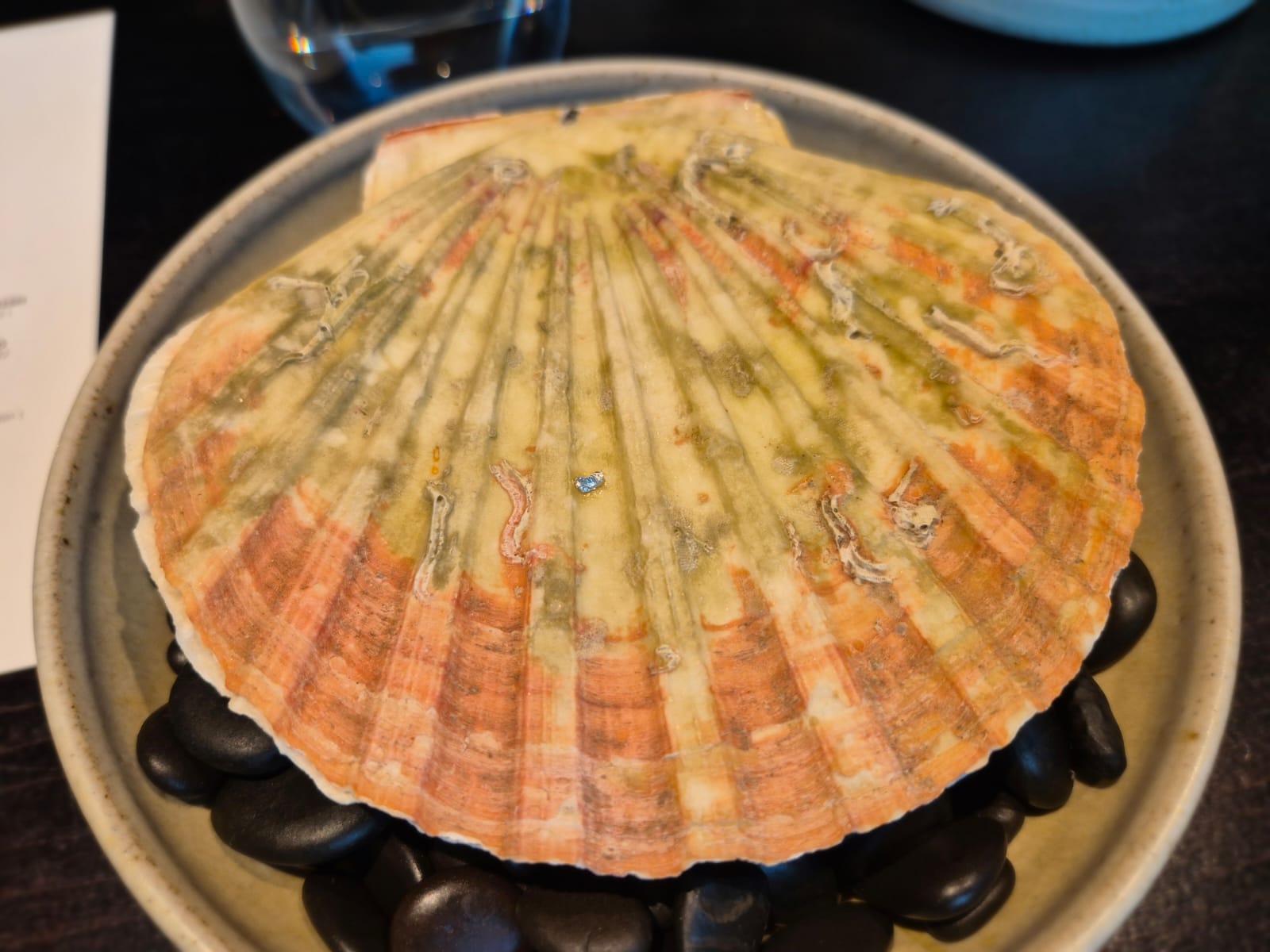
Orkney scallop in butter at etch.
Then came the Orkney scallop, hand-dived and shell-baked, with smoked scallop roe and lemon butter. This was one of the outstanding dishes of the evening. The scallop was plump, juicy, and intensely sweet, with the smoked roe providing a deeper savoury quality and the lemon butter bringing acidity and richness.
The wine was a Danbury Ridge Chardonnay from the 2023 vintage, produced in the Crouch Valley in Essex. This is a particular favourite at etch. and, unlike the other wines in the pairing, remains on the list as the wine, while the rest of the selection changes with the menu. It is a full-bodied, barrel-aged Chardonnay with enough weight to stand alongside the richness of the shellfish while retaining freshness. This is a keeper and a popular addition to the wine flight. I had not previously encountered Danbury Ridge, but it is now firmly on my list of English wines to look out for.
Danbury Ridge Chardonnay 2023
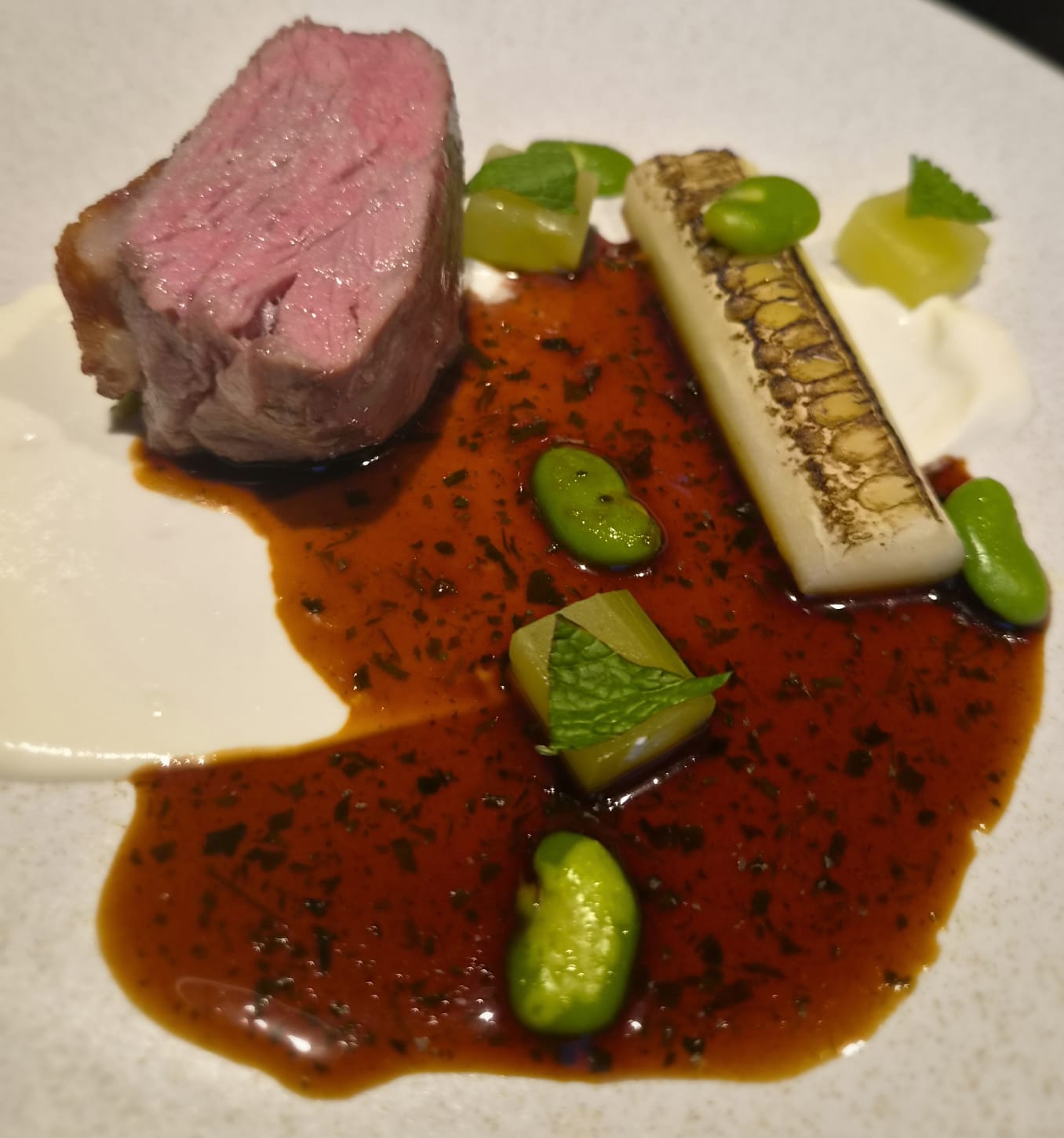
The rump of Cornish lamb comes medium-rare and is accompanied by braised cucumber, mint and tiny broad beans, all carefully placed. The meat cut through like butter and had a deep, distinctive flavour of excellent lamb. It was a really special dish. The cucumber and mint brought freshness, while the broad beans added a gentle sweetness and texture. This was paired with a Pessac-Leognan ‘Le C de Carmes’ Des Carmes Haut Brion 2017 from Bordeaux. Retailing at £39 per bottle in shops, it’s a Cabernet Sauvignon-dominant blend with grapes grown on the left bank of the Loire rather than on the right, as is traditional for these grapes (so I’ve been told). I have long loved a Cabernet Sauvignon, but with my advancing years have found that I can’t drink red wine these days as it keeps me awake, however, this glass looked, smelt and tasted divine, and I couldn’t help but finish it. This worked so well with the lamb and has been resting since 2017 ready for consumption in 2026. It is 13% vol and an appellation controlee wine for the region Pessac-Leognan.
Cornish lamb accompanied by braised cucumber, mint and tiny broad beans
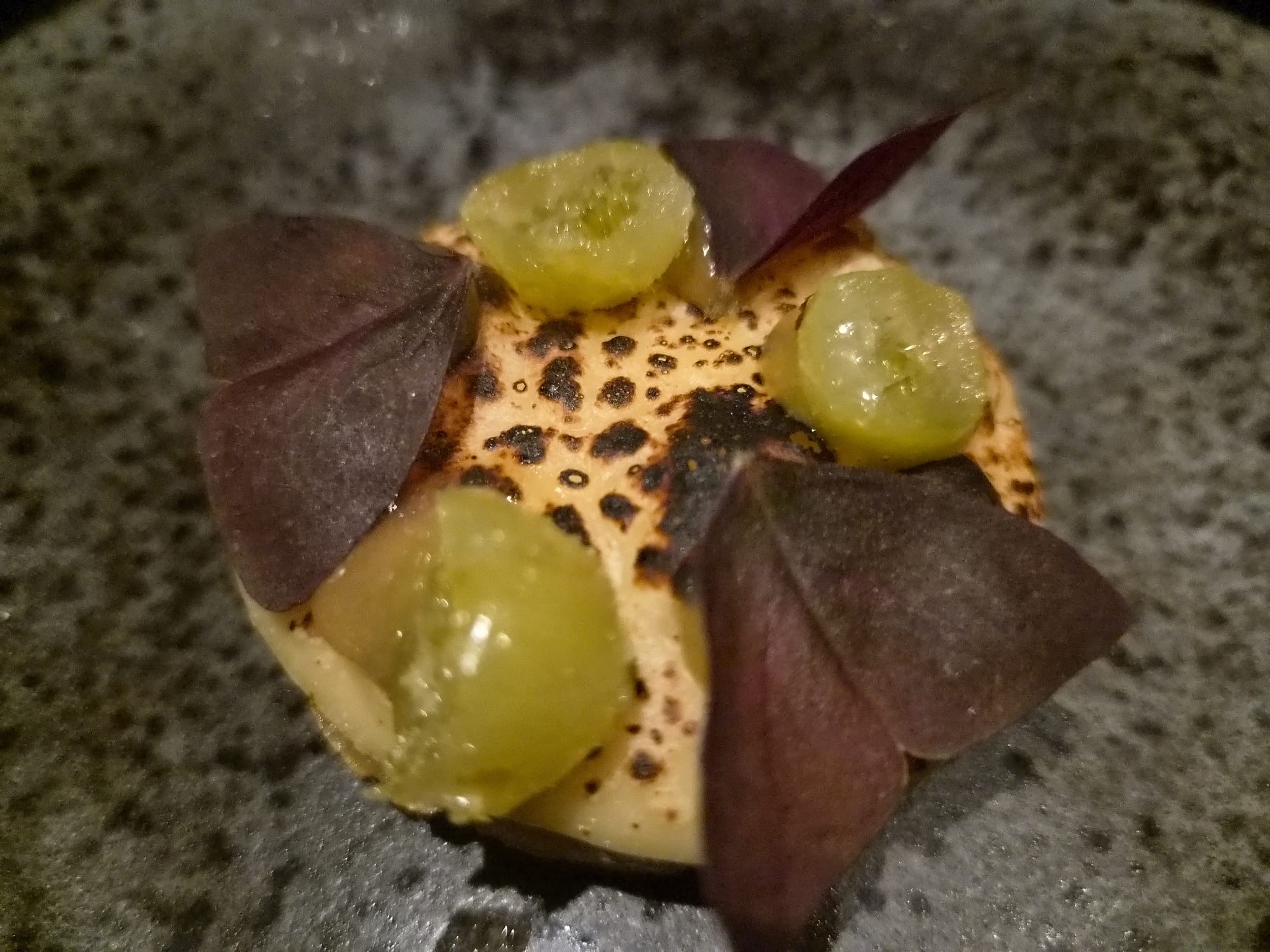
The delectable Tunworth cheese crumpet that followed was a miniature, highly sophisticated Welsh rarebit, accompanied by gooseberry jam, fresh gooseberries and sorrel. Tunworth is a soft British cheese, and the richness of the cheese, worked beautifully with the sharpness of the gooseberry. It was comforting but not heavy, with the fruit cutting through the cheese and bringing the menu towards its sweeter conclusion.
Tunworth cheese crumpet
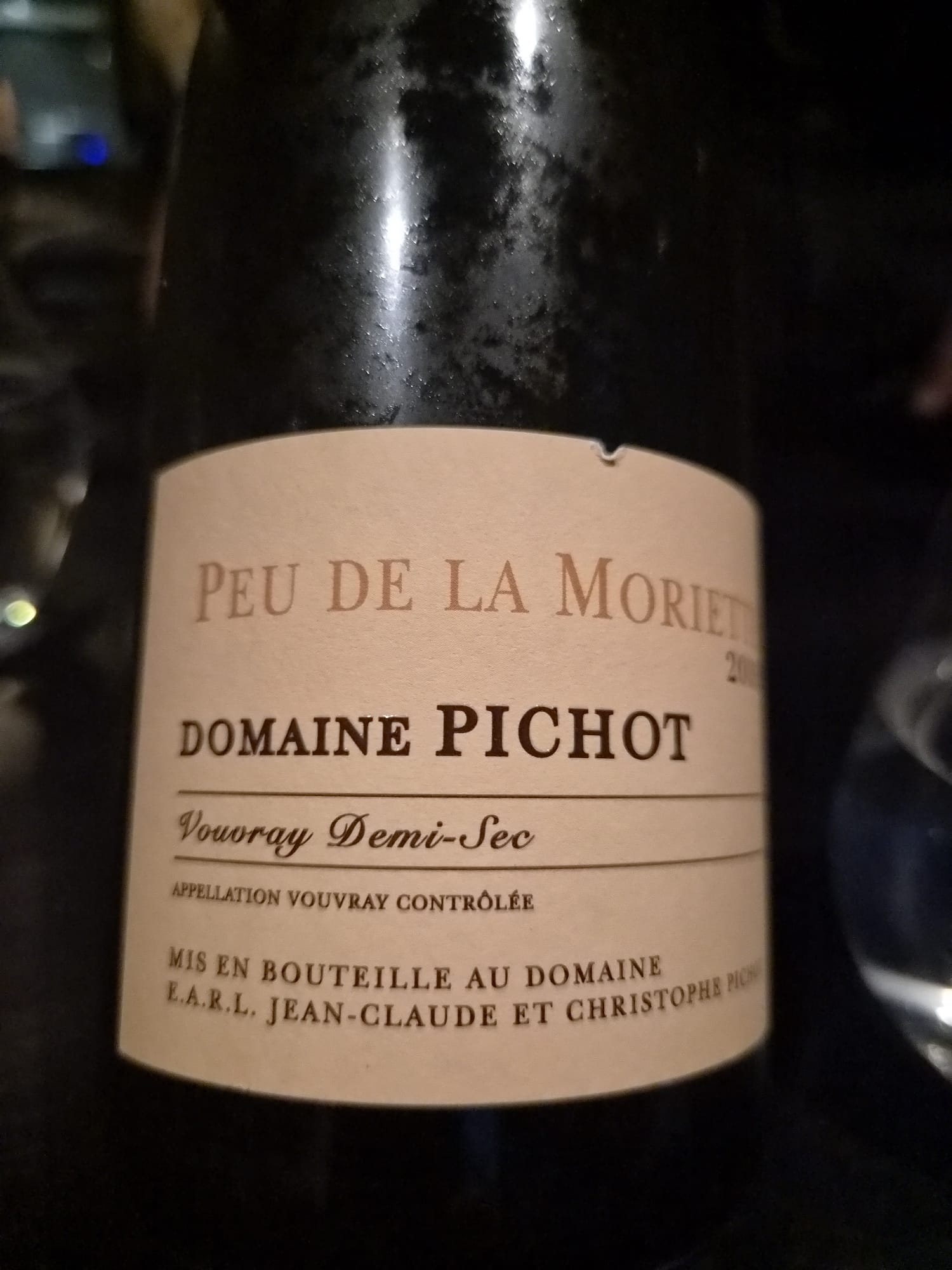
The accompanying Vouvray Demi-sec is from the Domaine Pichot 2019 harvest, a working vineyard since 1770. This is an off-dry Chenin Blanc from a family estate, a sharp wine balanced by rich honey and apple. This combined the characteristic acidity of Chenin Blanc with honeyed, apple-like richness, making it particularly effective alongside both the cheese and the fruit. The progression from savoury to sweet was gradual and considered rather than abrupt.
Vouvray Demi-sec is from the Domaine Pichot 2019 harvest
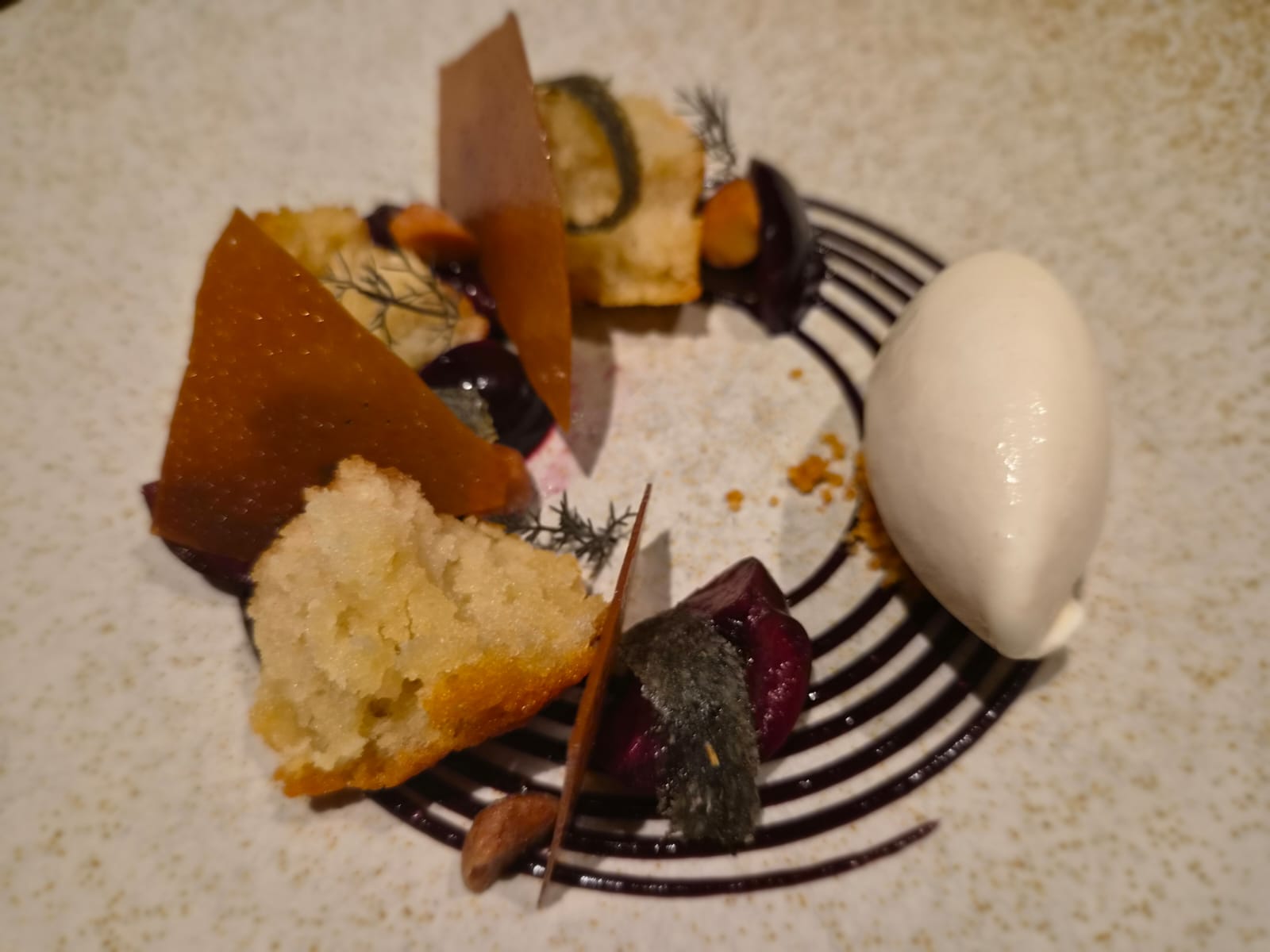
The final course of the evening, dessert, arrived in the form of a deconstructed almond and Oakchurch cherry tart with almond ice cream and homemade woodruff marzipan. The cherries brought sharpness and acidity, while the almond and ice cream supplied richness and softness. The subtle marzipan added a delicate aromatic quality. It was recognisably a cherry and almond tart but presented in a way that allowed each component to be experienced separately.
deconstructed almond and Oakchurch cherry tart with almond ice cream and homemade woodruff marzipan
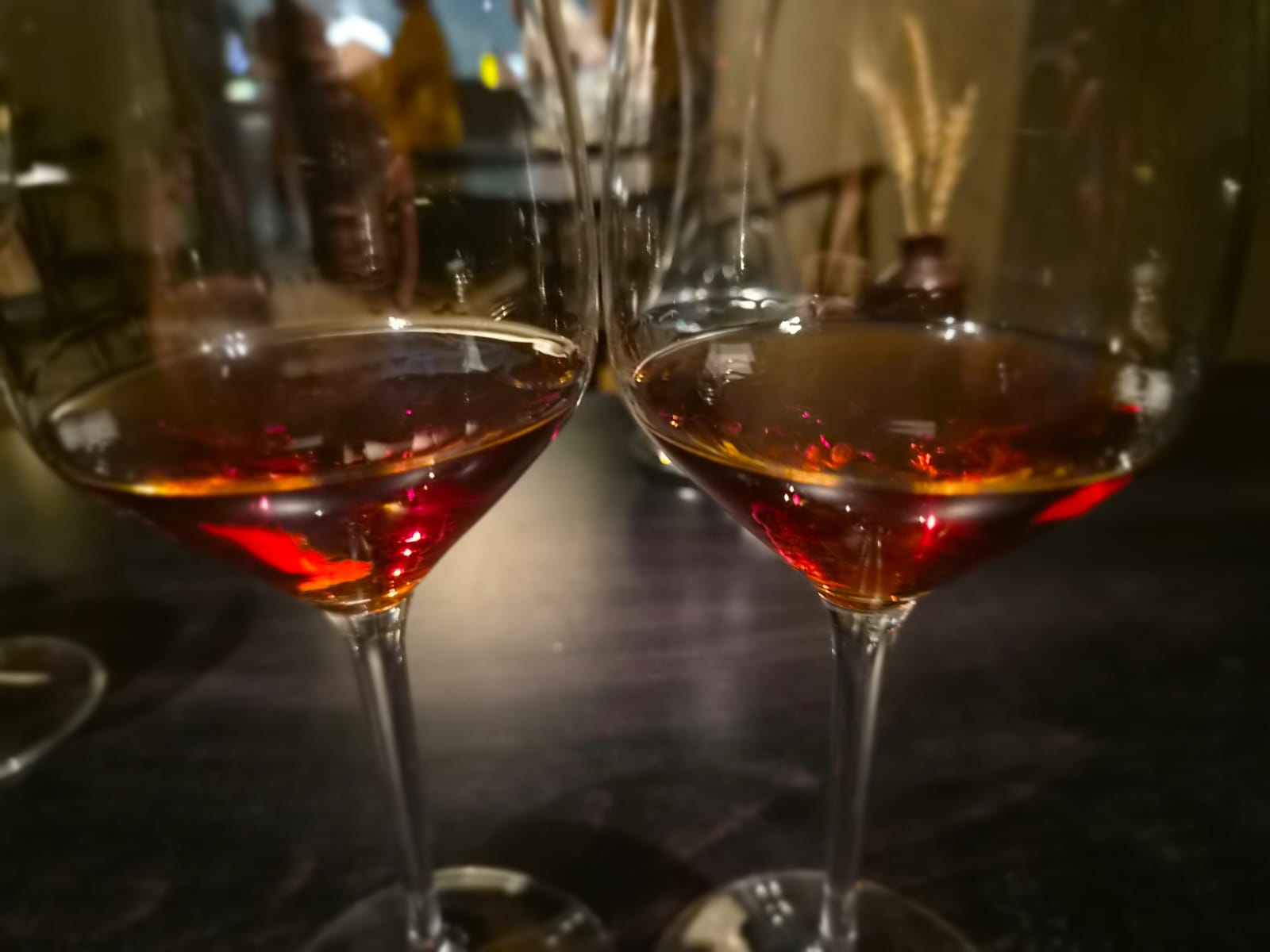
This was offered alongside a dessert wine from Greece, possibly my first one! This was a Samos 2018, a naturally sweet dessert wine made from white Muscat grapes with a hint of fig and raisin in the notes, and a tawny rich liquid made using white muscat grapes. It reminded me of a Malaga, although made using different grapes and methods. It was an excellent final pairing, sweet enough to accompany the dessert without simply adding more sugar to an already sweet course.
Samos 2018 – a sweet dessert wine made from white Muscat grapes
What makes the experience particularly impressive is the way the wine is treated as an integral part of the meal rather than an optional accessory. etch.’s Wine Director, Sam Weatherill, has been with the restaurant since it opened in 2017. He became Wine Director in 2024. Born and raised in Brighton, he is a Certified Sommelier with the Court of Master Sommeliers. His work has helped etch. win Best Contemporary Wine List in the UK at the 2023 International Wine Challenge Awards, and he was ranked 19th Best Sommelier in the UK in 2025.
Those credentials are impressive, but what matters at the table is the enthusiasm and knowledge behind them. The restaurant’s approach is not about showing off expensive bottles. It is about finding wines which make the food more interesting, while also introducing diners to less obvious choices.
etch. in Hove
That philosophy extends to the restaurant’s commitment to British produce. etch. says that more than 75 per cent of its ingredients are sourced from within the UK, with a particular emphasis on fresh seasonal produce and local suppliers. Its menus change six times a year, both to reflect the seasons and to encourage a more varied and sustainable diet. The restaurant also highlights British fish, cheese and wine, sustainably sourced seafood and its efforts to reduce food waste.
For me, this is an important part of the restaurant’s identity. ‘Local produce’ has become such a familiar phrase in restaurant marketing that it can sometimes lose its meaning. At etch., it feels more substantial because the food is actually structured around the changing availability of ingredients. You are not being given the same fixed tasting menu twelve months of the year and told that it is seasonal. The menu changes, and the restaurant expects you to come back and see what happens next. That gives etch. another reason to return. The restaurant is not just offering a six-course meal; it is offering a particular snapshot of British produce at a particular moment. The summer menu we ate is temporary and will be replaced by the next expression of the season in September.
There is also more to etch. than the dining room. Beneath the restaurant is Ink, a reservation-only cocktail bar occupying a former tattoo parlour. It has been designed as a modern interpretation of a basement speakeasy, with dark, intimate interiors and flashes of neon artwork by Ben Slow. It is a natural place to continue an evening before or after dinner, particularly if you want to turn a meal into a longer night out.
Baked scallop at etch.
The restaurant’s current reputation has been built over almost a decade. Steven Edwards became the youngest winner of MasterChef: The Professionals when he won in 2013 at the age of 26. Before that he trained with leading chefs, including Raymond Blanc, before joining South Lodge in Sussex, where he progressed through the kitchen and became Head Chef of the Camellia at just 25. He subsequently developed etch. through a series of pop-ups before opening the permanent Hove restaurant in March 2017.
That is reflected in the kitchen team as well. Junior Sous Chef Acauã Irê Fernandes came to the UK from Florianópolis in Brazil, while Jordan Rickwood has worked at restaurants including The Flint House and Apiary in Brighton before joining etch. Ben Meadows brings more than a decade of professional kitchen experience in West Sussex. The biographies are impressive, but again, what you notice as a diner is the confidence and calm of the kitchen.
The Michelin Guide currently recommends etch. as a Modern British restaurant, noting its former-bank setting, open kitchen, ambitious tasting menus and bold flavours, while the restaurant also holds a Michelin Plate, five Good Food Guide recognition and three AA Rosettes.
I would most definitely go back for the food, particularly those extraordinary Marmite buttermilk rolls and the mushroom tart. I would go back to see what the next seasonal menu looks like. I would go back to drink another glass of Danbury Ridge Chardonnay and to discover whatever new wine the team has decided to put alongside the next menu. I would go back for the room itself, because there is something unusually pleasant about being able to have a proper conversation in a beautiful restaurant without feeling as though you are sitting on somebody else’s lap.
Bannockburn Riesling from New Zealand’s South Island
It was one of those evenings when the meal becomes more than the sum of its courses. We ate exceptionally well, drank some wonderful wines, talked for hours and were looked after by a team who seem to care deeply about what they do. Not simply because Steven Edwards is a MasterChef winner, although that is part of the story. Not just because Michelin recommends it, although that is useful confirmation. Not simply because the food is technically accomplished, although it unquestionably is.
We had the most wonderful evening. I will definitely be returning, and I feel lucky to have shared this menu on the evening of the eclipse. The work at Etch is a fine and noble one and the staff and head honcho are to be commended on their talents. I feel particularly lucky to have had the opportunity to return after my first visit was cut short. This time I got the full experience, and it was worth waiting for.
Details
Venue: etch. by Steven Edwards is at 214–216 Church Road, Hove, BN3 2DJ.
Accessibility: etch. by Steven Edwards in Hove accommodates wheelchair users and features a disabled toilet accessible at ground level. The fine-dining restaurant maintains an informal, accessible layout, though it is recommended to notify the team in advance of specific seating or mobility needs.
Find more arts and culture reviews at Brighton & Hove News –
Follow @BHCitywhatson and @bhcitynews on Instagram. Covering everything from fringe theatre to major tours across Brighton & Hove – tag us if you’re going!