
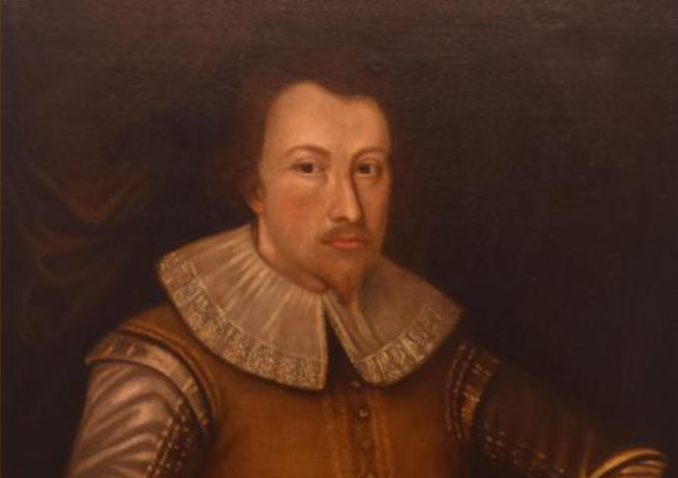
A lost manuscript, found in a Brighton archive, has given an insight into the divided loyalties at the heart of Henry VIII’s court during one of the most turbulent periods in British history.
The manuscript – six pages torn from a bestselling book that was in effect outlawed – were found at the Keep, in Brighton, by two academics.
They suggest that the Catholic text was saved by Sir John Gage, who helped in the dissolution of the monasteries and whose descendants still live in Firle, just outside Lewes.
Sir John was involved in the dissolution of Battle Abbey and stones from Lewes Priory were used to build his home at Firle Place.
In the Wolf Hall trilogy, by historical novelist Hilary Mantel, Sir John is portrayed as a religious conservative and yet dependable enforcer for Henry VIII during the Reformation.
But the new find and linked research suggest a bold act of subterfuge by Gage, in which he shielded a treasured Catholic text from the very destruction that the king ordered him to enforce.
The pages – and their significance – came to light as the result of “archival sleuthing” by researchers from Sussex University and Cambridge University.
It enabled six fragile pages in the Keep collection, at Falmer, to be identified as those missing from a manuscript held 3,500 miles away at Yale University in America – an early 15th-century work, Mirror of the Blessed Life of Jesus Christ, by Nicholas Love.
Katie Walter, from Sussex, and James Wade, from Girton College, Cambridge, solved a “cataloguing puzzle” which had frustrated scholars for nearly a century as they found the fragment “hiding in plain sight”.
Their study is published today in the journal Notes and Queries.
A trail of clues left by various archivists and scholars eventually led Dr Wade and Dr Walter to a digitised manuscript known as Takamiya MS 20, held by the Beinecke Library at Yale University.
Scrolling through it, they found the gap where pages at the Keep belonged – just before a controversial passage on the importance of oral confession to a priest.
They matched the scribe’s handwriting and the content of the missing passage to prove the connection.
On the final page of the Yale manuscript, among a list of names of likely owners, including those of two religious women, is the signature of Sir John Gage.
Dr Walter said: “The fact two possible owners before Gage were religious women suggests the manuscript might have been in a monastic house before it came into his possession.
“The dissolution of the monasteries led to the destruction of many books but others were taken and then circulated through informal networks.
“Considering Gage’s active role in the dissolution, it’s very possible he acquired the book during this chaos.”
Dr Wade said: “One possibility is that John Gage went to a monastic library and brought it home. Another is that someone else smuggled it out, and it briefly circulated from hand to hand until Gage acquired it.
“The key thing is – he kept it safe when he was meant to destroy books precisely like this one.”
Dr Wade said that 65 copies of Love’s text survive today, adding: “That’s a lot for a 15th-century manuscript but so many could have been destroyed in the Reformation.
“It shows how popular it was but it also shows how a work that became suspicious and dangerous for some could also be valued and preserved by others.”

Sir John Gage lived from 1479 to 1556 and was still gaining in influence in the royal court when the dissolution of the monasteries began in 1536. He worked with the king’s right-hand man, Thomas Cromwell.
Sir John had proved to be an effective administrator and was tasked with organising the dissolution of monasteries in Surrey, Kent and Sussex after the breach with Rome – an early Brexit.
His role involved taking stock of everything owned by monastic houses and working out how to dispose of those assets for the king.
Dr Wade said: “Gage had a very long career in a highly turbulent court. He survived when many other very shrewd people did not. And he made a fortune in the process.
“But he’s also this incredibly conflicted man because he remained a Catholic throughout the Reformation.
“He’s got all this power and bureaucratic savvy combined with a risky conviction in his faith. Somehow, he manages to reconcile these two things and survive.”
Dr Walter said: “We often associate this period with book burning and destruction so this manuscript’s story goes a bit against that grain. It reminds us that people were also rescuing, valuing and caring for books.
“By keeping this book on his shelf, John Gage and his family were part of a much bigger secret effort to preserve Catholic literature and knowledge.”
Dr Wade added: “It makes us think about the integrity that underlies subterfuge. There was a lot at stake for John Gage to perform tasks at court but then secretly preserve the very thing that he’s meant to destroy.”
The researchers hope their findings will open up new opportunities to trace Sir John Gage’s perilous steps through the dissolution and Reformation.







Now will be remembered as the most turbulent period in British history.
Maybe in scale, but maybe not in importance