
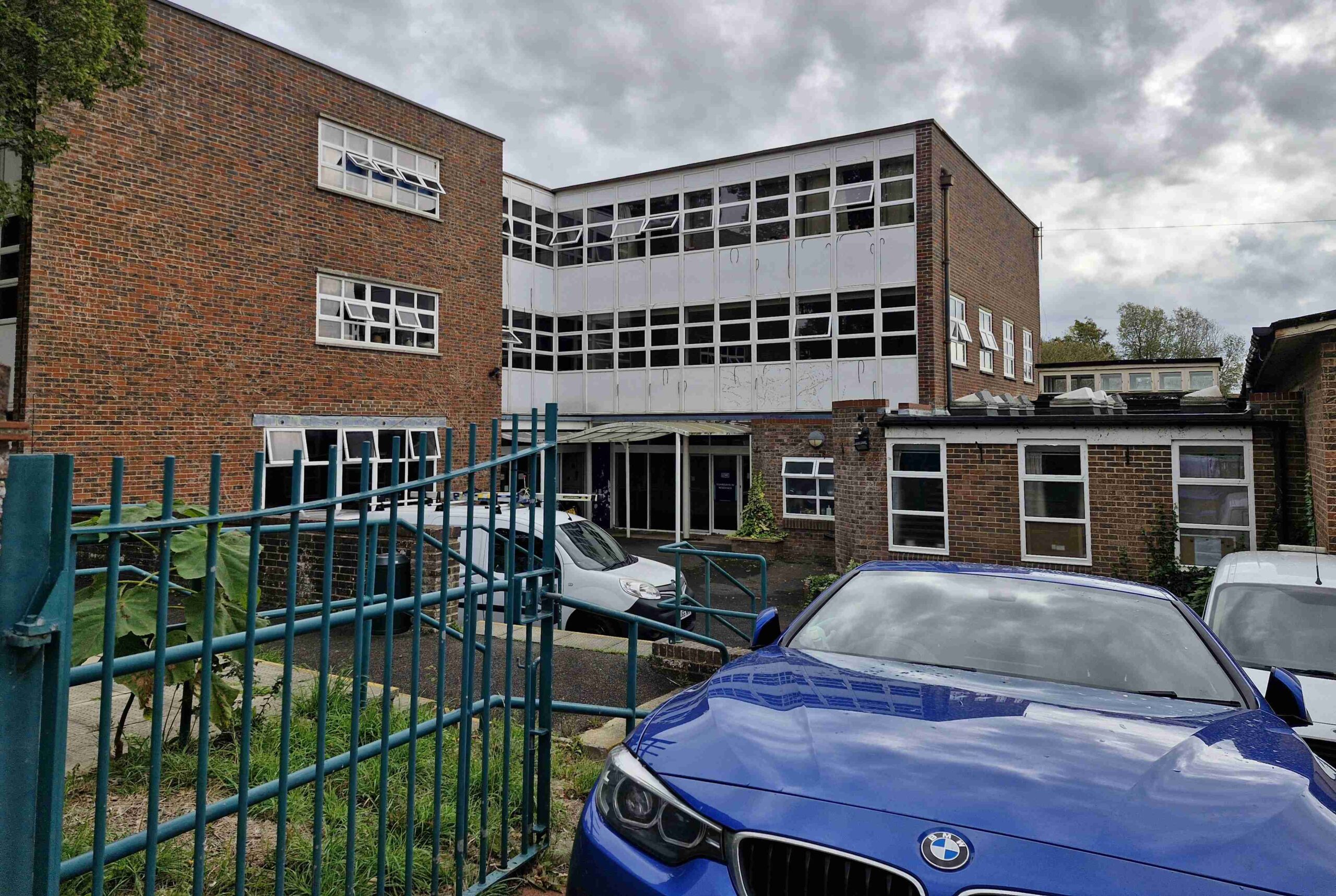
A councillor who teaches planning has blasted a retrospective application to turn a former school into a 47-bed shared house.
The proposal has been given the backing of planning officials and is due to go before councillors for a decision next week.
But Independent councillor Samer Bagaeen hit out at a recommendation to approve the scheme, saying that it conflicted with a number of Brighton and Hove City Council planning policies.
Councillor Bagaeen said: “The officer’s recommendation is not supported by the evidence or the development plan.
“The report acknowledges direct conflicts with policies … but repeatedly relies on the scheme’s two-year duration and claimed housing benefits to discount them.
“Temporary permission may affect the weight given to harm. It does not erase policy requirements, cure missing evidence or make an unacceptable use acceptable.”
Councillor Bagaeen said that the “decisive failures” were
- Protected community use: There was no marketing, needs assessment or evidence that the former school is redundant or unsuitable for another education, health, childcare, voluntary or community use. The relevant policy tests were therefore unmet. A reversion condition could not guarantee that any community use would return.
- Excessive HMO concentration: A 47-person shared house could not credibly be treated as merely “one residential unit” when assessing its local intensity.
- Demonstrated operational harm: The planning application was retrospective so the council’s Planning Committee had evidence from actual occupation – late-night noise, anti-social behaviour, vehicles and taxis, obstructed access, overflowing bins, poor maintenance and inadequate management. Those reports should not rationally be displaced by assumptions that future management will work.
- Weak and unenforceable mitigation: “Broad accordance” with arrangements in an email was neither precise nor robust. Monthly visits, no guaranteed professional on-site manager, no complaint response times, no escalation process and no clear controls over visitors, taxis, deliveries or smoking did not provide effective safeguards.
- Missing technical evidence: There was no adequate independent noise assessment, parking or servicing evidence or a defined refuse and cycle-storage solution.
Councillor Bagaeen said: “The absence of a transport objection is not positive technical evidence – and statutory nuisance powers are not a substitute for preventing harm through planning.
“The planning balance is clear. The claimed benefits are limited and unsecured. The use lasts only two years. It contributes one temporary residential unit for housing-supply purposes.
“Affordable rents and key-worker occupation cannot be guaranteed and 47 occupied rooms have not been confirmed.
“They do not outweigh four admitted policy conflicts, a substantial breach of the local HMO threshold and evidence of harm already experienced.
“The 6 Marlborough Place appeal reinforces the central principle: temporary guardianship does not disapply policy or remove the need for the evidence required at the date of decision.”
As a result, he said, “permission should be refused because the material considerations identified do not justify departure from the development plan”.
He added: “The refusal should rest on: loss of protected community accommodation, excessive HMO concentration and intensity, failure to safeguard neighbouring amenity, inadequate parking, servicing, waste and cycle-storage evidence and failure to demonstrate compliance with sustainability policy.
“At the absolute minimum, determination should be deferred until robust community-use, noise, management, transport, waste, cycle-storage and energy evidence is before the committee.
“The council should decide on evidence – not grant first and hope that conditions solve acknowledged problems later.”
The application is due to be decided by the council’s Planning Committee in a meeting at Hove Town Hall on Wednesday (7 October) which is scheduled to start at 2pm and to be webcast.