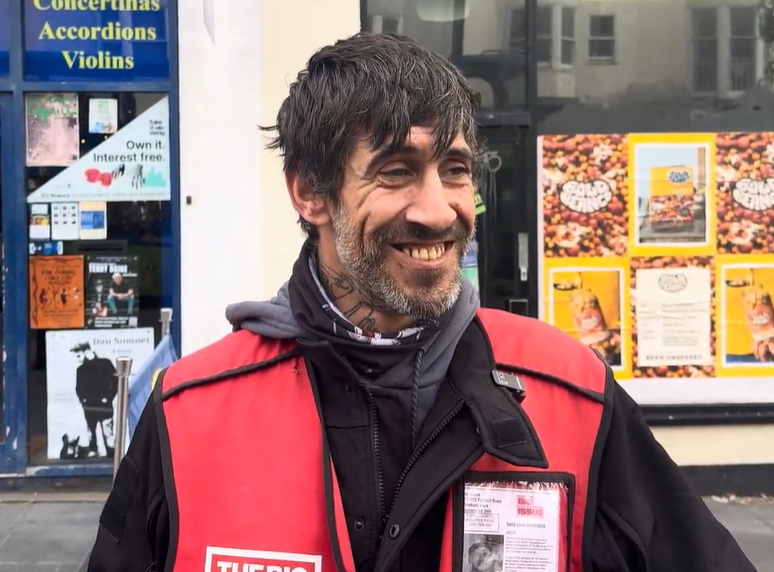
You’re homeless but you’re sober. You sleep on the street but you don’t drink or do drugs. This is the reality for Andy, who sells The Big Issue in Queen’s Road, near Brighton station.
You might have seen him among the crowds of tourists and commuters, flanked by his brown dog.
He said: “There don’t seem to be many options for the people that don’t drink, don’t do drugs.”
Andy is a former alcoholic. Yet, he said, the support offered to him by the council has repeatedly placed him in hostels where drug and alcohol use is widespread.
He said: “Their idea of trying to help me was to put me in a hostel full of degenerate alcoholics.”
Like many of the 3,500 homeless people in Brighton and Hove – a figure that includes those in emergency and temporary housing as well as scores of rough sleepers – Andy isn’t originally from Brighton and Hove.
Andy grew up in a care home in Jersey but felt that he had to leave the confines of the tiny island.
He said: “When I hit 19, I was like, I really want to better my life … I can’t do this in Jersey.
“Everywhere I look is a bad memory. To be yourself is impossible. You fart in Jersey, someone knows the smell of it before you even realise you farted.”.
People move to Brighton for a range of reasons: the nightlife, the LGBTQ+ community, the sense of freedom. Yet Andy said that the city’s reputation for tolerance doesn’t always extend to its homeless community.
There is often an assumption that homelessness and drug use always go hand in hand. And that influences how people treat Andy.
He said: “I get it all the time. People come up to me asking: ‘Where can I score dark and white?’”
That’s one of the street names for heroin and cocaine. And when he tells them that he doesn’t know, he’s met with disbelief.
According to Andy, they say: “You’re a big issue vendor … you all do drugs.”
This same assumption, Andy said, shapes the support that is offered to homeless people in Brighton and Hove, with most services geared towards people actively addicted to drugs and alcohol.
A range of hostels across Brighton and Hove provide washing facilities, hot food and support for rough sleepers. But Andy avoids them because of the drug and alcohol abuse that goes on in many of them.
He said: “As an ex-drinker, I felt more out of place and insecure sitting in one of them places than I would sitting in a sleeping bag in a doorway.”
It’s not just the lack of appropriate support services that makes it hard to be sober on Brighton’s streets. Andy also spoke about the social isolation that he felt when he quit drinking.
He said: “Now that I don’t do it (drink), you kind of realise how alone you are when you’re not drinking.”
Another Andy has heard the same story before. All too often. Andy Winter served as chief executive of BHT Sussex, formerly Brighton Housing Trust, for 37 years, overseeing the charity’s addiction and homelessness services.
Mr Winter said: “I think he’s 100 per cent correct. There is little understanding of addiction by some staff in the local authority … and the particular needs of people who are trying to come off alcohol and drugs”
Over the course of his career, Mr Winter worked with countless homeless people in the Brighton and Hove area. A recurring theme was the lack of tailored support for people who were trying to abstain from drink and drugs.
He said: “The majority of accommodation for them would be hostels where they were surrounded by people using and dealing or shared housing surrounded by people using and dealing.
“The statutory bodies in Brighton don’t like the concept of addiction. They like the concept of harm minimisation and controlled drinking.”
He paused.
“I think it’s idiotic because it doesn’t work.”
In response to the lack of alcohol and drug-free accommodation for people trying to stay sober, Mr Winter helped to establish a supported housing scheme specifically for those in recovery.
This project, run through BHT Sussex, provides stable housing and support, giving people a chance to rebuild their lives away from the chaos of street drinking and drug use.
But charities alone cannot solve the problem, he said. It requires a consistent and concerted effort from the government.
He pointed to the “everyone in” policy during the covid pandemic when the government funded emergency housing for rough sleepers across the country.
He said: “What covid demonstrated is that if there was a political will, you could move mountains.”
But when the pandemic ended, support did too.
He added: “Very often with government initiatives, they don’t think about the exit strategy – and people were cast back on to the streets.”
Andy, the Big Issue seller, experienced this lack of joined up government support first-hand when he moved to Brighton. He said that the council refused to house him.
He said: “Their exact words were: ‘You’re not an order of priority because of your clean and collected self.’”
In other words, because he was sober, they assumed that he could manage on his own. And it is this attitude, he said, that meant sober homeless people often slipped through the cracks.
Andy said: “If there were more services for the people wanting to get up, it wouldn’t be so bad in Brighton.”
Despite the struggles that Andy faces, he still has hope. When asked what he wanted for the future, he said that he wanted to help others in his position.
He said: “I would start a glamping site and have little units and use that for people like myself. Have it so that you have to stay sober, you have to make that effort.”
Brighton and Hove City Council were approached for comment.









These are facts,
Get both Andy’s to work together, the Power of these Two men will make all the difference within the City that’s for sure
Did Andy The Big Issue Seller say where he actually lives-as the Council try to put him in Hostels instead of a Studio or 1 Ned Flat
Hi Betty big issue andy here I am on FB Andrew sanguy .
I’ve always maintained, and proven through experience, that placing a vulnerable person in a vulnerable environment, like high-risk supported accommodation, or even a poorly managed low-risk accommodation, leads to safeguarding concerns. And from what I’ve personally witnessed, the commissioned services fail to be a safe haven for people; locking people into a vicious cycle of being stuck in for years, and in some instances even decades.
For those with addiction, they need specialist, wardened care. And there needs to be a better step-on method for those ready and able to move into independent living. Not everyone who ends up homeless is because of bad choices, after all. Sometimes, it is just because of bad luck.
Well said! Hope Andy gets back on his feet and doesn’t go back to the bottle.
Big issue Andy here I will never go back to the bottle.
Andy couldn’t be more right. Having lived next door to council emergency accommodation (aka money thrown at a slumlord on Seafield Rd) it was a chaotic hell hole. I don’t know how any one maintains their mental health and gets on the right track in these places. I really feel sorry for the sober homeless trying to get by in these situations. Best of my luck to you Andy
Can’t spend the money on homelessness im afraid. Too busy funding north African and middle Eastern illegal immigrants.