
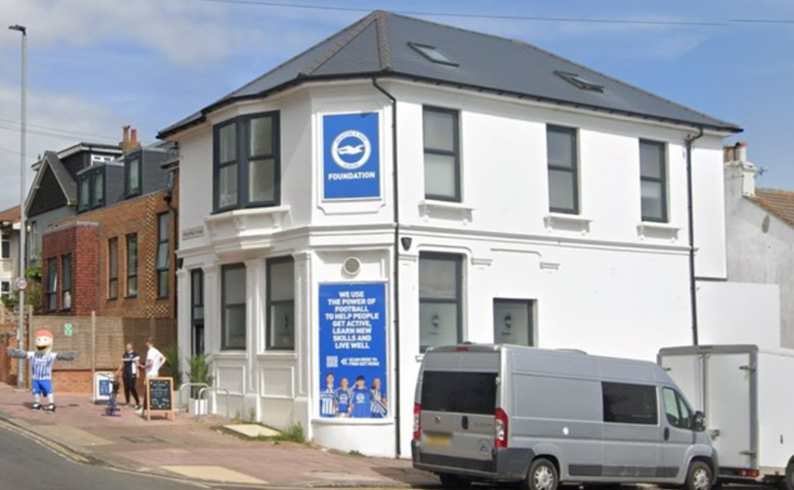
The owner of an old pub that was turned into flats, offices and the Albion Foundation community café has won an appeal to keep its plastic window frames and to paint them white.
The applicant had applied to have timber sliding sash windows and was granted planning permission for them – but fitted grey plastic UPVC window frames instead.
The plastic frames “detract from the character and appearance” of the Victorian building, previously the Cuthbert pub, in Freshfield Road, Brighton, according to Brighton and Hove City Council.
The planning team said that the plan to paint them white, “while lessening the current harm, would fail to deliver the high standard of design expected for new development affecting the setting of a heritage asset.”
When the Cuthbert closed in 2014, it became the first pub in Brighton and Hove to be listed as an “asset of community value”, offering a measure of protection from development.
But a community group had been unable to raise enough money to buy the pub.
Instead, Godfrey Investment Group Limited, owned by Brighton and Hove Albion vice-chairman Peter Godfrey, 77, submitted a planning application for a change of use in 2018.
The company was granted permission to build a three-storey extension and turn the premises into three two-bedroom flats, offices and a café.
It leased part of the building to the football club’s charitable arm, the Brighton and Hove Albion Foundation, which opened a community café on the site.
But a report by the council’s planning team said that some aspects of the conversion of the pub were not in line with the approved plans.
As a result, Godfrey Investment Group submitted another planning application, part retrospective, in December 2024. The key part of it related to the window frames.
The council said that its reason for refusing planning permission was: “The windows on the Freshfield Road and Cuthbert Road elevations of the former public house, by reason of their material, opening methods and method of finish detract from the character and appearance of the prominent building, harming the street scene and the setting of the adjacent Queen’s Park Conservation Area.
“The frames are chunky, dominant and top heavy, exhibiting none of the historic character and subtleties of timber sliding sash windows.
“Furthermore, the windows are dark grey and the proposed painting of these to a white finish, while lessening the current harm, would fail to deliver the high standard of design expected for new development affecting the setting of a heritage asset.”
Godfrey Investment Group appealed, saying that there were six properties in the conservation area with UPVC windows – and they had been in place for at least four years.
The company said: “It is difficult to understand why (the council) has placed such emphasis on the material of the UPVC windows, opening methods and the method of finish, detracting from the character and appearance of the appeal site and harming the street scene and setting of the Queen’s Park Conservation Area.
“This is because along Queen’s Park Terrace there are numerous properties where white UPVC casement windows are provided within the principal elevations.”
The appeal was granted and the “appeal decision” noted that the old Cuthbert was outside the conservation area but next to it – and other properties in Queen’s Park Terrace had UPVC windows.
The appeal decision said: “The installed windows may well be chunkier frames by the nature of the materials and opening methods.
“The stark colour contrast of the anthracite grey against the white render exacerbates their prominence.
“However, in mitigation, these would be painted white, utilising a specialist product guaranteed for 10 years.
“While I note the council’s concerns regarding longevity, there is no substantive evidence before me to show that treating the windows in this way would result in a poor appearance over time.
“Rather, I find that this would be a suitable mitigation to reduce their prominence and offer unity on the original part of the building.”
A condition was included that would require all the windows to be painted the same colour.







The standard grey windows, which match the same colour as the AirBnB property next to it, and match the roof colours, subjectively, provide visual coherence rather than discord. Painting everything white flattens articulation. You lose the depth of the render and shadow lines. Ironically, whitewashing the windows and façades arguably increases the prominence by being monolithic.
Makes you wonder why developers bother. UPVC has been around for decades, so why BHCC planners still seem to think it is a material that’s so evil is beyond me. Keep up! BHCC.
Benjamin,
Your comment overlooks the central issue in this case: this was never simply a debate about personal taste or “visual coherence.” The site sits immediately adjacent to the Queen’s Park Conservation Area, and the former Cuthbert pub is a Victorian building whose character carries weight in planning terms.
The council’s objection wasn’t about whether grey can ever look modern or coordinated. It was about materiality, proportion and historic character. Timber sliding sash windows have depth, fine glazing bars and traditional opening methods that contribute to the building’s architectural rhythm. The installed UPVC units are, by their nature, bulkier and flatter in detail. That difference isn’t subjective — it’s a recognised design distinction in heritage planning.
You argue that grey creates articulation and depth. In practice, the planning assessment found the opposite: the dark anthracite frames created a stark contrast against the white render, exaggerating their visual weight and drawing attention to their non-traditional form. The appeal inspector accepted that while the frames are chunkier, painting them white would reduce their prominence and create greater unity across the façade. That’s not “whitewashing for the sake of it” — it’s mitigation in a sensitive setting.
Matching a neighbouring AirBnB roof colour is not a heritage justification. Conservation considerations are based on preserving or enhancing character, not aligning with adjacent contemporary alterations. The presence of other UPVC windows nearby was noted, but “others have done it” is rarely a strong planning principle.
This decision wasn’t about flattening design — it was about balancing modern alterations with the setting of a heritage asset. Whether someone prefers grey or white aesthetically is secondary to that
Your comment persuades me of only one thing: we need to stop protecting heritage so much. Imagine posting such a wall of self-satisfied guff in furtherance of changing someone’s window colour against their wishes. “Traditional” is not a desirable characteristic.
How have we ended up in a situation where some wide boy can vandalise the tiles on a beloved local pub and nothing happens to him, but a material upgrade to a building (fitting modern energy-efficient windows which improve its appearance) draws so much official scrutiny?
That isn’t actually the point I was making, James. I wasn’t disputing conservation principles or material differences.
Is it a coincidence that a Godfrey Investment Group director is also the BAHFC chairman, and that the cafe is run by the BAHFC Foundation (a registered charity), which also has the chairman on the board?
Is it also a coincidence that the cafe itself has never really been run as a viable concern, with minimal ongoing promotion, and has been mostly closed…?
Could it be that the building is being lined up for a final conversion to flats once any commercial proposition has been “proven” to not be achievable? By the very people who always wanted it to be flats in the first place.
At least they were able to write any commercial losses off against their charitable foundation. A “charity” paid a commercial entity, run by the same directors, for a lease it never had a hope in hell of fulfilling. Something very circular is happening. Window frames are definitely not the story here.
It is such a shame that Brighton & Hove council are obsessed with preserving the look of old buildings. Most of the housing stock here could be vastly improved by fitting uPVC double glazed windows which would improve the health of residents and massively reduce their heating bills.
Not Benjamin couldn’t have put it better myself nail on the head opened a window into the corruption of BHCC! Bunch of bandits!
The key point here is that the building isn’t in a conservation area, it’s just next to one. From a planning perspective, that’s a big difference. If the council wanted to prevent “harming the street scene” they could have included that building in the conservation area. Or they could have put an Article 4 directive on it.
Also, this judgment implies that there are only two options: timber sashes or uPVC casements. There is a third option: uPVC sash windows. They are much slimmer than casements and virtually identical to original timber. In situations like this one, they’re a viable choice.
Full disclosure: I work for a sash window manufacturer, but we’re not retail, so this isn’t a sales pitch!