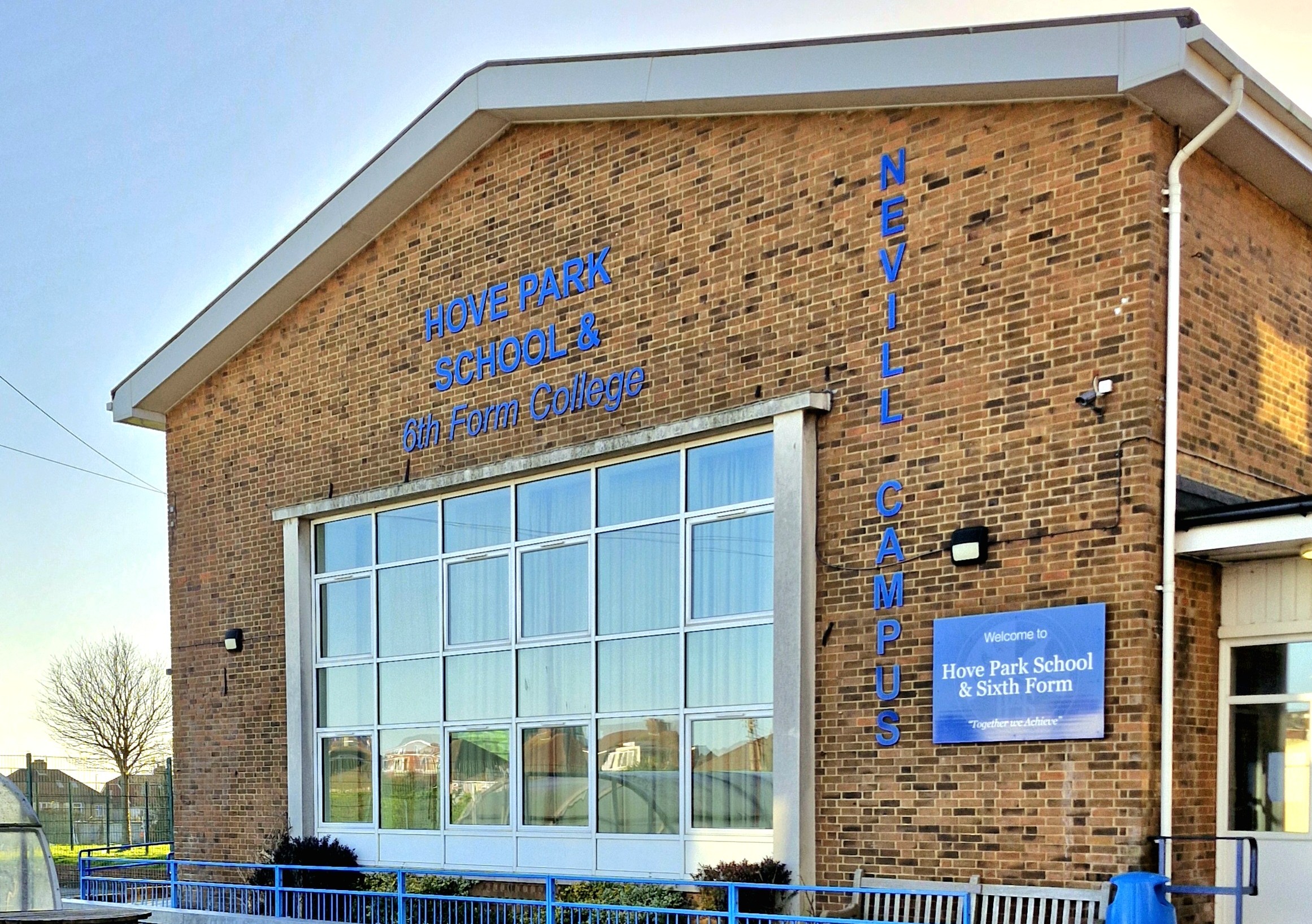
The official education watchdog Ofsted has highlighted persistent absence at a Hove secondary school in a report published this morning (Monday 23 March).
It said that exam results at Hove Park School dipped last summer. Provisional figures showed that just 34.7 per cent of pupils achieved grade 5 or above in English and maths GCSE, down from 46 per cent two years earlier.
The national average was 45.2 per cent last summer while Hove Park’s figure dropped from 46 per cent in 2022-23 to 41 per cent in 2023-24 to 34.7 per cent last summer.
The inspectors had praise as well, saying: “Inclusion is at the heart of the school’s work.”
They said that pupils tended to achieve in line with national averages in national tests but added: “Results in several areas were below national averages in 2025.
“This reflected significant changes to the cohort. The school has responded to this effectively.”
Ofsted said that attendance and behaviour “needs attention” – the second-worst out of the watchdog’s five new grades.
It said that this meant that the expected standards were not met but leaders were likely to be able to make the necessary improvements.
The report said: “Attendance is beginning to improve. However, it remains below national averages and persistent absence is still high.
“This affects disadvantaged pupils and those with special educational needs and/or disabilities most of all. As a result, too many vulnerable pupils miss important time in school.
“Leaders work hard to improve attendance. They track pupils’ attendance carefully and use this information to offer support to pupils and their families. This includes timely referrals to the local authority.
“When this does not have the intended impact, leaders consider different ways to encourage regular attendance. These actions are starting to make a difference.”
The overall absence rate was 12.9 per cent, compared with a national average of 8.1 per cent in 2024-25.
And the persistent absence rate – the percentage of pupils missing 10 per cent or more of their possible sessions at school – stood at 34.8 per cent, compared with 21.9 per cent nationally.
Ofsted said: “Leaders should continue to strengthen and embed their attendance strategies so that persistent absence reduces for disadvantaged pupils and those with SEND (special educational needs and disabilities), ensuring these pupils attend school more regularly and do not miss important learning time.”
The school achieved a strong standard – the second highest grade – for inclusion and post-16 provision. The report said: “Inclusion is at the heart of the school’s work.
“The school knows its pupils very well. Staff identify pupils’ needs quickly through detailed assessments when they join the school.
“They also identify pupils’ barriers to learning through a range of innovative approaches. This helps leaders to identify precisely the pupils who need extra support.
“They communicate this information clearly to teachers. Teachers know these pupils well and understand how they can best help them.
“The school meets pupils’ needs very effectively. The different levels of support are clear and staff understand them well.
“This helps all staff to support pupils with accuracy and confidence. The high‑quality training staff receive helps them to deliver this support consistently.
“Leaders work tirelessly to remove barriers to learning and wellbeing. The school uses additional funding effectively to support pupils who are eligible for pupil premium.

“Leaders have a detailed understanding of these pupils. They identify challenges through regular checks on pupils’ learning and development.
“The school has designed highly effective provision for pupils with the most complex needs. As a result, these pupils achieve well.
“The school uses alternative provision carefully and only when it is in pupils’ best interests. Leaders check the quality of this provision closely and make sure that external partners understand how to meet pupils’ needs well.”
On post-16 provision, the report said: “Leaders have designed a bespoke provision that meets the complex needs of a very small group of students very effectively.
“The curriculum is highly personalised. Each student has an individual programme that gives them a broad range of experiences and practical skills. This prepares them well for their next steps.”
Behaviour earned praise. The report said: “Pupils behave very well. They are polite and courteous and show high levels of respect to their peers and adults.
“Pupils have positive attitudes to learning. They concentrate well and listen carefully to teachers. This creates a calm and purposeful environment in lessons. It helps pupils take part in learning and contribute positively.
“Leaders understand that bullying can happen in different ways and make sure that bullying, harassment and discriminatory language are not accepted within the school.
“Staff build supportive relationships with pupils. These are shown in the warm greetings pupils share with staff each day. These relationships help pupils feel valued and cared for.
“Pupils who need extra help receive a range of support to help them return to learning and manage their emotions.”
The report also said: “Typically, the curriculum is taught well. Teachers explain learning clearly. They design activities that help pupils build on and apply what they already know.
“Teachers match these activities carefully to pupils’ needs. They know their subjects well and model accurate use of subject‑specific language.
“Teachers make regular checks on learning. These include formal assessments and skilful questioning in lessons. In most cases, these checks are appropriate and teachers can quickly identify and address misconceptions.
“However, some checks are not precise enough. As a result, the guidance teachers give does not always help pupils deepen their understanding.”
Ofsted added: “Leaders need to ensure that staff carry out precise checks on pupils’ learning in all subjects so that pupils’ next steps in learning are clearly identified and build securely on what they already know.”
The school has 948 pupils, with spaces for 1,664, and almost 37 per cent are eligible for free school meals. More than a quarter do not speak English as their first language and more than one in five receive special educational needs (SEN) support.
Parents of 103 year 6 children named Hove Park as their first preference when applying for a secondary school place in September.
This compared with 498 for Cardinal Newman Catholic School, 259 for Blatchington Mill, 218 for the King’s School and 163 for the Portslade Aldridge Community Academy (PACA).
To read the Ofsted report for Hove Park School in full, click here.







Well done to the school on their behaviour and inclusion. I know for most parents this will be the most important area to read. It would have been good to compare the attendance with other local schools to see how much this is a local authority issue, especially given the increase of SEND need across the city.
What an incredibly negative report on a great Ofsted. It’s like some kid getting a bunch of 7s and 8s in their GCSEs and the focus being on the single 5 they got. Why not explain how the new grade card works compared to the old single word rating?