Brighton and Hove City Council looks increasingly likely to expand to include Peacehaven and the whole of Falmer as a shake up of councils across Sussex edges closer.
But the cabinet minister in charge of the changes has put off making a final decision until the summer to allow for further consultation as he seeks a greater consensus.
The Labour leader of Brighton and Hove, Bella Sankey, welcomed the broadly supportive comments from Steve Reed, the Secretary of State for Housing, Communities and Local Government.
Mr Reed said that the Labour government remained committed to replacing the two-tier system across most of Sussex with new unitary councils like Brighton and Hove where one council provides all services.
He said: “We are still fully committed to delivering reorganisation in your areas with elections in May 2027 and changes coming into effect from April 2028.”
Mr Reed appears to be leaning towards an enlarged Brighton and Hove City Council that would include East Saltdean and Telscombe Cliffs, Peacehaven and the whole of Falmer.
East Saltdean and Telscombe Cliffs, Peacehaven and part of Falmer are currently served by Lewes District Council and East Sussex County Council.
The broader changes would include the creation of a new directly elected mayor of Sussex – similar to the executive mayors in places such as London and Manchester.
The elected mayors would work with a “mayoral combined authority” and would rely on the new unitary council areas – probably four in all – serving populations of about the same size.
Sussex has a population of about 1.8 million people while Brighton and Hove has fewer than 300,000. Even with the likely changes, the city council would serve about 308,000 people and be notably smaller than the government had initially proposed.
Councillor Sankey said: “We have a chance to make local service delivery in our region more effective and local growth more ambitious.
“We are pleased the government is supportive of Brighton and Hove’s approach to fit boundaries to how people work, live and travel.
“We welcome the government seeking greater consensus and compromise across Sussex as a region.
“This offers a chance to build sustainable, responsive and ‘connected to community’ unitary councils and reverse the previous decade of ‘managed decline’ of local government.
“When combined with newly devolved power and money to the mayoral authority, Sussex and Brighton have a chance to shape our own future, grow our regional economy and improve things for communities.

“We are also satisfied that government have confirmed today that we remain on track for new unitary elections across Sussex in May 2027 and vesting in May 2028.
“We are pleased that capacity funding will be provided to local authorities to implement final plans.”
Brighton and Hove City Council had proposed five unitary councils, all roughly a similar size, but this would have meant big changes to existing boundaries – known as disaggregation.
Ministers have been keen to keep to existing boundaries as far as possible, partly to save money and to enable the changes to happen as safely and smoothly as possible.
Mr Reed wrote to council leaders across Sussex today (Wednesday 25 March) saying: “On the five unitary, pan-Sussex proposal from Brighton and Hove City Council, I very much recognise the arguments made around the geographies suggested, in particular, balancing the distinct urban, rural and coastal communities in the areas.
“However, I have concerns around the costs associated with implementing this proposal and we are concerned about the disaggregation risks this proposal carries.
“Specifically, I am particularly concerned about the risk to vulnerable service users as a result of disaggregation during the implementation phase as there was a lack of joint working on the proposal.
“I feel the two-unitary proposal for East Sussex and Brighton from East Sussex County Council, Eastbourne Borough Council, Hastings Borough Council, Lewes District Council and Rother District Council has some positive strengths, especially in relation to the service delivery of the new authorities.
“However, I have significant concerns about keeping Brighton and Hove on its current footprint.
“Both my ministers and I have been forthright in our ambitions to leverage the power of local government reorganisation to support economic growth and design public services that respond to residents.
“A key component of this is facilitating the growth of smaller cities such as Brighton and Hove.
“By keeping Brighton and Hove on its current boundaries the two-unitary proposal limits opportunity for future economic growth in the city as well as the ability to build new homes there.
“By binding Brighton and Hove into its current geographies, we limit the city’s future potential as a key economic engine on the south coast and do nothing to combat the issue of Brighton and Hove’s high affordability ratio.
“The proposal also fails to adequately address the financial stability of councils and we understand that this reflects the representations made to the department in your previous submission letters and consultation responses.”
Mr Reed also wrote: “In West Sussex, I would like to seek further views to ensure that the proposals reflect the distinct communities and identities in the area while maintaining balance under the mayoral combined authority.
“The consultation revealed a concern that the two unitary proposal risks diluting the rural identity and economic profile of areas like Chichester by grouping them with coastal districts.
“I note that there was also some support from Adur and Worthing for the concept of a coastal unitary which could focus on specific coastal challenges and local needs.
“I also received representations from other government departments that Chichester should be placed with Horsham as it would be a better fit in terms of needs and demographics rather than placed with Worthing, Adur and Arun.
“I would therefore like to understand views on whether there would be appetite for this at a local authority level.”
Mr Reed added: “To be clear, I have not reached decisions on which proposal/s, if any, to implement. I am, however, considering modifications that could address my concerns.
“I have attached an option for potential modification of the proposals to this letter for your consideration.
“This would see four unitary councils for Sussex and involves modifying the West Sussex proposal for two unitary councils so Chichester was no longer part of the coastal unitary but was instead part of the inland unitary and modifying both East Sussex and Brighton and Hove proposals so as to expand Brighton and Hove as requested by Brighton and Hove (and in consequence reducing the size of the East Sussex unitary).
“These will form the basis of a further technical consultation where I will seek views on the options for potential modification, carried out on a condensed timeline after the local elections.
“I do not take this decision lightly and I know that this will be a disappointment given you were expecting decisions.
“I would like to reassure you that we are still fully committed to delivering reorganisation in your areas with elections in May 2027 and changes coming into effect from April 2028.
“I fully recognise the need for clarity on the future of local government in East Sussex and Brighton and Hove and West Sussex.
“My officials will be in touch to support all councils and provide more information on next steps.
“I look forward to continuing to work closely with you to deliver the vital improvements that reorganisation can facilitate.”
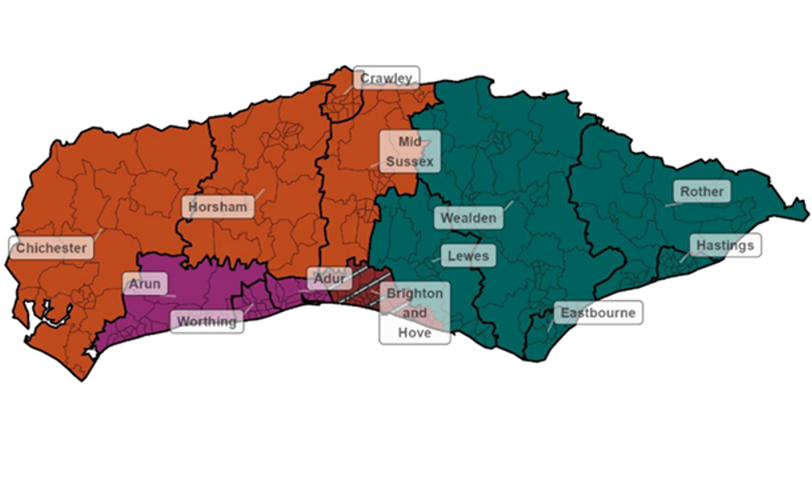
The option subject to the upcoming consultation consists of four proposed unitary councils.
Unitary A – Eastbourne, Hastings, Rother, Wealden and the remaining parts of Lewes. The population would be about 478,000.
Unitary B (coastal) – Arun, Adur and Worthing. The population would be about 437,000.
Unitary C – Brighton plus the following wards and parish from Lewes (as requested): East
Saltdean and Telscombe Cliffs, Peacehaven West, Peacehaven East, Peacehaven North and Falmer Parish (from Kingston ward). The population would be about 308,000.
Unitary D (urban) – Crawley, Chichester, Horsham and Mid Sussex. The population would be about 537,000.








There was practically know one in the Telscombe Peacehaven area that wanted to be part of Brighton and Hove . They seem to be incapable of looking after themselves let alone taking more on .As usual the people’s wishes are being totally ignored. No wonder this government are in disarray and likely to be decimated in the coming elections.
Spot on. Peacehaven anf Falmer would not benrfit from joining Brighton. Just looking for a place to expand into without infrastructure.
However, it does significantly loses from leaving it. I think what hasn’t been well articulated is how much Telscombe and Peacehaven get currently from Brighton.
Telscombe and peasehaven only exist because of Brighton… It’s just some bins mate lol
JT will be delighted to send kids from Hove to school in Peacehaven!
J.T. doesn’t give a monkeys about kids all he cares about are sound bites, posh beach clubs in Hove, agreeing with BS annd her campaign to become an MP and telling everyone how wonderful him and his party are. And by the time the decision gets agreed he will hopefully be voted out.
This is just another example of not listening to what the people want and telling everyone what they want.
No one want’s to be part of B&H.
The city and it’s council is rotten to the core.