
Review: Bach’s St John Passion – Brighton Festival – 4th May 2026
Confession first: as a relative newcomer to Baroque sacred music, the prospect of two and a half hours of Bach’s St John Passion might have sounded more worthy than enthralling. But this bold staging at Brighton Dome Concert Hall proved unexpectedly spellbinding, an ambitious, emotionally rich performance that transformed a 300-year-old magnum opus into something vivid, communal and strikingly alive. Brighton Festival’s ambitious exploration of this centuries old work, was a vast, immersive and often mesmerising reimagining of one of Western music’s great sacred masterpieces.
At its heart, St John Passion dramatises the arrest, trial and crucifixion of Christ through the lens of the Gospel of John, a story of betrayal, grief, persecution and redemption. It unfolded with theatrical immediacy. Tenor Nick Pritchard’s Evangelist acted as strong, narrative guide, propelling the audience through the unfolding drama, while a varied ensemble of soloists brought humanity and emotional depth to the biblical figures and witnesses surrounding Christ’s final hours.
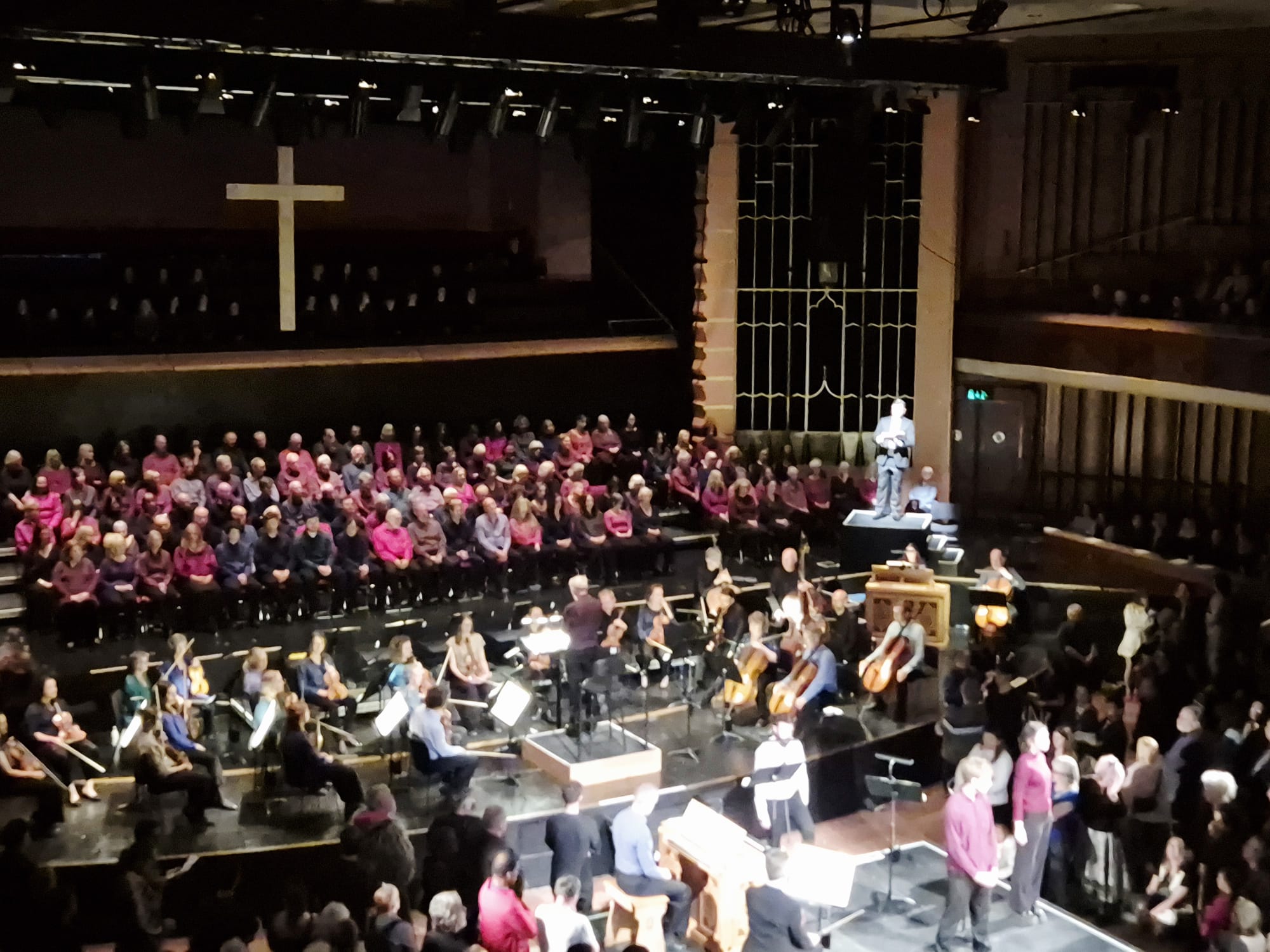
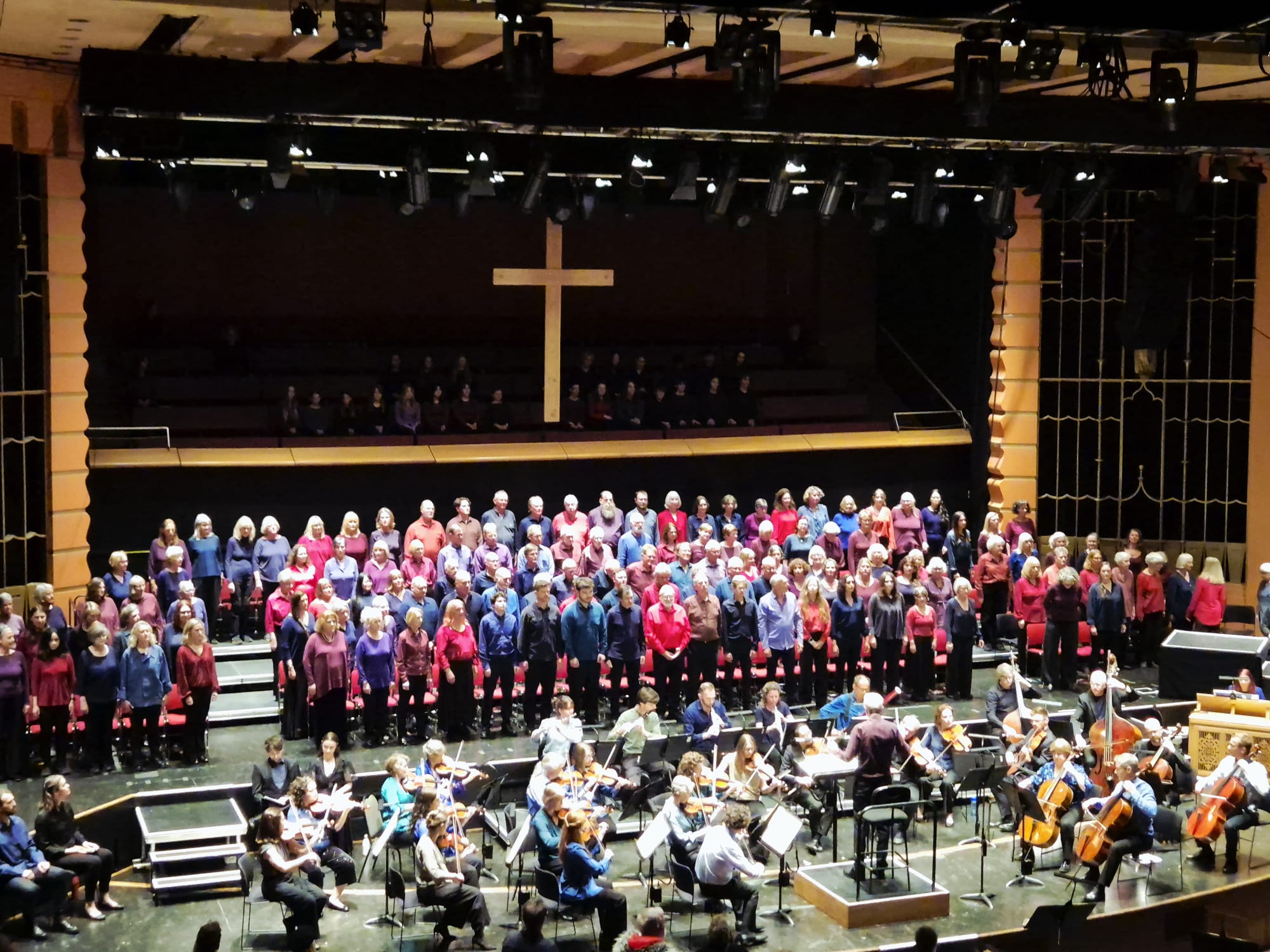
Performed by Britten Sinfonia alongside Brighton Festival Chorus and Brighton Festival Youth Choir, this contemporary English-language interpretation, directed by James Morgan, dissolved the usual boundaries between stage and audience. A packed concert hall became part of the performance itself, with choruses moving through the space, singers performing from memory, and audience members joining in the chorales, an unusual and unique invitation into Bach’s monumental work.
Musically, the scale was breathtaking. The great opening chorus dizzying in its repeated cries of “Lord and Master”, set the tone for an evening that moved between intimate reflection and overwhelming collective force. Particularly striking was the interplay between larger orchestral passages and smaller chamber-like instrumental groupings, allowing moments of delicacy and intimacy to emerge from the grandeur.
For those less steeped in Baroque sacred music, the prospect of a two-and-a-half-hour Passion setting might suggest solemn duty rather than emotional immediacy. Yet what unfolded in a packed Concert Hall was anything but austere. Received by an enthusiastic audience, the music functioned as theatre, ritual, and collective experience: expansive in scale, architecturally complex, and charged with extraordinary feeling.
Composed by Johann Sebastian Bach and first performed in 1724, St John Passion dramatises the arrest, trial and crucifixion of Christ through the Gospel of John. Written originally for Good Friday worship in Leipzig, it remains one of the defining achievements of Baroque sacred music, that is a work that moves through religiosity, betrayal, fear, brutality, grief and redemption with astonishing dramatic force. The familiar boundaries between performers and audience were deliberately dissolved, creating something far more immersive and communal.
Translated from German into English in the 19th century, the text gained immediacy and clarity, bringing renewed resonance to themes of suffering, persecution, compassion and sacrifice. Whatever the audience’s faith or lack of it, the emotional and moral force of the work remained unmistakably human and more easily accessible to modern audiences too.
One of the most striking elements of the evening was movement. Performing entirely from memory, the chorus was never static. At times massed on stage in glorious force, at others dispersed throughout the auditorium, voices rose from different corners of the hall, surrounding the audience in sound and transforming the space into something almost architectural, a living chorus in the round. Chorus became crowd, witness, conscience and congregation all at once.
That sense of immersion extended beyond the performers. Community choirs and audience participation in the chorales created an unusual collective dimension, turning what might easily have remained a reverential presentation of canonical music into a shared act of storytelling. It was an ambitious and quietly radical choice, opening a masterpiece often treated as rarefied high culture into something participatory, democratic and vividly alive.
Musically, the scale was breathtaking. The chorus built a dizzying, majestic intensity that established the emotional tone for the evening: urgent, turbulent and spiritually expansive. Thereafter, Bach’s extraordinary architecture unfolded in waves moments of overwhelming grandeur giving way to passages of exquisite intimacy.
Particularly compelling was the interplay between larger orchestral forces and smaller chamber groupings. A more intimate ensemble would peel away from the main body to accompany solo voices with delicacy and precision, offering contrast and breathing space amid the larger dramatic surges. Two harpsichords threaded brightness and propulsion through the score, while the strings moved seamlessly between agitation, tenderness and aching lyricism.
At the centre stood the character of the Evangelist, narrating events with clarity, intelligence and emotional sensitivity. Through his telling came Judas’s betrayal, Peter’s denial, Pontius Pilate’s judgement and Christ’s final journey to Golgotha. Around him, an impressive cast of young soloists including Benjamin Schilperoort, Edward Grint, Lauren Lodge Campbell, Helen Charlston, Bastien Rimondi and Olivier Bergeron who brought freshness, conviction and emotional depth, many drawn from the celebrated French ensemble Les Arts Florissants and its acclaimed young artists’ academy, Le Jardin des Voix.
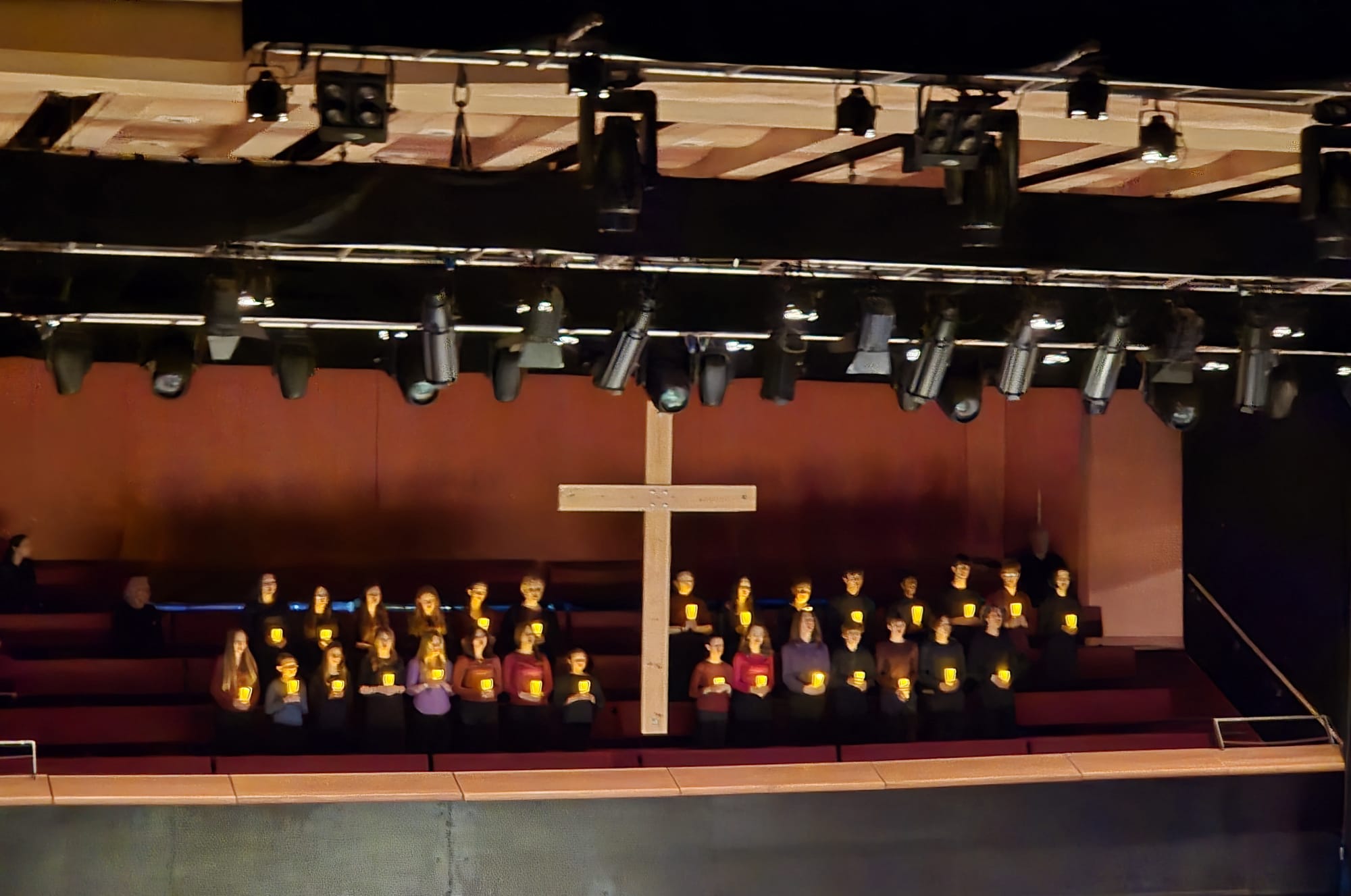
Equally striking was the prominence of younger voices throughout the production. The contribution of Brighton Festival Youth Choir brought vitality, warmth and a sense of renewal, a reminder that this centuries-old work still speaks powerfully across generations.
If there was a challenge, it was the scale of the undertaking. At two and a half hours, this is demanding work for performers and audience alike, with multiple logistics for such a large piece to factor in, let alone the musical focus. Such length is inherent in a work originally intended to flank a sermon rather than fit modern attention spans. Yet even when concentration drifted (partly due to lack of leg space), Bach’s astonishing musical architecture, and the production’s imaginative staging, continually pulled attention back.
The logistical complexity of the evening was immense: multiple choirs, shifting staging, layered lighting, moving performers, audience participation (sometimes wonderful, sometimes less so), intimate chamber textures and full orchestral grandeur, countless moving parts held together with remarkable coherence. Lesser productions might have buckled under such ambition. This one largely soared.
What lingered afterwards was not solemnity so much as awe, at the scale, the ambition, and the emotional force generated by hundreds of voices and musicians working in extraordinary concert. Three centuries after its first performance, St John Passion remains overwhelming in its power. In Brighton, it also felt urgent, inclusive and startlingly present, ancient music made vividly alive for a modern city.
St John Passion, Brighton Dome






I missed the second half as my arthritis was playing up.
Thank you for expressing so much of how I felt about last night – the wonderful experience of being immersed in beautiful music and a theatrical event, especially the crowd thronging menacingly around Christ and Pilate in the second half.