
Work is due to start next week to extend beach and protect the coastline.
A scheme to protect a key part of the shore from erosion and flooding will enter the next phase.
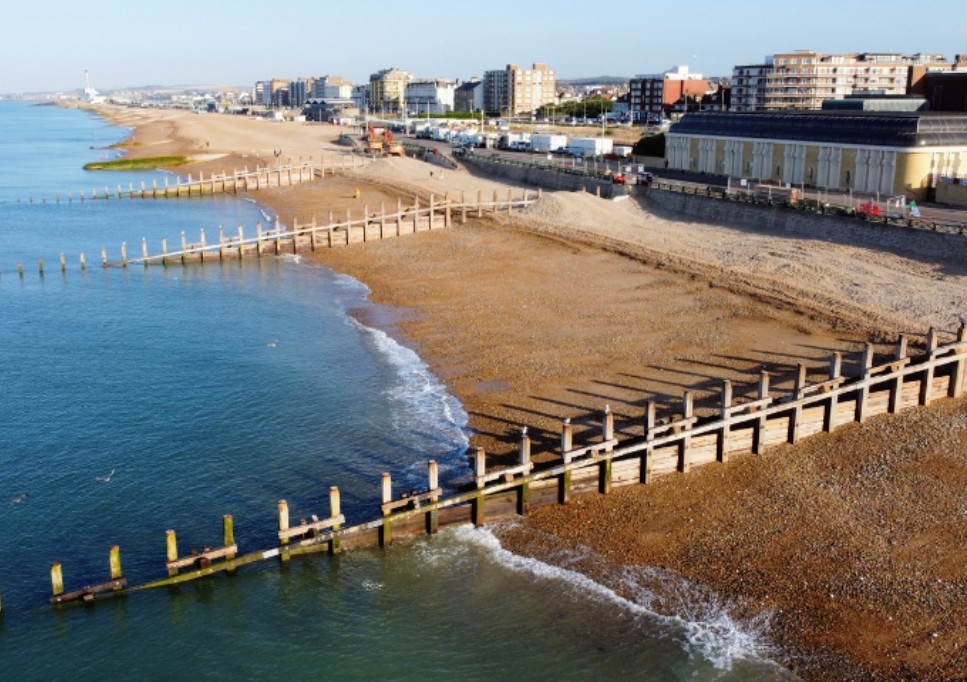
Work is scheduled to begin on Monday 3 August to fill the new groyne field in Hove with thousands of tonnes of shingle.
Taken from a licensed dredging site in the English Channel, the shingle will be pumped between the groynes using a large dredger, about 700m offshore, with support vessels and safety boats protecting the area and assisting.
The new shingle will extend the beach between the King Alfred Leisure Centre and Second Avenue by around 25 metres out to sea.
Helping to protect the area from flooding and coastal erosion, the larger beach will also reduce the amount of shingle washing up onto the promenade, like we see during storms and windy conditions.
The work is scheduled to take around 4 weeks and needs to be done around high tide. During the work, this section of the beach will need to be closed to keep everyone safe.
Work to construct nine new timber groynes has been taking place since the start of the year.
They’ll become largely buried beneath the replenished beach, with only the upper sections remaining visible.
Councillor Trevor Muten, the council’s cabinet member for transport and city infrastructure, said: “This is a really exciting phase of the scheme. It’s going to be great to see the barge offshore and the new shingle being pumped onto the beach
“The completed groyne field is going to ensure the homes and businesses here are better protected from climate change, rising sea levels and storms.
“We’ve seen for many years the impact storms can have, with tonnes of shingle washing up onto the promenade. This will help massively to reduce that and keep the prom accessible for everyone.”
Joris Jipping project manager Van Oord said: “We are proud to work alongside Brighton and Hove City Council on a scheme that will make the Hove seafront safer, stronger and better prepared for the future.
“The new groyne field and shingle recharge will not only help reduce flood and erosion risks but also enhance the beach for residents and visitors to enjoy.”
Before the work starts, the Brighton Marina to River Adur Coastal Defence Scheme project team is partnering with Leave No Trace Brighton to host a community beach clean on Tuesday 28 July from 7.45am.
Members of the public are invited to come along and help out the project team and Leave No Trace volunteers.







Absolute madness to close the beaches in the middle of a summer heatwave. Only Brighton Council could manage such an own goal.
Summer has typically lower wave heights and more predictable tidal patterns, which helps to ensure precise pumping of shingle between the groynes.
“Summer has typically more predictable tidal patterns” No it doesn’t. Tides are accurately predicted decades in advance regardless of the season. Reference the admiralty.co.uk FAQs.
Yes, it does. You’re referring to the underlying tidal mechanism that is constant and predictable, the actual tide heights and timing we observe at the coast can vary due to meteorological and oceanographic factors, and is more predictable in Summer.
Either way, Stephen claiming it is “absolute madness” is probably an overreaction in the grand scheme of things.
No it doesn’t. The pattern of the tide is entirely predictable. I think you are referring to events such as storm surges and fluvial events impacting local water levels as though they change the tide, which they don’t. They may however effect the underlying (average) water level about which the tide varies. Much as the waves you referred to separately in your initial reply aren’t part of the tide. You are correct that these additional factors are more likely in the winter. However, It’s important that people living in a coastal community understand that the tide is reliable, and that other characteristics occur due to specific factors; heavy rainfall, strong wind in certain directions, low pressure. Mixing these together and saying the tide is unreliable throughout the winter does not enable people to separate cause and effect and interact with the sea in an informed manner.
The variation in water level will be a second order effect on the ability conduct these marine operations compared to the wind and wave conditions.
…and is more stable in Summer, because that makes Stephen’s claim that it is “absolute madness” to do this that kind of work in Summer, probably an overreaction.
Seems good news. All is going to plan. Compared to the king Alfred it’s swift and decisive.
You’d rather have a dredger flinging shingles at people’s head’s lol love the visuals on that
Protect the new King Alfred development, more like. Why else add 25m to length of beach on this area compared to the rest?
“Helping to protect the area from flooding and coastal erosion, the larger beach will also reduce the amount of shingle washing up onto the promenade, like we see during storms and windy conditions.”
You really need to learn to read the article.
He’s jumped on Tracy again. You must have plenty of free time Benjamin.
No, it’s just her usual asinine comments take no time to point out the flaw in them.
Tracys a bit thick innit
If you want ‘asinine’, just read Muten’s comments.
He does love a speech, our Muten.
New beach and new King Alfred will be the perfect combo!
This is a really good project, and the work will continue all along the Hove coastline, including the Port Authority section that links Hove Lagoon with Shoreham Harbour’s eastern arm.
Work has already started within the Port coastline on Basin Road South, adding new groynes, and remodelling the existing sea wall.
This coastal defense work is best done in summer because the longer daylight hours allow workers to better deal with the fluctuating tides – or water levels.
We have so many beach sections that I don’t see this work disrupting most people’s access needs. For sure you may need to walk a bit further for your sunbathe or swim, but contractors can only work on one section at a time. The engineering work is generally done at mid to low tide, whereas most people I know prefer to swim at high tide.
The prize, at the end of this project, is we’ll have bigger, broader beaches. The hope is that the shallower shelving of the shingle will then lead to a less abrupt shore break wave – meaning safer entry into the water, and an easier exit.
The new groynes also reduce the perpetual eastward longshore drift of shingle.
Have less shingle on the prom after a winter storm is a further benefit.