
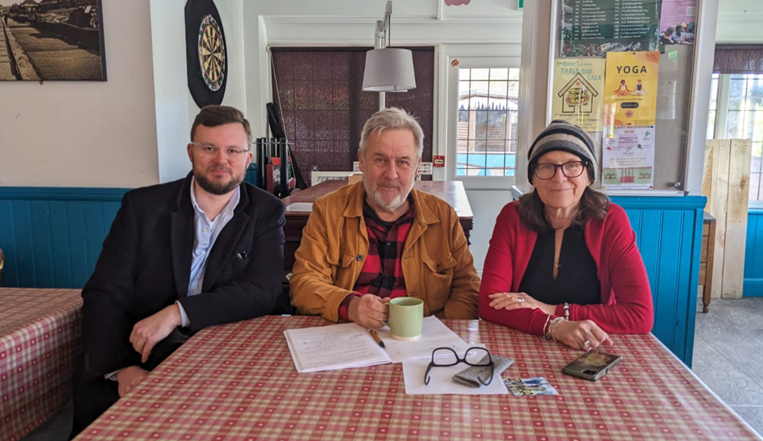
Three councillors have criticised plans to bring in communal bins along a steep-sided narrow road used by buses in their ward in Brighton.
The ward councillors also plan to call a public meeting as Brighton and Hove City Council officials push ahead with a proposal that they say is driven by health and safety concerns.
Councillors Ty Goddard, Amanda Evans and Jacob Taylor issued a statement in the past week as residents accused the council of going ahead with the proposal, which had been paused, even though a complaint was with the local government ombudsman.
The council plans to site two 1,100-litre rubbish bins in Auckland Drive, Bevendean, and two mixed recycling bins the same size – to be emptied several times a week.
One or two 240-litre glass recycling bins would also be placed in the road – which is on the 48 bus route – to be emptied fortnightly along with a food waste bin.
The Labour councillors’ statement said: “From the beginning of this process, we have let the (council) know how residents feel about the proposed change.
“We opposed communal bins in Auckland Drive and continue to do so.
“It has been made clear to us that this is an officer decision, based on their view of their legal and health and safety responsibilities as an employer. It is an operational decision driven by officers, not a policy one.
“Our Labour team are community champions, working hard with residents to improve our area – from the 48 bus (to) parking issues outside Bevendean Primary School and vans at The Avenue entrance.
“Our regular surgeries and casework over the last three years are there to support residents as well.
“And we will continue to support residents on this proposal – including bringing officers to a public meeting where all voices, including older and vulnerable residents, can be heard.”
A website for residents, called Auckland Drive BinGate, said that “expert safety warnings” had been played down.
The website said: “The council’s own highways team warned that placing large bins in the live carriageway could create ‘hazards’ and ‘obstructions’ including the risk of the road being blocked and poor night‑time visibility.”
It said that, despite this, the council’s environmental services team continued to favour communal bins, replacing 96 individual household bins.
And while the council identified health and safety risks affecting staff at the moment, the BinGate campaigners called for a solution that was safe for everyone including residents, pedestrians and bus passengers.
There have also been suggestions that the council may have exaggerated the health and safety argument, with just two minor incidents recorded in 10 years. The detail emerged in a response to a freedom of information (FoI) request.
The council had also proposed phasing out assisted collections for residents who needed help but officials have since said that those who need an assisted collection “will be provided with one”.
The decision to bring in communal bins in Auckland Drive was, according to a timeline on the BinGate website, taken in secret in August last year after a health and safety audit almost a year earlier.
Under the council’s cabinet system, only “key” decisions are now made in public – those that involve a proposal to spend or save £1 million or more or decisions that are likely to be significant in two or more electoral wards.
Previously, many more decisions were discussed in public and taken by committees of councillors, giving residents the chance to have their say beforehand.
Auckland Drive resident Dominic Leslie said: “Residents should not have to accept a street that looks like a dumping ground because a service that has operated for years suddenly becomes too inconvenient to provide.
“Communal bins invite fly-tipping, reduce already scarce parking and shift the burden of doing the bin crews’ job on to local people.”
Bevendean resident Kendrick Tugwell criticised the council for going ahead with its proposal while the community was awaiting a decision from the ombudsman.
Mr Tugwell said: “We’re not against bins. We’re against unsafe and unfair decisions.
“Communal bins in the road might be convenient for the council but they could block traffic, take away precious parking and make life harder for older and disabled neighbours.”
The council said: “We are planning to introduce communal bins in Auckland Drive. This is an operational decision as part of our ongoing work to address collection rates and health and safety in the area.
“The proposals were recently revisited but plans have taken into account feedback from our earlier consultation with residents.
“We are currently finalising proposals but will continue to engage with impacted residents and provide further information ahead of the change to communal bins.”







I might be wrong but as councillors in the administration, surely they can tell officers to stop this proposal. It’s a bit like we agree it, then there is a public outcry and now we are the saviors to stop it.
Yep – and with local elections less than 9 months away, and Labour councillors losing multiple recent by elections, I can’t help but think there is a bit of self-interest in Labour councillors trying to separate themselves from council decisions.
It’s not a good look for councillors to be critical of officers like this though, especially when, like you point out, it is councillors who ultimately decide council policy.
I think the 3 councillors should go out on that bin round and see how absolutely insane the current situation is for bin crews, maybe a day when it’s raining. Then they might actually side with the bin men on this one. Do people really think a bin man is going to fill in an accident form every time they slip over…
Just because something has been done wrong for many years does not mean it should carry on like that.
I don’t understand Mr Tugwell’s assertion that communal bins block the road, when they take equivalent space of a car parked?
> I don’t understand Mr Tugwell’s assertion that communal bins block the road, when they take equivalent space of a car parked?
Cars don’t have mattresses and building rubble piled alongside them. Also cars tend to be lower and don’t block the sight lines on corners like the bins do.
I see you ignore his other points: “take away precious parking and make life harder for older and disabled neighbours.” It is especially that latter point that is the most unfair. Instead of fit binmen doing their paid job they expect elderly people to walk long distances with binbags whilst still paying council tax for a bin collection that people in the posh houses get door to door.
This is nothing to do with H&S. It is to do with cutting corners on bin collection. Removing the time it takes to pickup individual bins with a full crew, as we all pay for. Instead sending out a cart to pickup a couple of bins twice a week. Its all about the money.
My assertation are based on 2 things:
– Feedback from Brighton and Hove City Councils Highways Department. In their own emails and documentation: https://bingate.bevendean.info/wp-content/uploads/2026/08/Options-table-updated-1.7.25-REDACTED.pdf
– Being a frequent driver of roads like Upper Lewes Road, and Viaduct Road.
I’m reading one reference to road blockages in that document:
“Road could be blocked IF they parked on the opposite side of the road [of the bin].”
Which is the same case if a car parked opposite to another car. Is that, plus your personal experience, not just an argument for double yellows on one side of the road, rather than against communal bins specifically? I say that because the same risk exists, even if you were to remove the bin element from the potential.
I agree that a car parked opposite another car can also create an obstruction. The concern is that permanently placing large communal bins in the carriageway reduces the available room on a road that the council’s own Highways team already described as tight for two-way traffic, with a narrow bus-route section.
The Highways comments also refer to obstructions, night-time visibility and the risk of cars parking opposite the bins. Those points need a proper answer, rather than simply being dismissed.
But the parking and road-access issue is only one part of a wider problem. Residents are also concerned about access for older and disabled people, the loss of individual collections, the alternatives that were considered, and whether residents were given clear information and a meaningful opportunity to influence the outcome.
The point of BinGate is not to argue that communal bins can never work anywhere. It is to ask whether this particular scheme, on this particular road, has been properly assessed and handled fairly.
I’d gently suggest that by the virtue of that very document existing, we can see several options, including no action, has been fairly assessed.
The reasoning still doesn’t make sense to me, because the introduction of a bin makes no meaningful difference to navigating the road, and the risks you described still exist without a bin, and are not made worse by one.
Individual arrangements don’t typically change with communal bins, but it’s a reasonable question to have answered for assurance.
I accept that the document sets out several options, including no structural change, and I am not claiming that nothing was considered. My concern is that the existence of several options does not, by itself, demonstrate that the process was fair or that the preferred option was properly justified.
The parking and navigation point is only a small part of the wider issue. The concern is not simply whether a bin makes the road harder to navigate, or whether the same risks might exist without one. It is also about the practical consequences of changing from individual collections to communal bins, including access, the effect on older and disabled residents, the loss of parking, the suitability of the proposed locations, and how residents were consulted and informed.
So the question is not just whether the scheme can technically be made to work. It is whether this particular scheme is appropriate for Auckland Drive and whether the rollout has been handled transparently, with residents’ concerns properly considered before decisions were advanced.
The parking concern is therefore one example of a wider problem, rather than the entire argument.
If you visit the site and look at what the internal emails say about assisted collections. They were fully planning on removing them from the street. I have since had it in writing that that’s not the case. Without bringing those emails to light, would those that require assisted collections had them removed? Maybe. We’ll likely never know.
The document does fairly consider the pros and cons of each option from several perspectives There’s also the consultation process that’s happened in parallel to fairly consider, so I would kindly suggest that it does justify.
I would kindly suggest that assisted collections is a red herring when we are talking about the road being blocked specifically, which was my initial question. Moving onto that one, there’s nothing to suggest that assisted collections are impacted by the introduction of communal bins at all, because they work across the city already and have done so for many years in far more complicated areas.
They wouldn’t have removed assisted collections, because they’d be unlawful to do so. Difficult to speak further on an internal email without the context behind it, but I suspect an intention doesn’t translate into a viable action, in this case. It’s good that you had this clarified.
Communal recycling doesn’t work.
Data from the Environment Agency proves it’s so bad that adding pots and trays resulted in less plastics being recycled
Useless
“According to the latest data from the Department for Environment, Food and Rural Affairs, the achieved recycled or recovered rate for plastic packaging increased from 25.2% in 2012 to 51% in 2024.”
Duh plastic pots added mid 2025
Get a grip of the latest data Benny by writing to the Environment Agency……..
You are the most annoying reactive on here that just can’t be bothered to think before pressing send.
The latest Defra dataset is from July 2025.
A public meeting to discuss moving some bins? Doesn’t Deputy Leader Taylor have the power to just do this???
Or is it a case of “Quick! Look busy! There’s an election coming up!”
Funny how they won’t have public meetings about anything controversial or important, just subjects that most people already agree on! Horrifying that Council officers appear to be allowed to make any decision under £1m. This just goes to show how poor scrutiny is and how the cabinet is failing tax paying residents.
A public meeting to discuss bins? Doesn’t Deputy Leader Taylor have the power to just do this???
Or is it a case of “Quick! Look busy! There’s an election coming up!”
Funny how they won’t have public meetings about anything controversial or important, just subjects that most people already agree on! Horrifying that Council officers appear to be allowed to make any decision under £1m. This just goes to show how poor scrutiny is and how the cabinet is failing tax paying residents.
They’ve had plenty of meetings about controversial and important things, such as development in Rottingdean, High-rises in Whitehalk, King Alfred in Hove, to name a few recent ones.
A public meeting about bins? Is Assistant BH Council Leader Jacob Taylor honestly suggesting he is controlled by the whims of Council Officers over bins?
Many of us are still waiting for the public meeting to discuss the £65m King Alfred redevelopment which the council declined to hold. Can he make this happen too?
Nor were we offered an exhibition with scale models this time to demonstrate where our money is going.
No-one is building you a Lego model of the King Alfred, Tracy.
One must admire Councillor Taylor’s extraordinary versatility. Deputy Leader of the Council by day; plucky campaigner against the Council by evening.
Apparently the bins are nothing to do with the administration at all, but an “operational decision driven by officers”. How terribly convenient. One had always imagined that being Deputy Leader involved rather more than observing one’s own council from a safe distance and issuing statements of concern when it does something unpopular.
Still, I am delighted to learn that a public meeting can be summoned over four communal bins. Residents awaiting similar democratic enthusiasm over rather larger matters – perhaps involving £65 million and the King Alfred – may wish to take note.
Lady Bracknell has long suspected that local government contains a great many bins. Until now, she had not realised quite how many of them were capable of passing the buck.