
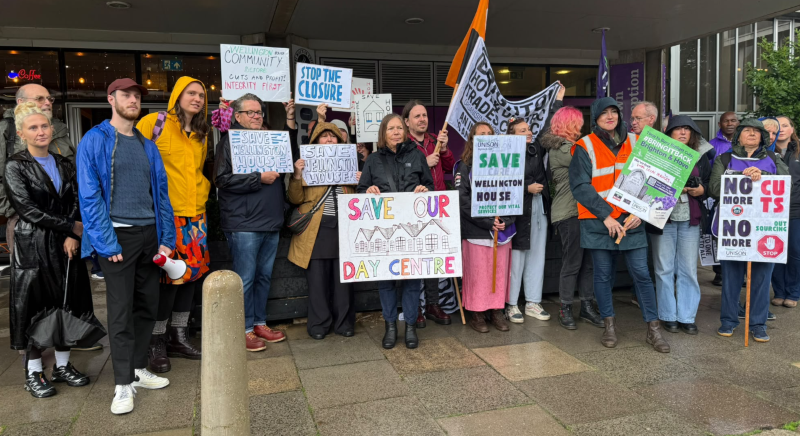
Senior councillors have agreed to close Wellington House day centre, in Brighton, although no date has been set yet.
The decision was made by Brighton and Hove City Council’s cabinet, affecting 21 of the most vulnerable adults in the area.
Dozens of parents, carers and union representatives protested outside Hove Town Hall before the cabinet met today (Thursday 17 September) in a final attempt to stop the closure.
The council aims to save £336,000 – less than the £400,000 a year that it budgeted – by moving 19 of the 21 clients to day centre services run by independent providers.
Two people are expected to move into full-time supported accommodation.
Green councillor Raphael Hill spoke against the closure, describing Wellington House as a community offering a lifeline for families.
Councillor Hill said: “This is a community that is cherished by extremely vulnerable people who’ve struggled at other similar services and found a home away from home there.
“The relationships that make the community that is Wellington House aren’t relationships you can just end and then expect service users to adapt easily to totally different relationships.
“If it is the case that dignity for these people is the priority then I would ask that you listen to the families of service users who are protesting this decision today.”
Labour councillor Mitchie Alexander, the council’s cabinet member for adult social care, said that she had visited alternative providers and saw the same level of love and care offered to the people using those services.
She said that the proposed closure was open-ended as each of the people moving on would receive an individual “person-centred” transition plan.
These plans would take into account people’s individual needs, preferences and their friendships, she said.
Councillor Alexander told her colleagues: “Not one of us in the council, whether it’s a council officer or one of us cabinet members, wants to see people upset, especially a cohort of people who are so vulnerable and who may fear change and not really understand why change is happening to them.
“I do not enjoy having to make a decision that will be upsetting and confusing for some but I have to say it’s my duty as a cabinet member to ensure that we move forward in a sustainable way.”
She said that the service users would have a review six weeks after starting a new placement.
The Labour deputy leader of the council, Jacob Taylor, said that he had taken the decision very seriously and had met people from his Moulsecoomb and Bevendean ward who were potential future users of Wellington House to discuss their needs.
As the council’s finance lead, he accepted the real cost of social care had increased substantially and the council needed to allocate its resources effectively.
Councillor Taylor said: “Huge amounts of money are now going into the system but we still know there are huge problems and that’s where the government is looking to address it.
“But within that context, what we have to do as a council is make – not hard-headed – but make compassionate and sensible decisions about how we use our precious resources for the best outcomes for our residents.”
Council leader Bella Sankey said: “We are doing proper and detailed and person-centred transition planning.”
Councillor Sankey said that the service was “highly regarded” and this had “come through so clearly in the feedback”.
She said: “The professionalism and the commitment of our staff that currently work at Wellington House are also recognised and how challenging this process has been for them, for our service users, for their families and loved ones.”
While the closure proposal generated a great deal of discussion, it emerged that councillors did not appear to have approached directly those running the two main special schools.
Councillor Alexander said that when young people reached the age when they became eligible to use the services at Wellington House, they had tended to opt for other providers.








Shame on this shabby Labour council with the wrong priorities and no humanity or empathy whatsoever.
Sounds like they have decided they are too popular and need even more angry residents contacting them.
I would however question if this can be counted as a valid decision if the Councillors were whipped and their votes were not properly recorded. Earlier on, Council Leader Sankey appeared to have reduced the formal voting process to an “Are we all agreed?” and a collection of affirmative noises in answer.
There were NO votes being counted or any Councillor invited to voice issues or misgivings. How is this then an official meeting if it’s a casual meeting where votes are irrelevant? Moreover the council is putting itself on a sticky wicket re Judicial Reviews if it can produce no formal Councillor motion voting records any more.
Ms Sankey comes across like a spoiled and petulant child playing at being Council Leader. You can tell she doesn’t care.
My understanding is that all issues are discussed and agreed in private by the Labour group, who hold all the seats on the Cabinet, before they bought to Cabinet. That does make the meetings little more than tick box exercises with little to no real public scrutiny and debate.
Personally I hope the Council follows the proposals from the new PM Andy Burnham who wants to reduce the use of whipping of MPs in Parliament “letting MPs be authentic representatives and not using the whip system to create fear or close down debate”.
I’m sure that the majority of those who give up their time and energy to serve their community as a local councillor also just want to be able to authentically represent those in their Wards.
It’s got to be worth a formal complaint about the unprofessional way today’s meeting was conducted as they are not elected to hold private meetings in breach of the Nolan Principles of public office and their Councillor Code of Conduct. They legally have to be transparent. I wonder if they have a buyer lined up for the Wellington House site? They agreed in a recent meeting they needed to raise £55m by selling off council assets. We didn’t agree though. And it certainly wasnt in their May 2023 Labour election manifesto.
So many things wrong with that comment, Tracy, as usual. Formal complaint wouldn’t go anywhere, because it’s not based on anything. Party Meetings are not in breach of Nolan Principles, nor the Code of Conduct.
Ensuring a balanced budget is a legal requirement, and doesn’t ask or require public approval. Manifesto is irrelevant here, although you might want to watch the council meeting, because a few of the councillors do talk about the circumstances that all councils are struggling with ASC costs, a sign of an aging system from the 40s.
That’s a self defeating comment, Toto. Groups take the time to debate internally to clarify the party’s position, and that frees up time for public involvement. Also scrutiny happens at Scrutiny, which it has done on this occasion, as well as the questions, extra meetings, deputations, and consultations that have happened leading up to this. To say it’s nothing more than a tick box exercise is to ignore all of that.
Alternatively, you’d have opposition calling out the party for infighting, something that has happened not too long before. No, it’s important to have a clear position, otherwise you have a really ineffective organisation, at whatever level.
Ward Councillors aren’t MPs, but I agree that whipping should never become a punitive measure. You also have to remember that to be a party member, is to say you will support the party because it’s far more effective at representing the interests of the people, otherwise, you’d be an independent at the cost of perhaps not being too relevant on the bigger stuff.
I really think your proposition that it is fine that debate all happens behind closed doors because otherwise the opposition would criticise us is ridiculous. If all the debate is happening in private rooms, the trade-offs aren’t transparent and people cannot see the democratic process.
I think proper public scrutiny is important, so that people can see their concerns are being raised and know how they’re being addressed. I don’t think that’s a minor issue. I find your dismissal of my concerns about all the discussion going on behind closed doors rather odd for someone who claims to have such an interest in local democracy. Maybe it feels different if you are one of those in the room?
We have also previously discussed the fact that scrutiny committees are chaired by Labour councillors rather than opposition, unlike at Hastings or Lewes, where the chair goes specifically to the opposition to give scrutiny some independence from the administration it’s meant to be testing. Having watched a few scrutiny sessions here, they definitely do not seem to be holding the administration properly to account.
This sort of tribalism is why I have always disliked party politics and been much more interested in good policy and proper governance.
I think it’s fair to say that scrutiny should be chaired by other parties, because even the perception of fairness and holding to account, regardless of the accuracy or not of that view, is often far more important to people. Anti-labour sentiment changed on Miller and Gauge overnight as a prime example.
And it’s not that all debate happens behind closed doors, it is that parties decide what their position is as a unit before a meeting. It’s standard practice amongst all political groups. They all do it. Greens historically struggled to form a council once because they didn’t, and got blasted by everyone else for a lack of direction, so it’s not that ridiculous, it literally happens. Nothing that happened in that council meeting today would be a new revelation, as often is the case.
Maybe there’s should be an overhaul on how decisions are made to be perceived as more transparent; but you’d still have conferring. I take your point that you dislike party politics and tribalism, but unfortunately, without that, you’d have chaos, rarely have consensus, and ultimately, this translates into very little progress. Labour have objectively achieved a lot more as a majority, than hung councils have in yesteryear.
A ship full of captains is doomed to sink. Still, good policy and good governance are always excellent foundations, and are always conversations worth delving into, which I hope we do have more of in the future!
I appreciate you engaging with this, and it’s worth pausing on what you’ve actually just conceded – that scrutiny should be chaired by other parties. Hastings and Lewes already show that’s entirely compatible with a local Cabinet system.
On the wider point I’m not arguing that parties should never agreeing a position. Manifesto commitments are a reasonable case for a whipped line, people voted for those specifically. But that’s a very different thing from whipping every single issue, most of which were never in any manifesto and couldn’t have been foreseen.
If a fully whipped position on everything were genuinely necessary to avoid chaos, wouldn’t that apply equally at Westminster? Burnham has said he wants fewer votes whipped, precisely so MPs can be “authentic representatives” rather than having every position dictated from the top. Do you think that will produce chaos in Parliament? If not there, I don’t see why it would here.
Councillors should be able to stand up and publicly represent the people they were elected by. That’s literally the job.
That does make the assumption that every issue is whipped automatically, when the reality is a discussion is had, and voted on establishing what the party line is, or clarifying the established direction of travel based on previous rationale, that’s been dictated several months prior, that’s literally local democracy.
Slightly tangential, it sounds like you might enjoy some of the policy-side of politics, ever thought about giving it a go? Can be even as part of your local residents association, absolutely need more people to express a constructive voice.
But yes, a hung parliament is objectively less effective and chaotic, as it has to make compromises to pass Bills, has more instability, slower decision-making and less implementation. The Con/Libdem collation is a great example.
Councillors are already able to stand up and publicly represent the people they were elected by; but that’s not a free pass to doing whatever they want; there’s a proper way of challenging issues, Councillors have to respect law, process, governance and policy, right? And if one doesn’t like the process, well, there’s a way of challenging that too!
It is bold of you to assume that I don’t do anything in relation to public policy.
I’m not sure why you are raising the issue of hung parliaments. Hung parliaments do involve more need for compromise and building bridges across political parties – but they can still get things done. However, Burnham’s suggestion is fewer whipped votes within a majority government, not no majority at all. That would seem to be a comparison that would hold with the current make-up of the Council. But there currently seems to be a narrative that any dissent is weakness – but for a genuinely confident administration it can be a strength.
On “there’s a proper way to challenge issues, and a way to challenge the process too”, I’d be genuinely interested to hear what you think that actually looks like in practice here. Given what we’ve discussed about how scrutiny, FOI, and public questions actually function at this council, I don’t think that reassurance holds up to much scrutiny of its own. What is the proper way to challenge on issues and process?
Andy burham talks about supporting carers and this labour council have done the exact opposite. They have lost my vote . They should be ashamed of themselves, nothing labour about them when they take crucial resources from the lives of the Most vulnerable people in our community.
I imagine the Council have lost a lot of Labour votes over this. The most offensive thing about the meeting was that Ms Sankey wasn’t even pretending to be remotely bothered. If she could have got away with painting her nails while proceedings went on, one suspects she would have done.
Where does one begin? With the curious pantomime of consultation, scrutiny and Cabinet?
One cannot help wondering about the rather obvious tension inherent in the Chair of a scrutiny committee being a member of the very same political party that leads the Council and forms the Cabinet whose decisions the committee is charged with scrutinising — particularly when comments around this debate appear to suggest that members are nevertheless expected to align themselves with a party position.
Can scrutiny be genuinely effective — and, just as importantly, command public confidence that it is effective — in those circumstances? Perhaps it can. But one finds the optics, and indeed the whole spectacle, rather depressing.
Consultation ought surely to be capable of changing a decision, and scrutiny ought to be capable of challenging one. Otherwise we are left with an elaborate piece of municipal theatre in which everyone knows the ending before the curtain rises.
Then there is the cost-benefit analysis. On the back of Lady Bracknell’s proverbial napkin, one remains less than entirely persuaded — but I shall leave the bean counters to duel over the £336,000.
My principal concern is rather more human.
There are 21 vulnerable people currently using Wellington House. We are told that each will receive a person-centred transition plan and that their new arrangements will be reviewed after six weeks.
Very well. Let us remember those promises.
And, come May 2027, let us return to those 21 individuals and their families and ask the question that matters: are their lives genuinely better as a result of this decision?
One shall not prejudge the answer. But surely that — rather than the choreography of committees, consultations or party meetings — is the genuine acid test.
Lady Bracknell, from the stalls
Lady Bracknell has, with her customary economy of language, rather neatly identified the difficulty: consultation ought to be capable of changing a decision, and scrutiny ought to be capable of challenging one.
Having now followed the rather curious chronology of Wellington House, however, I find myself wondering whether the curtain may have been raised somewhat after the scenery had already been dismantled.
The £400,000 saving was incorporated into the budget in February. The consultation then took place. The procurement exercise for replacement services proceeded, and contracts were apparently awarded before Cabinet came to make its supposedly final decision today. We are now invited to regard today as the moment at which the decision was made.
I am no constitutional scholar — merely a Viscount with an unfortunate tendency to read the programme notes — but one does rather wonder what meaningful alternatives remained on the table by the time the audience was admitted.
This is why I have rather more sympathy with Toto’s concerns than Benjamin appears to have. There is nothing inherently improper about a political group discussing matters privately before bringing them to Cabinet. The difficulty arises when the public is then asked to believe that consultation and scrutiny retain genuine capacity to alter an outcome which, judging from the chronology, appears to have been substantially baked into the pudding some considerable time beforehand.
And if I may say so, Benjamin’s description of Toto’s objection as “self-defeating” seems a little severe. Toto is asking a perfectly respectable question about where democratic deliberation actually occurs. One might reasonably expect an interest in local democracy to extend beyond defending the mechanics of the machine.
Lady Bracknell’s image of municipal theatre is, therefore, rather apt. Consultation, scrutiny and Cabinet make a splendid cast. But if the ending is already written, one begins to wonder whether we are watching a drama or merely attending the final rehearsal.
There is, of course, one excellent opportunity to settle the matter without further philosophical disputation. The Council has promised person-centred transition plans and reviews after six weeks for the 21 people affected.
Very well.
Let us return to those 21 people next May and ask the only question that ultimately matters: are their lives genuinely better?
If they are, I shall be delighted to eat my words — preferably with a decent biscuit.
Until then, I fear the crumbs of this particular decision are not quite adding up.
Viscount Biscuit
There is no justification for this decision and those that voted it through should hang their heads in shame. I am usually supportive of local democracy but this has all the hallmarks of of a rotten borough. Anyone who pushed this through has lost my respect and imo should be limited to deciding whether to have cornflakes or muesli for breakfast. They should be nowhere near public office and they should be rightly criticised and held to account at the ballot box. I am hoping for a Portillo moment for Bella and her cronies. I don’t think that I have ever been so angry with a decision and the underhand way it was arrived at.
On this we agree. A despicable decision by Councillors who have no right to hold the office if they can decide to do such a thing to 21 vulnerable adults unable to object or advocate for themselves. It seems Sankey’s council cares more about undocumented incomers and bending over backwards to accommodate and welcoming such to ‘The City of Santuary’ than looking after their own residents’ needs.