
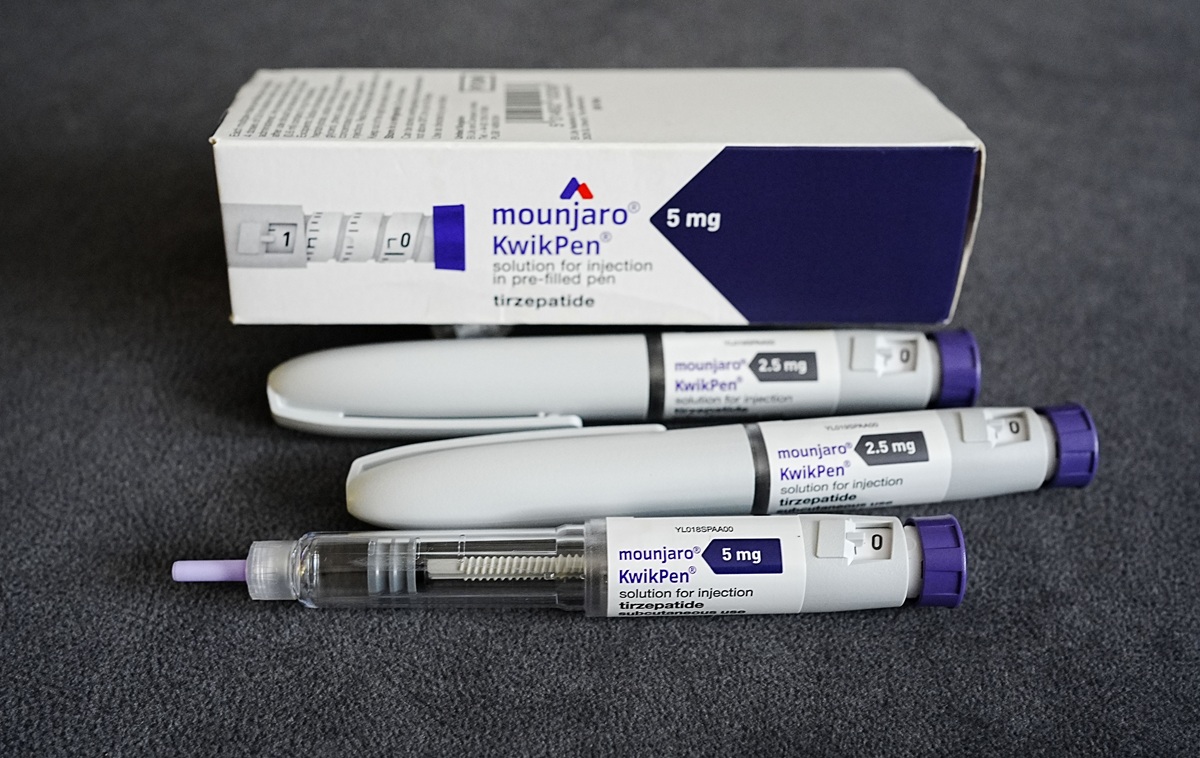
Boots is offering customers an in-store service for weight loss drugs that will allow people to pop in and buy jabs in their lunch breaks.
The pharmacy chain has started the service as a trial initially across 17 stores nationwide, including Brighton, offering treatments such as Mounjaro and Wegovy on the high street for the first time.
Customers will be offered an in-person consultation with a pharmacist in a private consultation room, where their health and medical history will be assessed to see if they are eligible for treatment.
Weight loss medication has until now been largely only available through online prescriptions.
GPs in England are also allowed to prescribe Mounjaro on the NHS, but only to severely obese people who also suffer from a range of other health problems.
Estimates suggest more than 1.5 million people in the UK are already taking weight loss drugs, which may have been prescribed through specialist weight loss services or via private prescription.
Jamie Kerruish, chief healthcare officer at Boots, said: “We know that people have different preferences for how they access healthcare services – some seeking online support and some wanting in person conversations with their local practitioner.
“The launch of our in-store weight loss treatment service alongside our digital offer delivered through Boots Online Doctor means we can now deliver convenient care to people both online or in person.”
He added: “Our weight loss treatment services are for anyone whose lives are affected by obesity.
“For people who are overweight or living with obesity, it can be hard to lose weight through diet and exercise alone.
“Weight loss treatment combined with 360 support to make lifestyle and behavioural changes, can be a powerful tool in helping people manage their weight and at Boots we are here for every step of our customers’ weight loss journeys.”
Boots has already been selling Mounjaro, made by Eli Lilly, and Novo Nordisk’s treatment Wegovy through its Boots Online Doctor service.
Customers can book in-store appointments for the service online or on a walk-in basis at stores taking part in the pilot.







Been seeing a lot more patients with pancreatitis related to tirzepatide. The evidence base is light at the moment, and I am afforded a more biased view, seeing the issues more often, but I wouldn’t be surprised if some further risk factors are exposed.
Lots of people are obtaining these medicines outside of professional advice, too.
No, unless you are a medical professional. You have not “Been seeing a lot more patients with pancreatitis related to tirzepatide”
Pancreatitis and other risk factors are clearly highlighted as part of the process of being able to purchase these products legally via reputable vendors.
You are correct that there is a growing black market for not only legitimate versions of these particular medications, but also fake versions which of course is a big concern. This happens with other medications however this class of medicine is obviously a big talking point at the moment so one does not hear about the black market of diazepam etc.
This problem could be resolved should the supply increase and cost be reduced. The target population that these types of medications can help (pre-diabetes, type 2 diabetes etc) are less able to access it due to many other, financially able, people using the medication as a first port of call for weight loss. I am paraphrasing from UK medical professionals here.
This class of drugs is so successful at what it’s supposed to be used for, companies that specialize in kidney dialysis machines, insulin production etc are losing share value because the need for such is dropping.
All medications have side effects and risk factors that must be balanced and should be only prescribed by medical professionals. Currently the risk factors are far less than the potential benefit to the target patient group. Ongoing world-wide medical studies will, over time, change the published risk factors and side effects if need be.
Oh, in that case Frank, I’ve been seeing a lot more patients with pancreatitis related to tirzepatide.
You’re absolutely right, that there’s always a black market for popular drugs, we saw the same with Olistat. And of course in the illicit drug trade, you can tell when a bad batch is in the city, because the amount of OD calls increases, a recall a few months ago it was because a prominent batch of heroin as being laced with fentanyl, which has the lovely side effect of also being resistant to naloxone.
I also agree that the first port of call for weight loss should be diet control and exercise, before looking at a pharmaceutical approach.
However, bringing it back to the original point, tirzepatide-related pancreatitis is something that could benefit from further research.
Dr Benjamin, exactly how many have you seen or as I suspect, you are guilty of supposition and anecdotal commentary that you often accuse others of?
Not a doctor. About 20 or so, and my colleagues have also seen similar. It’s also emergent research, so there’s a bit more to it than alleged supposition.
There’s also a difference between conspiracy theories and anecdotes. Bit like how ad homenium makes for terrible arugments…Ann.
This reads more like a paid for article and if so it should clearly state that at the start.
If it’s at the clock tower branch, how are people going to waddle up the stairs?
Exercise is also highly recommended.
What sort of society have we become?