
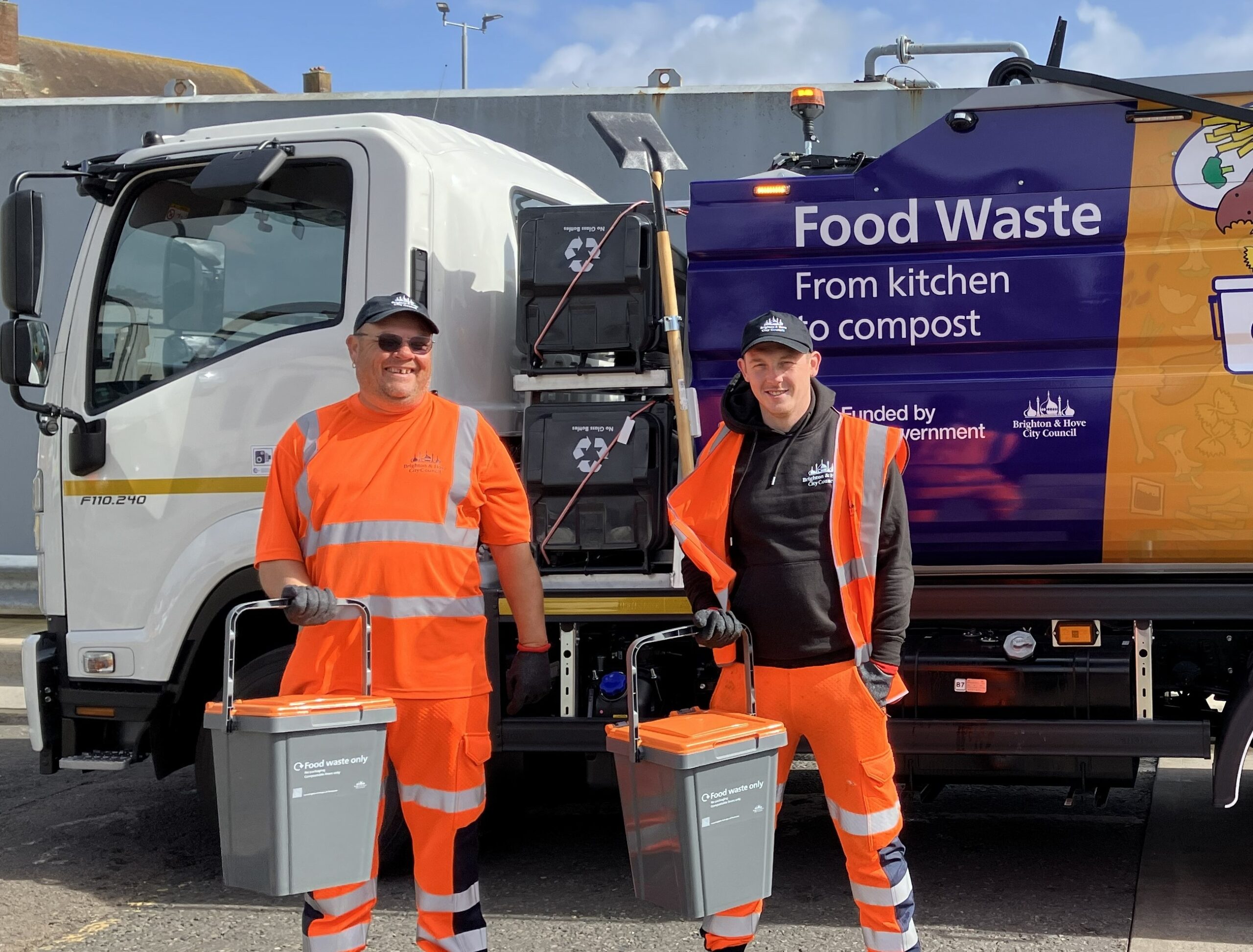
The final phase of the rollout of free food waste collections is due to start on Monday, 9 March.
About 76,000 households in central Brighton and Hove, Hanover, Kemptown, Queen’s Park, Roundhill, Seven Dials and Whitehawk make up the final area to get them.
Most residents have received their caddies, with the last ones being delivered imminently. Click here to check your collection day.
About 600 communal on-street bins as well as bins for flats have been installed since the beginning of January. These currently have tape covering the lids which will be removed a few days before collections start.
Food waste collections have shown steady growth since they started in the east of the city in September 2025, with phase 2 coming on stream in October and phase 3 in December.
Weekly tonnage has increased from 6 tonnes in the first week to 1,029 tonnes of food waste collected across 3 areas up to 20 February – that’s 17,150 wheelie bins worth or 93.5 fully laden refuse trucks diverted from waste to recycling.
After collection, Brighton & Hove’s food waste is turned into compost and soil improver to help grow more food.
Councillor Tim Rowkins, Cabinet member for Net Zero and Environmental Services, said: “We’ve invested £1.2 million in our new weekly food waste service so all households, whether in a flat, kerbside or communal area, will be able to recycle their food waste.
“We wanted to bring in food waste recycling to everyone as soon as possible and have introduced collections in stages so that we can learn from and build on the successes of each area. This has helped us make sure the distribution of equipment and collections go as smoothly as possible.
“The take-up of the scheme so far has been incredible, and I want to thank residents for tackling food waste and helping to divert over a thousand tonnes of food waste from incineration to be put to good use.
“Food waste recycling is a truly circular process, taking what would be thrown away, turning it into compost and reusing it to grow more food.”
Residents can now put all cooked and uncooked food waste in their caddies, instead of the waste bin. This includes unpackaged bread, pasta and rice, fruit and vegetables, fish, meat and bones, dairy, tea bags and coffee grounds.
Contamination has also been very low. Residents can reduce contamination by making sure just food waste goes into their caddy and using compostable caddy liners only. No packaging, liquids or any other waste.
Residents with their own orange lidded outdoor food waste caddy should leave them on the edge of properties where crews can easily see them. Place the handle upright to keep the lid secure.
The advice is to put food waste out for collection either the night before or by 5am on collection day. Crews are out collecting between 5am and 10pm.
Some blocks of flats will have access to a shared food waste bin instead of individual outdoor caddies. Communal on-street households will be able to use the shared on-street food waste bins as often as they need to. The council’s dedicated food waste crews will collect regularly.






Only introduced because the council has been forced to by national legislation intriduced in 2021. The council have been given millions of punds by the govt to roll it out. It’s still unclear why the council spent £1.2 million of money this year rather than rely on the millions of new burdens funding they were given by government.
If the new burdens funding wasn’t enough, the council surely could have challenged the government on it, like Worthing did, they managed to secure hundreds of thousand extra in national government funding by challenging the government. Brighton council seem to have just accpeted the amount, and topped it up from council budgets, which could have been used for other things (like saving libraries)
It’s worth noting that food waste diversion reduces disposal costs over time. Incineration and landfill are expensive. Funding from the government doesn’t automatically cover 100% of local implementation costs. It’s based on national modelling assumptions, and councils still have to fund local set-up costs.
But Worthing did point out government funding was not enough and appealed the amount they got, Brighton look like lapdogs in comparison. They never stick their neck out and criticise the government.
The council in Worthing is Labour led, but they seem to care more about pushing back against poor government funding decisions than the Labour councillors in Brighton and Hove do. By pushing back against the shortfall in government funding and submitting an appeal, Worthing council got an additional £227,000 from the government. Labour councillors here just accepted the shortfall and took money out of other budgets to plug the funding gaps instead. It’s really quite poor imo and not good representation for Labour councillors here to be silent on funding shortfalls and to not challenge.
Not criticising in public ≠ not challenging internally. Every party does that. Green, Cons, Labour, Reform infamously did it on a Zoom Meeting, etc…YourParty is a pretty good example of what happens when discourse spills publicly.
The link does not work on the council site.
huh, that’s odd. Try this one (and I’ve changed it in the story too) https://enviroservices.brighton-hove.gov.uk/link/collections
Benjamin makes an important point. Government “new burdens” funding is based on national modelling — it doesn’t automatically cover 100% of the real-world costs each council faces. Brighton & Hove has a high number of flats and communal properties, which makes rollout more complex and expensive than in many areas.
It’s also worth remembering that diverting food waste reduces disposal costs over time. Incineration is charged per tonne, so moving over 1,000 tonnes away from residual waste already represents significant avoided costs — and that saving continues every year.
The £1.2m covers caddies, communal bins, vehicles, staffing and the phased rollout. That’s upfront investment in a legal requirement that should reduce long-term costs and environmental impact.
Scrutiny is fair — but this doesn’t look like wasteful spending, it looks like implementation of a statutory service in a complex city.