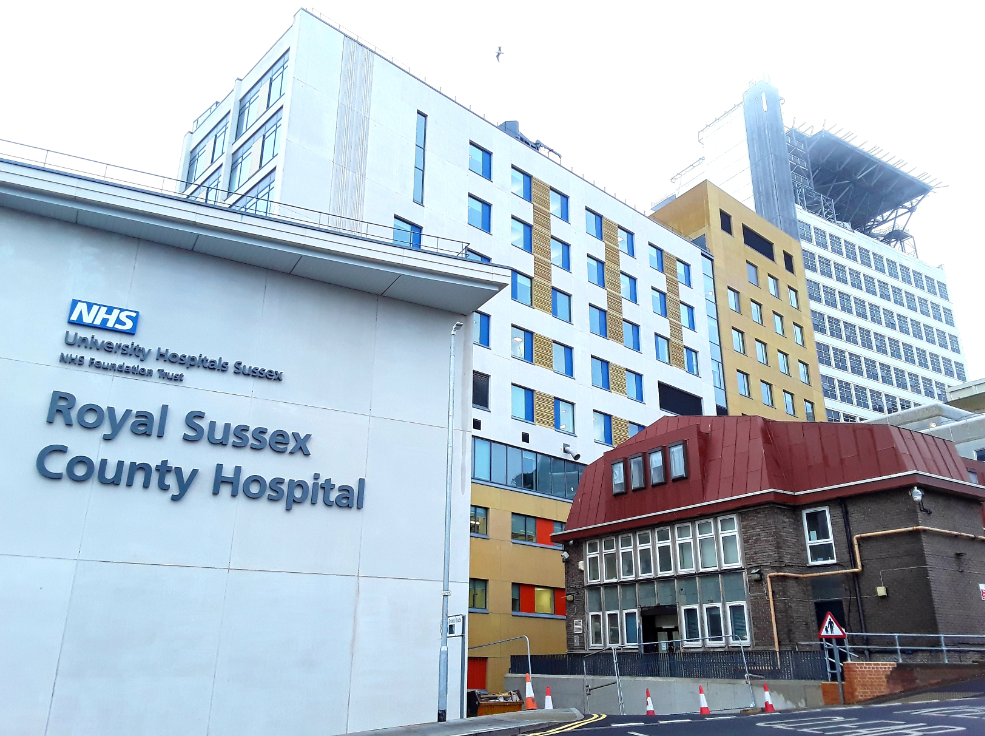
At least 55 babies who died at the NHS trust which runs Brighton’s Royal Sussex County Hospital may have survived with better care, a review has found.
Last June, Health Secretary Wes Streeting announced an independent investigation into maternity care at University Hospitals Sussex NHS Foundation Trust, which has now been expanded to include 15 families.
The families involved are still in discussions with the Government about who will lead that investigation.
The trust carried out its own review from 2019-2023 on maternity deaths and concluded a different outcome may have been possible for 55 babies, the BBC and New Statesman first reported.
Freedom of Information (FOI) data obtained by the group Truth for Our Babies, set up by bereaved parents whose babies died, shows that between 2019 and 2023, the trust carried out 227 internal hospital reviews into maternity deaths.
At least 55 cases were given grades of C or D by the trust, indicating that different care either “may” have or was “likely” to have made a difference to the outcome.
Robert Miller’s daughter, Abigail Fowler Miller, died two days after being born at the Royal Sussex County Hospital in Brighton in January 2022.
An inquest concluded she would likely have survived if her mother, Katie Fowler, had received medical treatment sooner, with Ms Fowler also going into cardiac arrest.
Mr Miller is one of those who wants senior midwife and investigator Donna Ockenden to lead the investigation into what happened at Sussex.
He told the Press Association Ms Ockenden is “someone that families across the UK trust”, adding: “It’s about our trauma and our harm and not being re-traumatised unnecessarily.
“It’s difficult for us to accept someone who’s never done this before and is learning on the job – that’s the bottom line.
“We’re scared of being re-traumatised and having more harm done to us through this process by someone who perhaps has never done it before on this scale.”
He said a current national maternity review, ordered by the Government and led by Baroness Amos, also does not go far enough.
“We’re still of the opinion that a judge-led public inquiry is really needed to hold people to account, to really scrutinise and be able to compel people to give evidence,” he said.
On Sussex, he said: “We’re not seeing improvements quickly enough”.
A Care Quality Commission (CQC) report in December on the Royal Sussex County Hospital said its maternity care requires improvement “and that’s only up one step from inadequate four years ago”, Mr Miller said.
He added: “To us, improvement is not happening quick enough to save babies’ lives.”
A Department of Health and Social Care spokeswoman said: “Every family who has lost a baby deserves answers, and we are determined to ensure they get them.
“We are actively working with families in Sussex to appoint a chair and agree terms of reference for this vital review.
“No one should experience substandard maternity care, and this government will not rest until women, babies and families get the care they need, in Sussex and beyond.
“Bereaved families will remain at the heart of Baroness Amos’ national investigation every step of the way.
“The opening of a call for evidence last month provides an important opportunity for women and families affected to share their experience.”
Dr Andy Heeps, chief executive of University Hospitals Sussex NHS Foundation Trust, said: “No words can truly express the heartbreak of losing a child.
“To every family who has experienced this unimaginable loss, I want to say directly: we did not always get things right.
“As chief executive, I take responsibility for that, and I am deeply sorry for the pain and distress you experienced while under our care.
“Our purpose is simple: to provide the safest possible maternity care. To do that, we must listen to women and families, learn from moments where care has fallen short, and support our staff to make meaningful improvements.
“In 2021–2022, we carried out a detailed investigation into a number of neonatal deaths to understand what was happening.
“We acted immediately to give families answers, to learn, and to make changes.
“Since then, we have strengthened our maternity services in several important ways.
“We have recruited 40 additional midwives across our four maternity units, bringing us to full staffing.
“We have increased theatre capacity for planned Caesarean births.
“And we have introduced a dedicated telephone triage service, staffed by highly experienced midwives whose sole focus is making safe, timely decisions about when women should come into hospital.”
He said the changes “are making a difference” but “we recognise there is always more to do” and welcomed the range of investigations.
According to the trust, its perinatal mortality rate has fallen to 2.19 per 1,000 births as of last October, down from around three per 1,000 in April 2024.
Over the past three years, the rate has remained well below the national average.
In Mr Miller’s case, he says that after a “straightforward” pregnancy, Ms Fowler went into labour at home and rang the hospital at around 10am on January 21 2022.
Two further phone calls were made after Ms Fowler began to bleed, with a fourth call stating that she was feeling faint and out of breath.
While the couple travelled in a taxi to the hospital, Ms Fowler went into cardiac arrest after suffering a uterine rupture, which required 20 minutes of resuscitation.
Abigail was delivered through a Caesarean section, but it took 40 minutes for her to be resuscitated and stabilised.
Ms Fowler was placed in an induced coma and was awoken on January 23 so she could meet her daughter, who died later that day.
An inquest concluded medical intervention should have happened sooner, with a Healthcare Safety Investigation Branch report also making safety recommendations.






This is a shocking scandal considering hospitals are touted as the only safe place to have babies. Corporate manslaughter charges would seem to be in order.
*Medical Malpractice.*
Devastating… our son Caspar lost his life at Brighton hospital in 2009 due to a catalogue of errors that left him completely brain damaged.
Awful to read that so many babies have died here due to medical negligence.
All this hospital wanted to do was cover up their mistakes and cover their own backs at the cost of our previous baby.
Im so sorry to read about all these lives lost from people not doing their jobs properly.
Hi there, I lost my baby 1989. He opened his bowels and was in distress. He was delivered eventually. He should’ve been taken to the Trevor Man baby unit and give antibiotics. Instead, we were sent home 10 hours after he was born in that time he cried constantly. I took him to the doctors constantly every day for 14 days in the end I was just told it was colic and not to worry on 16 February all he done was crying scream, my husband console him and got him to sleep. My husband got up for work on 17 February, and checked on him. He was gone .we called an ambulance We were taken to the hospital. The inquest concluded that he died of a viral pneumonia that was probably down to meconium in his lungs and he got pneumonia. Sadly died on 17 February. He was born on 1 February 1989. I wanted answers and I got none we were left just to get on with it.