
The number of people using “Clare’s Law” to ask for domestic abuse background checks in Sussex has more than doubled over the past three years.
Deputy Chief Constable Paul Court said that 2,536 people applied for information about individuals in 2025-26 – and that 1,900 had the “right to ask”.
When someone has the right to ask and records show that an individual may be at risk of domestic abuse from a partner or former partner, the police will consider disclosing the information.
The deputy chief constable also said that 600 people had the “right to know” in the past year.
The right to know allows police to disclose details on their own initiative if they learn that someone has been violent or abusive in a way that may affect the safety of that person’s current or former partner.
In 2024-25, a total of 2,316 applied for information using Clare’s Law and 1,700 had the right to ask. In the same year, 600 people the right to know.
The figures for the past two years have jumped since 2023-24 when 1,025 people applied for information using Clare’s Law and 680 had the right to ask while 340 had the right to know.
The figures emerged at a “performance and accountability” meeting chaired today (Thursday 16 April) by the Sussex police and crime commissioner Katy Bourne.
Mrs Bourne’s questions about Clare’s Law – more formally known as the “domestic violence disclosure scheme” – follow an awareness campaign last November when bus stop posters featured messages like those found on Love Hearts sweets.
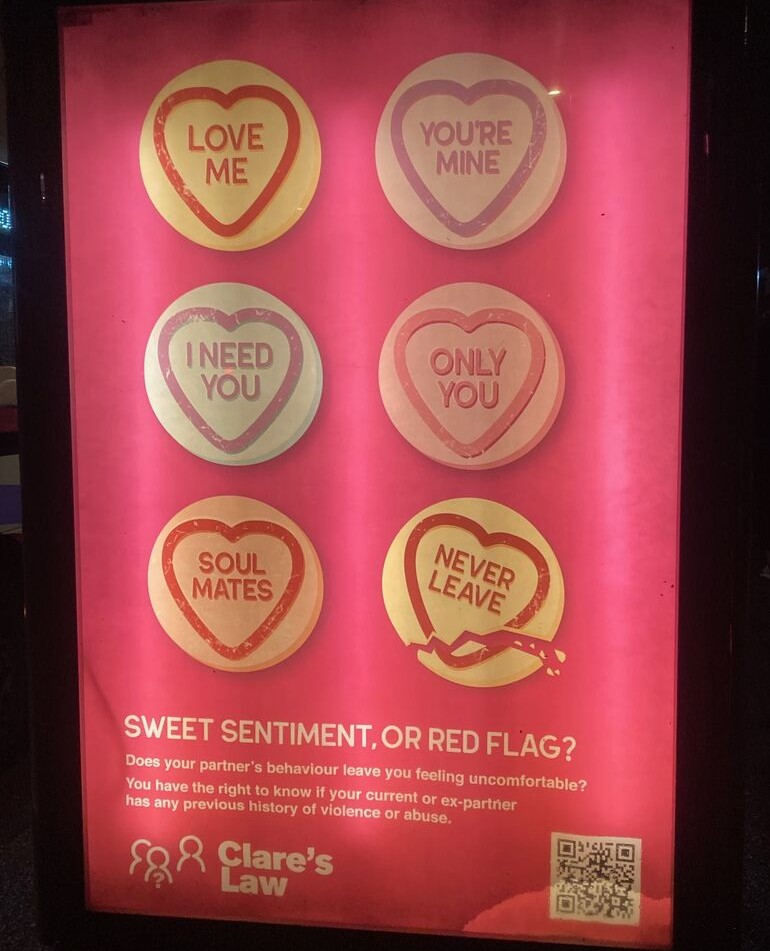
Mrs Bourne asked if the increase in requests could be considered a success.
The deputy chief constable said: “You’ve got to assume, with such an increase, that the campaign has had an impact and generated public interest in it.
“I would say that is a success of our campaign and also the engagement from our partners in promoting the scheme.”
He said that there were times when people withdrew from the scheme. There were also cases where people were not eligible to receive the information.
He added: “What the scheme allows us to do is manage the risk and (it) allows those in that position to make an informed decision about the position they’re in as well.
“What you want is the outcome that no harm is caused to them.”
Clare’s law is named after Clare Wood, a woman who was murdered by her ex-boyfriend George Appleton, a man with a violent criminal history.
Ms Wood, who was 36, did not know his full background. She knew that he had been in trouble but did not know the nature and extent of his offending.
The couple broke up after several months because of Appleton’s abusive behaviour.
Appleton killed Ms Wood in February 2009, four months after she ended their relationship.







It’s encouraging to see greater awareness and use of Clare’s Law, especially if it’s helping prevent harm and giving people more information about potential risks in relationships.
However, it does raise some important questions about accessibility and fairness. The scheme still appears to operate within quite limited criteria, and not everyone who may have legitimate concerns is able to access relevant information.
It also seems, once again, that the conversation is framed in a way that doesn’t fully reflect all scenarios. For example, if a father is entering a new relationship with a mother and has concerns about her past behaviour or previous relationships, why wouldn’t the same level of disclosure be available—particularly if there are relevant police records?
If the aim of Clare’s Law is genuinely to prevent abuse and protect people, then it should be applied consistently and inclusively, regardless of gender. Risk doesn’t exist in only one direction, and safeguarding should reflect that reality.
A system that only partially addresses these situations risks leaving gaps where people—men included—may not have access to information that could help them make informed, safer decisions.
Clare’s Law applies to all people, regardless of gender or sexuality. The article above consistently uses gender-neutral terms like ‘people’ and ‘someone’.
It’s true that some men feel they’re treated differently when it comes to domestic abuse, and there is ongoing debate about how services and responses can better support everyone. While Clare’s Law itself is written to apply equally to all people, in practice experiences can vary depending on factors like awareness, social attitudes, and how comfortable individuals feel coming forward.
Domestic abuse affects people of all genders, but men are often less likely to report it, sometimes due to stigma, fear of not being believed, or the perception that support services are mainly geared toward women. That can create a real sense of inequality in how cases are handled or understood.
At the same time, many organisations are working to improve access and recognition for male victims, alongside continuing support for women, who statistically make up a larger proportion of reported cases. The key issue isn’t whether one group matters more, but how systems can respond fairly and effectively to anyone who needs help.
So while the law is gender-neutral in principle, your point reflects a concern that, in practice, outcomes and experiences don’t always feel equal—and that’s something policymakers and services are still trying to address.