
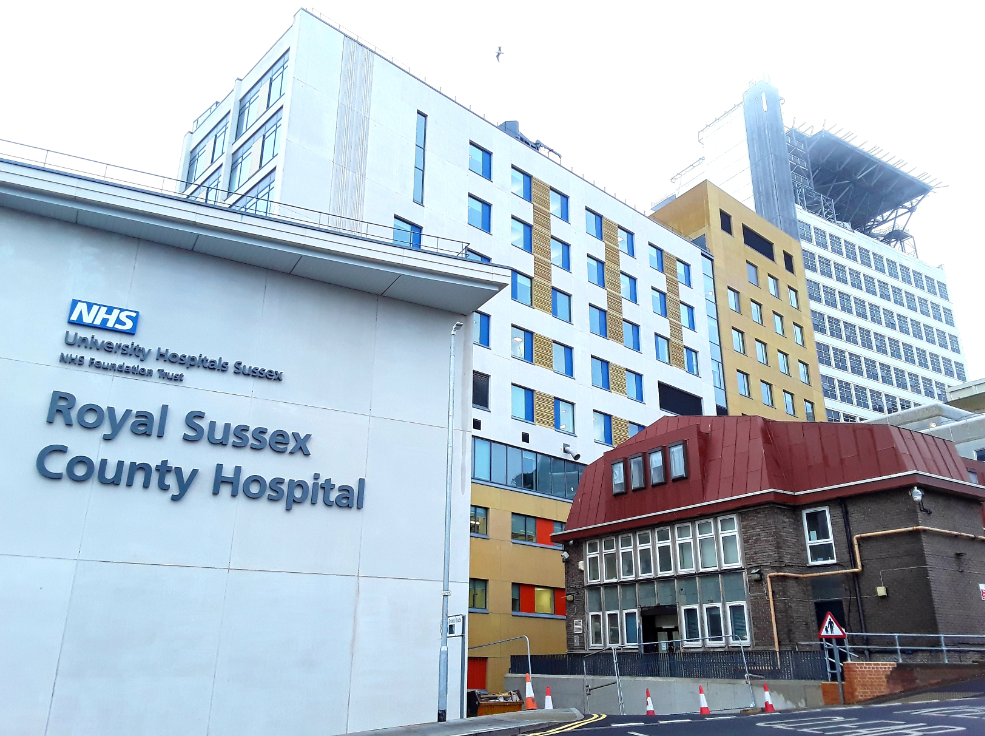
The Accident and Emergency (A&E) Department at the Royal Sussex County Hospital was described as “bedlam” by a councillor who needed to go there last week.
Hospital bosses were given other first-hand accounts of long waits, safety fears and people being treated in corridors at a council meeting yesterday (Wednesday 8 July).
They heard from members of Brighton and Hove City Council’s Health Overview and Scrutiny Committee in a meeting at Hove Town Hall.
The hospital team updated the committee on the £62 million project to improve the “acute floor” in the Thomas Kemp Tower including A&E, the Acute Medical Unit (AMU) and the Urgent Treatment Centre (UTC).
Labour councillor Amanda Evans told the hospital bosses that she recently had to go to A&E early in the week during the day.
She had nowhere to sit, with people having to stand for hours, even without the “drunks and fighters” from the pubs and clubs who turn up there late at night.
Councillor Evans said that one of the frustrations was the size of the “vast echoing” reception area of the new Louisa Martindale Building which she called a “huge wasted space”.
She said: “I walked all the way through there (reception), past all the people being treated in the corridor in the middle of the summer, not the NHS in winter crisis, and then into an A&E department.
“We’ve talked about sitting in A&E for four hours. There were no seats (and) there were lots of patients, including me, standing for hours.
“It was beyond chaotic. I felt really sorry for the staff and all of us patients as well as sorry for myself.”
She wanted to know if there would be more waiting capacity in the expanded facilities.
The hospital’s interim chief operating officer Nigel Kee said that there were 15 patients receiving care in the corridor on the day of the meeting. He said that bed-blocking caused the “bottleneck” in A&E.
Mr Kee said: “We know that our patient flow is quite challenging on a day-to-day basis and that’s partly because some of the challenges of safely discharging patients from our wards and that creates a bit of a bottleneck through to A&E.
“There’s a lot of work going on around how we can continue to improve that patient flow through the hospital and back to their home.”
The head of nursing on the acute floor, Craig Marsh, said that the previous week had been a particularly busy one.
Mr Marsh said: “We don’t need to wait for the rebuild to happen for us to start improving our pathways for patients when they come through.
“What we need to work on is how we better stream patients from the front door to other places.”
He said that the seating area would be bigger in the rebuilt A&E, with the aim being to achieve the “gold standard” of every patient receiving a medical plan within four hours.
Healthwatch Brighton and Hove chair Geoffrey Bowden said that the organisation had carried out many “interim reviews” of A&E, arriving unannounced to observe.
Mr Bowden said that it was a great shame that the money could not have been found to reconfigure A&E when approval and funding was being sought for the Louisa Martindale Building.
When he went to A&E about 10 years ago, he said that he ended up discharging himself from the hospital.
Mr Bowden said: “It felt extremely unsafe when I was there sitting, surrounded by people in tracksuit bottoms, with cans of Special Brew slipping out of their pockets and axes in their heads and so on.
“I discharged myself after 18 hours because it felt safer to be in my own bed if I was going to die rather than there.”
He praised the new parts of the hospital as “much calmer and better organised”.
Community and voluntary sector representative Nora Mzaoui, director of community organisation Bridging Change, shared her concerns about the lack of water in A&E, particularly during the hot weather.
She said: “A lot of people are scared to lose their seat so they won’t get up and get water. So will there be more spaces more accessible to snacks and water?”
The hospital’s transformation programme manager Nikki Mead said that water dispensers would be included in the new waiting area.
She said that there were no vending facilities in the department now but they would be added in the new waiting area.
The meeting was told that when the A&E Department opened in 1970, it was designed to manage 20,000 patients a year but currently received more than 100,000.






Amanda need to have a chat with her colleagues in Westminster
How difficult can it be to provide water?
I imagine fairly hard considering the building cannot be shut down.
I do have to wonder why they didn’t widen the main road when they rebuilt at the front of the hospital. It would have made sense to make the bus stops from town, in a bay rather than blocking the main route for ambulances to a&e. Something I’m sure Brighton councillors actually have some power over ?