
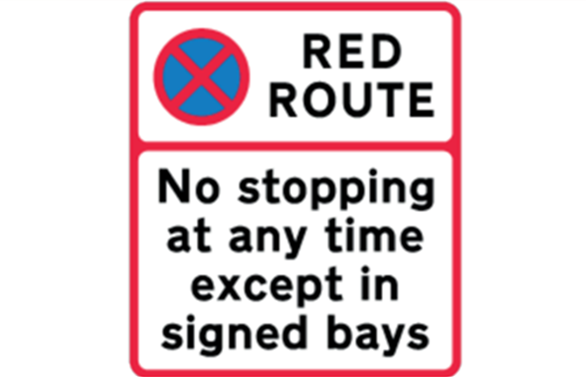
A red route has been approved for Western Road on an experimental basis to prevent cars from stopping, loading, unloading or parking.
The initial six-month “experimental traffic order” for the route – from Holland Road to Montpelier Road – was announced by Brighton and Hove City Council today (Friday 12 June).
The decision was made by Labour councillor Trevor Muten, the council’s cabinet member for transport and city infrastructure.
A start date was not included in the announcement, with work still need to put in more disabled parking bays and loading bays.
For the first two weeks of operation, any drivers who break the rules will be sent a warning. After that, the council will send a £70 penalty charge notice, with the fine reduced to £35 if paid within 14 days.
In the first six months, traffic flow will be monitored by cameras, as will loading and disabled bays, to assess the effects and to make any necessary changes.
The experimental traffic order cannot be extended beyond 18 months and changes would be made only in the first year.
The Western Road red route is being brought in after the red routes in London Road, Preston Road and Lewes Road just over two years ago.
More than 1,000 people responded to a public consultation from late November to early January. The council wrote to 4,700 addresses and liaised with traders, the Brunswick and Adelaide Local Action Team and Disabled Car User Advisory Group.
Of the 1,032 responses, 91 per cent were from residents, 3 per cent from businesses, 5 per cent from visitors and 1 per cent from others.
Half of the responders said that it would make the area safer, with 53 per cent saying that bus journeys would speed up and 56 per cent saying that the red route would keep traffic moving.
In response to traders’ concerns, an extra 10 loading bays are being created, with 140 metres of the road set aside for loading bays for shops and businesses.
In the early stages of the London Road scheme, businesses raised issues about the loading bays, with McDonald’s in particular having problems because the bay near the restaurant was too short for the smallest of its delivery lorries.
As part of the latest scheme, the council said that a further 10 disabled bays were being introduced to Western Road and the side streets.
The cabinet agreed to go ahead with a design for Western Road in March last year but faced objections from some of the businesses in the area. Florian florists started a petition which was signed by 1,690 people.
Red routes are funded from a government grant of £3.2 million for the council’s Bus Service Improvement Plan, with about £200,000 going towards the Western Road route.
The council said that bus reliability had improved along the existing red routes, according to Brighton and Hove Buses.
The council’s decision statement said: “Western Road is a major bus route in the city with a high frequency of services running through the corridor.
“Bus journey times through this corridor can be affected by parking on double yellow lines on both sides of the road.”
The statement added: “The purpose of the red route is to relieve congestion and make the area safer for drivers, bus passengers and cyclists which can also encourage active travel.
“Air quality improvements have been observed in areas where other red routes have been introduced.”
In London Road, there were more than 100,000 extra movements of people on the road after the red route was created – up from 4.78 million in the year to April 2024 to 4.89 million in the year to April 2025.
The number of “slight and serious injury accidents” fell in London Road, Preston Road and Lewes Road from 31 in the year to April 2024 to 19 in the year to April last year and 17 in the year to April 2026.
Monitoring sensors also recorded a reduction in nitrogen dioxide levels in the six months after the scheme was introduced. This reduction continued last year, the council said.





Sit on the front seat of a double decker bus and witness the difficulty of maneuvering down Western Rd due to parked vehicles ignoring double yellows and it’s obvious this is the right decision.
But they’ll be parking on pavements in side roads
Displacement is a very valid concern. I’m thinking ahead where pavement parking will be banned as well.
I concur but also think a more dynamic approach to Blue Badge abuse is included.
I was reading that a separate piece of work was going on concurrently around blue badge fraud.
You will need traffic wardens to do their job. Doesn’t seem to be many of them about?
Red Routes are typically camera controlled.
£100 fine in the post I believe.
Don’t think you get the 2 week window to get the rate reduced.
About time. They should have done this years ago. One part of traffic enforcement that I agree with, keeping traffic flow moving!!!
They should also bring it on on the Churchill Square to Waitrose section.
They also need to do something about cars parking on the pavement. This isn’t half on the pavement / half on the road but 100% on the pavement.
They can set up an enforcement zone for those who park completely off road. We arranged it for our area previously when it was being a major issue. Two weeks of tickets makes a big change in behaviour.