
A developer is hoping to build 30 homes on the site of a former plant nursery and caravan site in Saltdean.
Boaks Family Trust has submitted plans for 18 houses and 12 flats at the former Saltdean Nurseries.
No details of what the homes will look like are included in this initial outline application, which also includes plans to knock down derelict greenhouse foundations and sheds.
Nine people have already commented on the plans – eight of whom are opposed to any building on the site.
Twelve of the 30 homes would be affordable. An informal natural play space would be included in the centre of the site, and new trees would be planted throughout.
The site lies between Looes Barn Close and Saltdean United Football Club. It is not in the South Downs National Park.
Boaks Family Trust has been talking to the council’s planning department about the application since June last year.
The council’s city plan, which gives indications of what kind of development are acceptable on different sites, says the site is suitable for **.
Officers say that building more would depend on the developer demonstrating they would look acceptable.
They also warned the football club could have a “significant adverse effect” on anyone living in the homes, and it would be up to the developer to put measures in place to reduce any nuisance to residents.
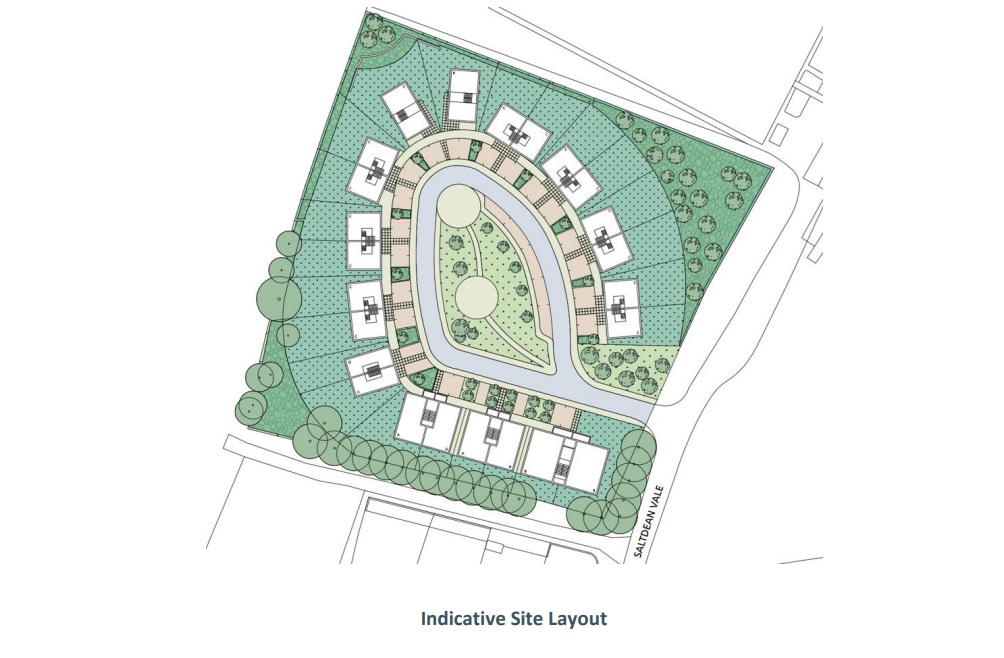
The developer says eight one-bedroom flats, four two-bedroom flats, 14 three-bedroom houses, two two-bedroom houses and two four-bedroom houses could be fitted onto the site – a lower density than council housing policy usually requires for new developments.
It uses the same curved road layout which is common in Saltdean.
The application, written by Lewis and Co, says: “The property has been owned by the applicant’s family since 1961 and includes a dilapidated house and an access drive from Saltdean Vale.
“The land was also used for the stationing/storage of up to 35 caravans until 2018. The site is repeatedly broken into and the subject of vandalism and anti-social behaviour.
“Due to the location of the adjacent football ground, housing development on the application site would not represent a northward expansion into undeveloped countryside.
“The sharp urban edges of Saltdean are very visible in local views, and development of the site would not introduce an urbanising element that is not already present.
“A higher number of dwellings than that anticipated by the city plan can be successfully accommodated on the site.
“This density and the indicative site layout would be similar to that achieved at the Chalk Cliff Road development in Saltdean (and less from that associated with the former nursery buildings and caravan storage) and would therefore be appropriate for the character of the site and the local area.”
Most of the people objecting to the plans are worried about parking, with other concerns including flooding, noise and light pollution and overdevelopment.
Unlike most other councils, Brighton and Hove City Council redacts the names of those commenting on planning applications.
One said: “Who will actually be prepared to spend half a million pounds with the guarantee of football traffic, floodlights on until 10pm and regular risk of flooding.
“There is already insufficient parking for cars for match days at Saltdean Utd FC so residents will also have to endure significant congestion with football related traffic.”
Another said: “Further development in the area will increase noise and light pollution on the edge of the South Downs National Park. This will likely have adverse impacts on wildlife, quiet enjoyment, and the dark sky reserve of this area of the South Downs National Park.
“The area is a well established diverse habitat of scrub, grassland and trees that will be providing impact habitat for biodiversity on the urban fringe.
“This development will destroy this habitat and replace it with more amenity and ornamental green spaces that will provide very little value for nature.
“The increase of population on the edge of the South Downs National Park has the potential to cause conflicts between the local farm and nature.”
The one comment supporting the scheme says: “As a Saltdean resident I am fully supportive of this and further developments in Saltdean.
“We need to be forward thinking and stop living in the past.”








Get it built, cheaper to build now than in 10 years after useless aquabbling, and it will be housing available which is income also for the council. build it build it build it
Another great opportunity for gift giving…who cares about the environment or what residents think. The council needs to support corporate welfare if the gravy train is to keep rolling.
This is obviously a development that needs to happen, the site has been left in a mess by it’s former use, and a development tastefully designed with plenty of trees would be a vast improvement, and it’s on the EDGE of the south downs.
Lev’s typical conspiracy and accusations aside, it seems like a solid proposal. Thanks to Jo for posting a direct link, it was good to easily access to read the various reports attached. Ecologically speaking, it was interesting to read a low-value area, which is seemingly easy to mitigate.
Parking and flooding are reasonable comments to make, so the area would need some mitigations in place to ensure that these are handled. Permitted parking and SUDs come to mind.
Overall, I personally see this going ahead.
That is an interesting claim. Could you share the specific study or dataset you are referring to so I can review it?
…as stated, it is part of the planning application pack that Jo has linked in the article.
Brighton & Hove has one of the UK’s lowest birth rates, with a fertility rate around 0.97-0.98 children per woman in 2023/2024. National average is 1.41. Replacement is 2.1. It might be a struggle now but in a generation or two the population is going to be significantly smaller. Of course, the developers don’t know, don’t care or both. Irresponsible on the basis of 1 minute on Google.
The challenge here is that we have consider all the other factors as well at play and their influence on supply and demand. For example, we have a massive demand for housing, with, last I checked, 7,500 on the waiting list. Then we have to consider that the number is likely not go down, as we have the high-rise LPS blocks that need to be decanted over the next 5 or so years first.
There’s quite a bit more nuance to it.