
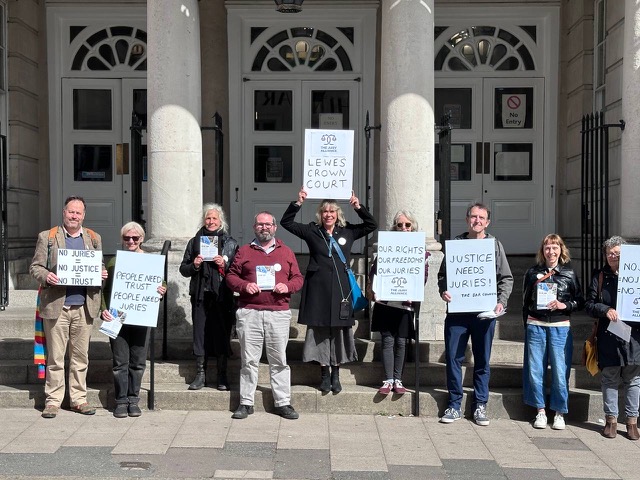
Protesters demonstrated outside a local crown court about the government’s plans to scrap trial by jury for all but the most serious offences.
The protesters, members of the Jury Alliance, gathered outside Lewes Crown Court which handles hundreds of cases a year affecting people in Brighton and Hove.
From July, defendants facing up to three years in prison will no longer be tried by a jury, ending a right that stretches back 800 years, campaigners said.
One of the protesters, retired police officer Jason Ede, 55, from Newhaven, said: “As a retired police officer, I know what every police officer knows.
“Jury trials matter. Public participation in justice matters. We risk undermining confidence in the criminal justice system if jury trials are further restricted.”
The protest outside Lewes Crown Court was one of more than 30 similar protests across the country “to demonstrate opposition to the government attack on trial by jury”.
The campaign group said: “Juries are a fundamentally local issue. Juries are made up of 12 randomly selected, local people. They reflect the local community and provide a vital, common-sense check on the law.
Serena Schellenberg, 64, a film-maker, from Hellingly, and one of those taking part outside Lewes Crown Court said: “Juries are democracy in its most human form.
“Ordinary people standing between the individual and the power of the state. Even many lawyers and judges know that once juries go, public trust goes with them.”
Another protester, Peter Thornton, 60, a TV producer, from Worthing, said: “There is no evidence whatsoever that banning juries will reduce the backlog in our courts.
“This is simply another clumsy authoritarian lunge by a failing government that finds itself increasingly out of step with public sentiment.”
The Jury Alliance is a new public campaign group, aiming to raise public awareness and demonstrate the strength of public opposition to the government’s plans to limit trial by jury.
The Justice Secretary David Lammy announced the proposal to scrap the right to trial by jury in tens of thousands of cases in December last year.
The aim, he said, was to try to reduce the backlog crisis in the criminal justice system – and since then, the government has tried to rush through the new law.
The court backlog currently stands at 80,000 cases. From 2010 to 2019, the government closed over half of all courts.
Until this year the government limited the number of days that judges could hear cases, called sitting days, to save money
If passed, the Courts and Tribunals Bill, which is still before Parliament, will mean that a single judge replaces a jury, 12 randomly selected members of the public, for all cases when a prison sentence of three years or less is expected.
Delays in local cases more commonly result from overstretched barristers and approved court translators being unavailable than any problems attributable to jurors.
Sitting days have been lost to problems with technology and from courtrooms being too hot or too cold because heaters or air conditioning systems don’t work.
The government has said that 2 per cent of delays are attributable to juries and that the overall backlog of cases is currently being reduced because of more sitting days for judges and recorders.
Some fear that a switch to judge-only trials could even lengthen delays because they would be required to take time to set out their reasoning unlike juries who do not give a reason for their verdicts.
Locally, there are 11 courtrooms available for crown court trials in Lewes, Hove and Brighton on an average sitting day but there are not always enough judges and recorders – or part-time judges – to staff all those courts.
A further increase in the number of sitting days for judges and recorders and even just a few more barristers being made available for the (Crown Prosecution Service (CPS) have been proposed in Parliament and elsewhere as more practical measures.
Flora Page, the barrister who overturned wrongful convictions in the Post Office Horizon scandal, resigned in response from the Legal Services Board, the independent regulator of legal services in England and Wales to oppose the changes.
In her resignation letter to the Justice Secretary, she wrote: “I am sorry to say that I believe the backlog is a cynical cover, something that the officials have worked on intentionally to give you … the ammunition you feel you need to take aim at jury trial. You should be ashamed of yourselves.”
The former Attorney General, Sir Geoffrey Cox, told the House of Commons in a debate on the bill: “Jury trial is the most powerful instrument and engine of social justice that this country has ever invented.
“It is a safeguard against oppression. It is a built-in defence against establishment and administrative power.”
Sir Geoffrey, a Conservative MP, added: “At a time when our institutions are under unprecedented attack, is now the time to transfer a massive chunk of the administration of criminal justice to a representative who will unquestionably be seen as a representative of the state?”
Several MPs and peers have also said that when Mr Lammy was in opposition, he defended the need for jury trial which dates back to the year 1215 and Magna Carta.
For more about the campaign, click here.