
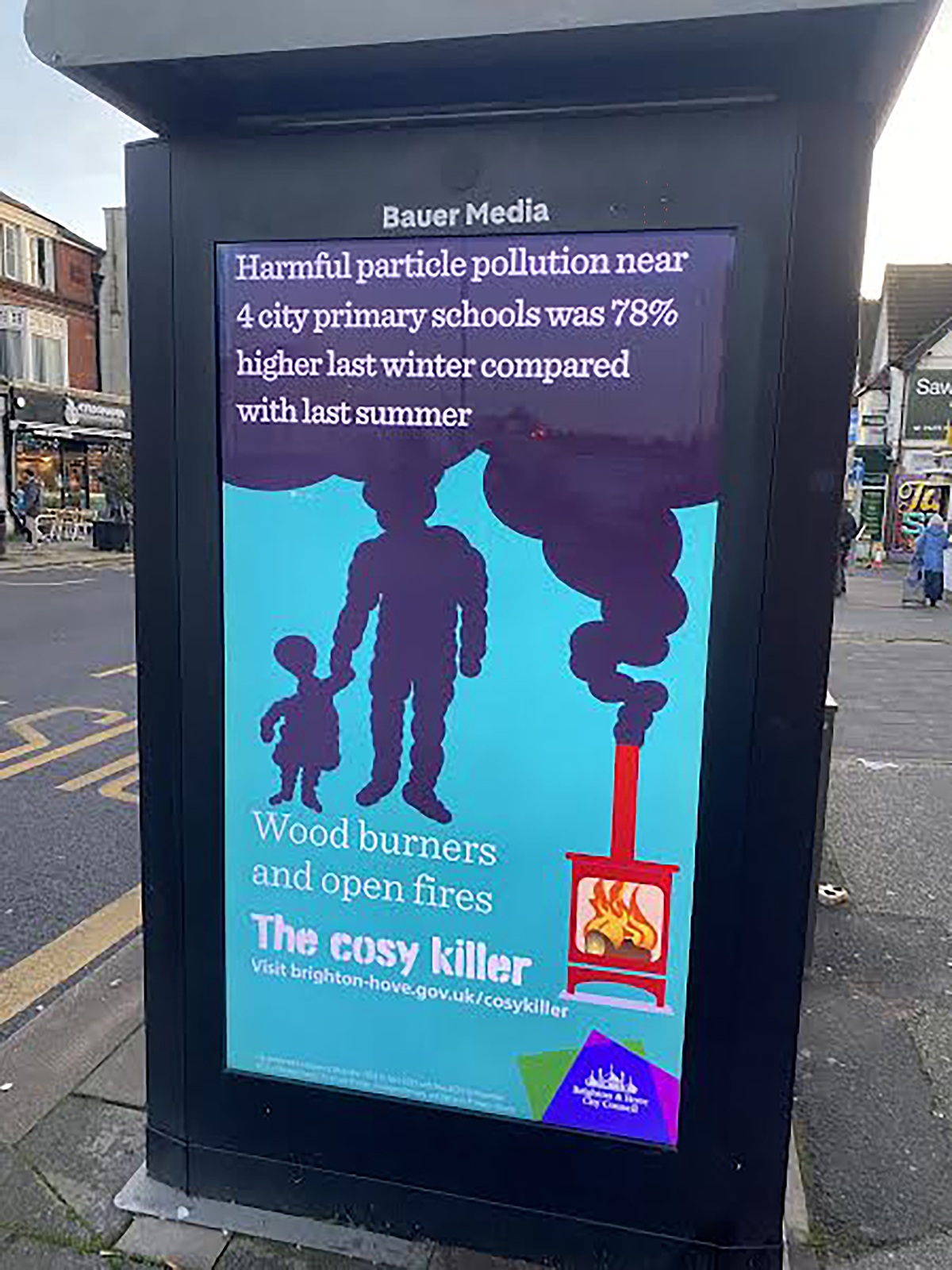
An ad by Brighton and Hove City Council has been banned for misleadingly suggesting a direct link between the use of wood burners and open fires and an increase in pollution.
The digital poster, seen in December, included a graphic of a wood-burning stove that was emitting smoke in the shape of an adult and child, and the text: “Harmful particle pollution near 4 city primary schools was 78% higher last winter compared with last summer. Wood burners and open fires. The cosy killer.”
Small text at the bottom of the ad stated: “City sensor data comparing December 2024 to April 2025 with May 2025 to November 2025 at Middle Street, Elm Grove Primary, Adlington Primary and Saltdean Primary schools.”
Two complainants, including the owner of a chimney sweeping business, said the ad misleadingly implied that the use of wood burners and open fires was the cause of the claimed increase in particle pollution.
Brighton & Hove City Council said the ad was part of a campaign to raise awareness of the damaging impact of particulate matter (PM) pollution from domestic wood burning, including open fires and wood burners.
They compared pollution levels in two parts of the year – one covering winter months when wood burners and open fires were used more often and the other covering the warmer April to October.
Across all eight monitoring sites PM2.5 (particulate matter with a diameter of 2.5 micrometres or less) pollution was 91% higher in period one than period two.
The same results showed a 79% increase across the four primary schools between the two periods.
The Advertising Standards Authority (ASA) said the ad implied there was a direct causal link between the use of wood burners and open fires, and the claimed increase in particulate pollution, and that those heat sources were the sole cause of the increase.
It said: “While we understood domestic wood burning was a significant contributor to urban PM2.5 emissions, we had not seen evidence in support of the direct link claimed in the ad.”
The ASA found that additional evidence supplied by the council did not make findings on the claimed increase in particulate pollution at the primary schools referenced in the ad.
The ASA concluded: “The ad implied that wood burners and open fires were the cause of the claimed increase in particulate pollution around four city primary schools.
“However, we had not seen evidence to substantiate the claim. We therefore concluded the ad was likely to mislead.”
Banning the ad, the ASA said: “We told Brighton & Hove City Council to ensure that robust evidence was held to substantiate any claims where a direct causal link between the use of wood burners and open fires and an increase in particle pollution was stated or implied.”
Councillor Tim Rowkins, cabinet member for net zero and environmental services at Brighton & Hove City Council, said: “We have clear and detailed local data that shows the impact that burning solid fuels has on air quality in our densely populated urban areas.
“The ASA has ruled that, in one of the campaign graphics we used, there was an insufficiently clear link to the evidence. There was no ruling against the campaign as a whole, or the other materials that were used.
“The health implications of PM2.5 exposure are well-documented. We’re working towards cleaner air in Brighton & Hove and will always act to protect the health of people in our city.”







Note there is no Adlington Primary school in B&H
This illustrates one of the dangers of local democracy. Some elected councillors fall under the misapprehension that a couple of thousand votes makes them experts in matters about which they have little or no qualification or experience. The hubris occassional extends to the level that they feel they must impose their poorly thought through ideas on the local electorate and further afield. There was a similar situation not long ago when Hannh Claire of the Green Party imposed Critical Race Theory on local schools.
Of course there will be no apology from Sankey, Rowkins and co. Instead, a barage of lame justification. It would be helpful if local politicians left such matters to experts and concentrated on the more basic tasks expected of those running a local authority such as maintaining infrastructure, traffic flow, public refuse and other somewhat less ‘headline grabbing’ activities.
I don’t think it’s local democracy as such that is the problem, but think there is an issue of honesty and integrity from some councillors.
In the case of Cllr Tim Rowkins, he has said things on multiple occasions that are simply not true. wWhether that’s down to ignorance and a lack of knowing the detail and nuance of an issue like you suggest, or a deliberate misrepresentation of facts for political point, we’ll probably never know. What is clear though is that the way in which the council doubles down when they get things wrong is costly. No doubt the council spent addition public funds through officer time and seeking legal advice to defend its case. Why are they so frequently losing legal cases and what is being done to ensure the council doesn’t waste more public money defended cases when it has made a mistake with careless wording.
The council has also made it harder for public scrutiny of decision making and for opposition scrutiny at meetings. They simply double down and consistently end up in a position of doggedly defending poor decision-making.
scoring councillors appearing to just make stuff up as they go along. Councillor Tim Rowkins has simply said things on multiple occasions, in the press and at council meetings, which simply are not true
They were claiming that wood is not a rewable fuel. Despite the UK Government claiming it was, oh and the EU, Scottish and Welsh Governments and a heap of Government quangos.
Rowkins and Goebells have some things in common.
The renewable claim has been looked at more thoroughly and thinking revised in the light of that. You will know that of course, but then you are biased by your profession as a stove installer. I wouldn’t go to Ronald McDonald for dietary advice, any more than trust your judgement.
Muten said that removing the Aquarium Roundabout was a tremendous improvement and would result in less congestion.
Experts disagree
So correlation rather than causation. They can re-jig the ad and use it next year ensuring that they make that point clear.
There is a big difference.
Except in this particular case it is quite possible, indeed very likely, that the council monitors’ increased particulate level readings were entirely due to the smoke from local wood burners being used mainly in the winter months.
The ASA think diferently.
Only because it can’t be absolutely proven. To anyone living next door or nearby to one of these home smoke-making machines it’s bleedin’ obvious.
Without giving data on actual levels and thresholds any statement on air quality is erroneous. The relevance of a % change is entirely dependent on the baseline levels. UK has very conservative thresholds for air safety. If these criteria are met then there is no cause for concern. Nitrogen Dioxide: Maximum annual mean of 40 ug/m3. Hourly mean must not exceed 200 ug/m3 more than 18 times per year. Larger Particulates: Maximum annual mean of 40 ug/m3. The 24-hour mean must not exceed 50 ug/m3more than 35 times a year. Fine Particulates: Maximum annual mean of 20 ug/m3 . In England, legally binding long-term targets require this to fall to 10 ug/m3or lower by 2040. BHCC is very poor at accurately communicating the impact of scientific findings – thee communications group needs an overhaul. The bus signs were misleading and irresponsible. Burning dry wood is acceptable and cheaper than paying for gas.
Burning dry wood is not acceptable by 400% and is not cheaper than gas. It is you who are misleading and show a poor values to other people lives
What exactly does ‘not acceptable by 400%’ mean?
Eco wood burner are 400% more polluting than using gas central heating. Old and open fire are worse. Wet wood and coal even not polluting to the environment and and surrounding residents.
Give the pollution and bad smell using a wood burner gives off to its surrounding area it is a poor and selfish choice to make.
Find it odd that people who profess to be caring and humanitarian turn it to the a version of American gun lobby or flat earthers when suggested not to using their wood burners. Particularly the evidence and experience living next to neighbours that use a wood burning fire.
You should not project your opinions as facts. I like the odour given off by wood burners. The smell of an open fire is a very popular attraction in country pubs.
Being caring and humanitarian is perfectly concordant with calling out exaggeration and untruths from authoritarian politicians. The latter is very ‘Trump like’.
You may like the smell, but what gives you the right to inflict it on the rest of us? Would you smoke a cigarette and exhale it through next door’s letterbox. There’s not much difference. So selfish.
Your puerile analogies do not constitute a valid argument. Pollen and wind blown sea salt produce p2.5 particulate. Do you want plants eradicated and the oceans drained?
There.. now you know what it’s like to be on the other side of your own hysterical non-logic.
HETAS seem to think Wood is 15% cheaper than majns gas.
My calculations concur when you factor in standing charge, efficency of appliances, etc. I used Octopus and Logs for Brighton in Stanmer Park as my comparators.
I don’t mind people criticising my figures (I’m sure they are not 100%) but assertion is not arguement. I was reasonably thorough and fair in my calculations unlike most energy companies who will often not give a kWh price.
Would you burn bin bags if they were cheaper than gas Andy?
How much does a wood burner cost to procure and install?
Can I have one in my flat?
Can my friends have one in their rental property?
The council burns bin bags Gabe. Thousands of tonnes of rubbish including hard plastics are burned every year in the Newhaven incinerator creating huge amounts of pollution. Waste incinerators are officially worse than coal power stations for their pollution levels & they have the nerve to try and blame woodburners.
Spending thousands of public money on a council misinformation campaign to scare people out of staying warm in winter, paly thoewho can no longer afford their utility bills is a disgrace. The Council cabinet minister for the environment and deputy leader Tim Rowkins should resign with immediate effect and any associated council officers sacked.
oh come off it! Wood burners are almost always middle-class accoutrements. Most people in the city who are struggling will have no access to them and kiln-dried logs are pretty expensive.
Wood is by consensus 15% cheaper than gas. I use mine to keep my gas bill down as do many of my customers.
But carbon foot print up
Wood is carbon neural to about 98%. Gas is not, oil is not, electricity is to about 40%.
Non of this is contentious stuff.
Cavemen burned solid fuel Tailor. Yet, here you are, thousands of years later.
Short lives they had, cavemen.
Local people with breathing difficulties loudly applaud your principled stand Andy.
Its why chimneys are hugh up. Fireworks night accounts for more particulates released in one night than all domestic combustion combined.
Again these figures are widely agreed.
If you have a smoky one, you probably need a chimney sweep as all fumes are supposed to be released above the roof line, not below.
Misleading ≠ misinformation
Does this make misleading statements by politicians acceptable? If so, in what context?
In this instance, I’d be considering the intention of why wood burners are being highlighted as an issue. Justin makes an excellent pragmatic point. Clarify that correlation rather than causation. Wood burners contribute significantly to fine particulate matter emission, and supported by multiple sources; and pollution levels are seasonally higher in winter, and the advertisement should then be reasonable. The intention – improving the environment and local health of young people – would reasonably be seen an acceptable one.
On the other hand, for a different example, the intention of misleading by obfuscating a £5 million donation before your election campaign by a crypto bro overseas with no alleged kickback, despite this typically being against the law, would be fundamentally different, which many are seeing as unacceptable.
Either way, scrutiny is important. Debate is important. And claims and ideas should be challenged. A good idea is sharpened by an effective challenge, and a bad idea is exposed. And in both cases, residents win.
So, essentially, a means to justify an end. Where have I heard that before? You are supporting an excursion into very dangerous territory Benjamin.
That interpretation is not accurate; a positive concept can be argued poorly, and a negative one can be argued well. Which is why scrutiny is important. Debate is important. Claims and ideas should be challenged.
The claims fell apart as a result of Rob Whittington’s well worded and persistent FOI requests.
In one the Council had to admit there was ‘no apportionment data’ — they didn’t know where this stuff was coming from but thought blaming a small disorganised industry (solid fuel) would wash.
They tried to pass observations made by Council members as ‘quantative data’. Namely a Council member ‘saw smoke emitted from a chimney. They spent the DEFRA grant on this shit and should be charged with misuse of public funds, maladministration or even misconduct in public office.
Andy of Hove wood burners where is your data to back up your claim that wood burners are safe?
Plenty of research to say they are harmful yet you never use and of the your data to back up your claims odd that?
Do you ever read your posts? You should try it. People would have an outside chance of understanding you if you did.
Tailor, you need to do some research. The latest data from DEFRA shows emissions of PM2.5 and PM10 from domestic combustion have fallen by 17% between 2020 to 2023, with a further 7% reduction in 2024 despite the increasing popularity of wood-burning stoves. Over the longer term, since 1990 there has been a 72% reduction in both PM2.5 and PM10 from domestic combustion.
https://www.gov.uk/government/statistics/emissions-of-air-pollutants/emissions-of-air-pollutants-in-the-uk-particulate-matter-pm10-and-pm25
Latest reports from The National Atmospheric Emissions Inventory (NAEI) show ecodesign stoves are responsible for less than 0.3% of overall pm2.5 emissions.
Road transport emissions are approximately 66.7 times higher.
Cigarette smoking produces 4.7 times more PM2.5.
Bonfire Night emissions in a single night are 7.4 times higher than the annual output of all ecodesign stoves in the country burning dry wood.
A bbq releases 10 times more pm2.5 than an eco stove. Why arent you trying to ban bbq’s then?
Please read this as well:
https://www.hetas.co.uk/clean-air-night-fact-sheet/?utm_source=Newsletter&utm_medium=Email&utm_campaign=Trade+Newsletter+January+2025
I did an FOI request with the Council and last year 302 burners were installed across Brighton & Hove. The emissions data on these stoves indicate a car produces more particulates in 3 miles from its tyres than an ecodesign stove does in an hour.
Easily obtainable data. My sources were the Guardian and Kiwa Gastec (the UK testing station).
All very well till you’ve got one next door to you and one a few doors away in every direction? Takes us back to the coal smoke fouled air of the 1950s and 60s. Great. What if we all take this up ? Are you seriously suggesting everyone does? Why is there smoke in my house every winter? What shall we do to combat it? All run ineffective air purifiers? That’s energy that negates any saving on burning wood you know, Andy.
302 a year across Brighton’s 283,870 residents will mean in 940 years everyone will have one. It will be unbearable you’re right as long as nobody takes any out in the meantime.
Tell you what I can almost guarantee it isn’t from wood stoves. I’m happy to visit and use my monitor to see what I can detect. Email me at andy@hovewoodburners.co.uk
Your maths is wrong since you are assuming there’s only 1 person per household. And it’s pretty insulting you implying the five or more wood stoves that you yourself probably sited near me,and in some sense are responsible for, aren’t emitting smoke that makes the winter air round here so obviously foul at times. Another 300+ per year of these across the city is not trivial, but will mean more and more people suffering as we do.
You’re rather missing the point Erin. Anecdotal statements such as; ‘makes the winter air so obviously foul at times’, is merely your unfounded assertion, not evidence. The ASA insisted that BHCC pull the advert for the same reasons.
I rather think you are Atticus. No doubt you have one of these monsters in your own domestic space. The only blessing is that every time you open it to load it with fuel, it will give you a heavier dose of particulates than you even inflict on your neighbours through the air outside, and yes that’s been thoroughly researched.
Not that the smoke with all it’s toxicity besides particulates just stays outside, as everyone living by or near one can attest, it comes inside their houses too.
Hi Andy – if you think there has been a misuse if council funds or abuse of process, you could consider raising the matter as a standards complaint: https://www.brighton-hove.gov.uk/council-and-democracy/feedback-about-council-services/complaints-about-councillors.
I also think on some serious matters it is possible for members of the public to raise issues with the council’s independent auditor: https://www.brighton-hove.gov.uk/sites/default/files/2024-05/Whistleblowing%20Policy%20updated%2015.5.24.pdf. The external auditors are: Grant Thornton. Their address is 30 Finsbury Square, London EC2A 1AG.
It sounds like the ASA ruling covered a very specific aspect of your concerns – ie the council using misleading data, but from what you’ve said in other comments you suggest deliberate manipulation of data and misuse of public funds might have occured too, which won’t really be covered by the ASA ruling. So I’m mentioning these other routes to further scrutiny – especially since the current Labour council in the city have reduced scrutiny of decision making at the council since taking control in 2023, which means you may need to look further at external scrutiny options. Possibly the Local Government Ombudsman as well.
Heads need to roll over this. No doubt this misinformation was the prelude to fining residents for using solid fuel burning stoves. Don’t they think residents are suffering enough under a Cost of Living crisis without having tax payers’ money wasted on this guff to guilt-trip taxpaying residents if they can’t afford gas or oil heating? The council keep claiming to be short of money, but they don’t hesitate to waste “other peoples’ money” on anything they they can dream up. Any problem which doesn’t exist and you can count on them to create, inflate and throw money at it, finally claiming to have solved it. Our money. From the public purse. Meanwhile they close schools, day centres for the disabled and Libraries, claiming there is no money.
I agree, this has harmed my livelihood and was untrue.
This is the second time the ASA have ruled against Rowkins et al. It takes about 9 months each time from complaint to resolution during which time the denigrate and destroy small business’ like mine.
There are less than 10 people involved in solid fuel in Brighton & Hove all small business’ providing employment. 302 installations a year.
Perhaps the council should wage a campaign against EV buses next as environmentally damaging. They weigh up to three times more than a 1950s double decker routemaster did and Brighton and Hove roads are not built for 23 ton vehicles so they plough up the roads causing endless cracking, potholes, damage to cellars, sewers and infrastructure beneath, all the while leaving excess weight tyre particulate calling cards behind, especially when full of passengers. They have lithium batteries which are short-lived, harmful to the environment and come with a greater fire risk. Lithium batteries rely on child slave labour for their raw materials and are not much more recyclable than nuclear waste. EV buses also require expensive charging infrastructure, are harder and more expensive to fix and maintain and also scrap at the end of their shorter lives. They also cost on average four times more than a diesel bus. An EV bus is a carbon footprint worth measuring from every angle before overpriced investment on idealistic assumptions. Not forgetting with or without full passenger capacity in the calculations.
Perhaps Tracy should wage a campaign against making misleading claims in her rants?
Modern bus designs and infrastructure planning account for additional weight, so claiming that they are a core reason for road deterioration is misleading.
Data consistently shows that lower fuel and maintenance costs make EV buses cost-competitive over their operational lifetime, especially with current subsidies, and is getting better. So your claim on diesel is factually wrong.
The lifecycle emissions of EV buses are dramatically lower than diesel buses. The production emissions are offset within a relatively short period of operation. The comparison to “nuclear waste” is misleading.
Child Labour is a red herring, as UK adhere to strict supply chain due diligence.
EV buses aligns with UK decarbonisation goals, and is supported by data, not “idealistic assumptions”.
1. Vehicle construction footprint
Routemaster
The Routemaster used:
Steel chassis
Aluminium body panels
Mechanical diesel engine
Minimal electronics
The embodied carbon of construction was comparatively low because:
Vehicle mass was lower.
No large battery pack.
Materials were relatively simple.
A rough estimate from modern lifecycle studies suggests a Routemaster-sized vehicle might embody on the order of 20–40 tonnes CO₂e when built.
Electroliner
The Electroliner includes:
Large lithium-ion battery pack
Power electronics
Electric motors
More sophisticated safety and control systems
The battery alone can account for a substantial portion of manufacturing emissions.
A modern electric double-decker can embody approximately 50–100+ tonnes CO₂e before it carries its first passenger, depending on battery size and manufacturing energy sources.
Winner: Routemaster
2. Operational carbon footprint
Routemaster
Typical fuel economy:
Around 4–7 mpg (UK gallons)
Significant particulate and NOx emissions
Over a long service life, operational emissions dominate total impact.
A heavily used Routemaster could emit thousands of tonnes of CO₂ during decades of operation.
Electroliner
Tailpipe emissions:
Zero, but emissions-by-proxy depend on electricity generation.
In the UK grid today, electric buses typically produce dramatically lower direct emissions per mile than diesel buses.
Winner: Electroliner .
3. Weight and resource consumption
Routemaster
Designed around post-war engineering priorities:
Lightweight aluminium construction
Approximately 7–8 tonnes
This is remarkably light for a double-decker.
Electroliner
Battery packs are heavy.
Typical weight:
Roughly 18–20 tonnes
More materials:
Copper
Lithium
Nickel
Rare-earth materials (depending on motor design)
Winner: Routemaster
4. Longevity
Routemaster
This is where the comparison becomes fascinating.
Many Routemasters:
Entered service in the 1950s–1960s.
Survive today.
Remain operable after 60–70 years.
They were designed for complete overhaul.
Major components could be rebuilt repeatedly.
Electroliner
Expected service life:
Approximately 15 years in standard transit service.
Potentially longer with battery replacement and refurbishment.
However:
Battery degradation is unavoidable.
Electronics become obsolete.
Software support eventually ends.
No one yet knows whether electric buses built today will still be operating in 2080.
Winner: Routemaster
5. Repairability (“fixability”)
Routemaster
Advantages:
Mostly mechanical.
Accessible components.
Repairable with conventional tools.
Parts can often be fabricated.
A skilled mechanic can diagnose most failures directly.
Electroliner
Advantages:
Fewer moving parts.
Disadvantages:
Proprietary electronics.
Battery management systems.
Software dependencies.
High-voltage safety requirements.
Repair often requires manufacturer support.
Winner: Routemaster
6. End-of-life footprint
Routemaster
Recycling:
Steel highly recyclable.
Aluminium highly recyclable.
No battery disposal challenge.
Many buses were refurbished rather than scrapped.
Electroliner
Challenges:
Battery recycling.
Complex electronic waste streams.
Specialized processing.
Battery recycling is improving rapidly but remains resource-intensive.
Winner: Routemaster
7. Infrastructure costs
Routemaster
Infrastructure required:
Fuel delivery
Fuel storage tanks
Maintenance workshops
Most cities already possessed this infrastructure.
Electroliner
Additional requirements:
High-capacity depot charging
Grid upgrades
Transformers
Electrical distribution systems
Load-management software
The infrastructure cost per depot can run into millions of pounds.
However, operating costs are generally lower once installed.
Winner (upfront cost): Routemaster
Winner (long-term energy efficiency): Electroliner
8. Passenger-mile environmental impact
A bus’s environmental impact should ideally be measured per passenger carried.
Because electric drivetrains are much more efficient:
Modern electric buses can use 60–80% less energy per mile than diesel buses.
When heavily occupied, passenger-mile emissions become very low.
Even after accounting for battery production, most lifecycle studies find electric buses become environmentally preferable after several years of operation.
Winner: Electroliner
Overall environmental scorecard
Category Winner
Manufacturing carbon Routemaster
Vehicle weight Routemaster
Repairability Routemaster
Longevity Routemaster
End-of-life simplicity Routemaster
Infrastructure simplicity Routemaster
Noise pollution Electroliner
Local air quality Electroliner
Energy efficiency Electroliner
Lifetime operational emissions Electroliner
Passenger-mile climate impact Electroliner
The surprising conclusion
If your goal is minimizing resource use, maximizing durability, repairability, and service life, the Routemaster represents an extraordinarily sustainable piece of engineering. A vehicle that remains usable after 70 years spreads its manufacturing footprint over an exceptionally long period.
Again, you have to be really careful about how you use comparison prompts, because it often makes mistakes, and this is yet another example of that.
You have to consider that a single, state-owned operator has a dedicated workshop, and a philosophy of complete overhaul is not a scalable or realistic model for modern, commercially operated bus fleets that need reliability and standardised parts. It’s a misapplication. You also are lacking systemic thinking – it’s a big red flag not to consider electrification, and the benefits it provides beyond the bus itself. The situation with the Strait of Hormuz is a fantastic example.
Your comparison also ignores operational realities, downplaying the health cost and premature deaths caused by pollution, which you appear not to factor into your scorecard.
You’re also forgetting that EV technology is not static. Batteries are improving, V2G technologies are getting better, and charging times are improving; in comparison, diesels aren’t getting much better.
And the £7m BHCC have pished away in VG3 (over and above the Grant) , which will cause more congestion and will have little benefit, according to council advisors
Can someone in authority, tell me how exactly are we meant to keep warm?
Those lucky enough to have central heating are finding using it means bankruptcy through the energy companies extortionate rackets!
Or storage heaters which are hugely expensive?
Or are we just expected to freeze to death?
The most cost-effective way to keep yourself warm is an electric blanket, so you warm yourself, rather than the room, but it can pose risks if you sleep with it. There are usually also Brighton-specific funds that help people who are struggling to keep warm. There are some special rates you can apply for as well with energy companies if you are having financial hardship.
But yeah, prices are really high, especially at the moment.
Yet Labour have done zero to prevent the mostly foreign-owned utility and fuel companies making the most obscene profits they’ve ever made on the back of a Cost of Living crisis in this country. Zero. Then at local level they seek to punish residents for using their own initiative to keep warm at affordable cost, even if that means lying about the risks of doing something humanity has been doing since prehistoric times. There are still no death certificates citing ‘Solid fuel burner’ as a cause of death.
Well, there wouldn’t be, because “object” isn’t a cause of death. Respiratory illness, however, is.
Do you have an air fryer? A Hoover? Pets or soft furnishings or use aerosols? Well all these things flood your home with particulates. I can monitor them with a meter. In the same way I monitor my stove installations to ensure they are not flooding the room with CO..
Outside. Do you own a car, travel by bus or push bike? Then you are inhaling huge numbers of particulates as they are more prevalent in and around busy roads. I assume you live in Brighton? Then you are inhaling the vast number of particulates that blow in from the English channel.
Ecodesign stoves (all stoves sold new since 2020) account for less than a percentage point of particulate emissions. This is non contentious stuff.
The Council owns and operates an incinerator in Newhaven. They decline to publish ANY emissions data from it. Every stove I sell has its outputs clearly given.
If the Council truly cared about respiratory illness, they would be highlighting the dangers of Vape shops not targeting wood burners. But since they get money out of Vape shops…
The do frequently advertise the dangers of vaping, Tracy, there’s a whole national campaign about the dangers of vaping, Tracy. It’s a common check up question within the NHS to check for the dangers of vaping, Tracy. As usual, your whataboutism isn’t a good answer, even more so when the whataboutism itself is fundamentally flawed.
I want to start by saying the information you’ve provided has been well articulated, just so my position is clear, Andy. I agree that one particular item is likely not the sole cause, and absolutely reasonable to highlight that has not been proven, and the request the advertisement is not misleading on that point is one I agree with completely. Accuracy is important.
However, wood burners are not a minor issue. Academica shows they are a significant, preventable source of toxic air pollution with real health and economic costs, especially in dense urban areas like Brighton.
My calculation is wood bought in a bulk bag is about 15% cheaper per Kwh than mains gas when you factor in efficiency (stoves are typically 80% efficient. Gas boilers up to 90%). Wood needs to be dry and kept dry.
Usually due to how we use wood stoves (typically in the lounge eveniings only) you can expect to save about ⅓ of your gas bill. It is not a exact kWh saving as the stove tends to heat you not the house generally because we are in close proximity to it.
So savings are about ⅓ of your gas bill costs are installation (large – maybe £3200 all in), fuel (about £200 pa) and maintenance (maybe £100pa).
Carbon neutrality is about 98%, life expectancy is maybe 15 years with minimal maintenence.
Misleading information from a Labour administration. Colour me shocked😳
Isn’t this the second time around that this advert has been banned?
It would be interesting to know just how much (in true costs terms which include council officers time), has been spent on this campaign. It is public money which should be being spent on other things such as maintaining infrastructure including the seafront railings which we are told is not an affordable expense.
According to Andy’s FOI, viewable from the public disclosure log, about £4,900 from a grant.
That was for one year of the campaign.
It’s been running for two years, so I guess we could reasonably double that figure.
More of less, minus a few one-off or frontloaded costs. Seems reasonable! Not a lot of money in the grand scheme of things.
It’s a public health campaign and it’s their duty to warn people of harms. Countrywide, local authorities get a lot of complaints about smoke around and inside people’s homes coming from elsewhere. Even when the local populace live in Smoke Control Areas, that’s pretty meaningless in the face of this fashion for polluting wood burning that is now the greatest source of particulates ahead even of transport, never mind all the other toxins in it that rarely get a mention. The council’s campaign was good advice based on the latest evidence from research. Your gripe should be that you ever fell for the lies the stove industry keeps telling its customers.
So for the entire history of Homo sapiens existance we have burnt wood and now its a problem!
No.. Its political rhetoric trying to push a policy by scaring the crap out of the public.
It about ‘net-zero’ and making everyone dependant upon wildly expensive electricity.
If the government wants everyone to move away from burning ‘stuff’ for energy they need to slash the price of electricity ~ unleach it from the cost of gas and get the price down…
Incorrect, we used to burn Peat and also dried Dung with straw, not sure our “Civilisation” has evolved much but people will always burn whatever they can get their hands on.
You do realise you’re commenting on an article which reports that a Council advert has been banned by the advertising watchdog for being misleading?
https://www.lewissilkin.com/insights/2026/06/03/like-a-seagull-on-the-esplanade-the-asa-dumps-on-brighton-council-from-a-great-h-102n0xg
Benjamin, your argument basically boils down to: “Yes, the claim was misleading, but it was for a good cause.”
That’s a strange standard to apply to public information. If a claim is inaccurate, it’s inaccurate. The fact that the people making it have noble intentions doesn’t magically turn it into truth.
Nobody is disputing that PM2.5 can be harmful, or that wood burners contribute to pollution. The ASA ruling wasn’t a declaration that wood smoke is made of vitamins. It was a finding that the council exaggerated what the evidence actually showed.
You even acknowledge the central problem yourself when you say they should have clarified the difference between correlation and causation. That’s not some minor footnote—it was the entire basis of the complaint.
It’s also amusing that you’re praising scrutiny and debate while simultaneously arguing that we should cut the council some slack because they were trying to improve public health. Scrutiny only matters if it applies when we agree with the objective as well as when we don’t. Otherwise it’s just selective fact-checking.
If campaigners want credibility, they need to be held to the same standard they demand from everyone else: make claims that are supported by evidence, not claims that sound persuasive enough to achieve the desired outcome.
“Misleading isn’t misinformation” may be technically true. It’s also not much of a defence. If your best argument is that something was merely misleading rather than outright false, you’ve already conceded the main point.
Deliberate scaremongering of the electorate could be seen as a type of domestic terrorism perpetuated on the electorate by a council who are supposed to be public servants acting in the best interests of the electorate and only broadcasting factual information, not encouraging residents to live in fear of heating their homes in the only affordable way some have. For such propaganda to be paid for out of the public purse is even more insulting to residents.
Hello James, I see we’re going by the name Lesley on this account today. And I see we’re back to using AI to once again, create, a misleading misrepresentation…very ironic.
It is falsely framing what I said as “ends justify the means.” – I’ve never said that at all. It’s missed the nuance of distinguishing between intent and execution – a classic strawman fallacy. I’ve cited Andy’s FOI requests and the ASA process as examples of effective scrutiny in action, so again, a false representation. And to top it off, it’s misleading by ignoring that a semantic distinction is not an attempt at a moral defence, of which, I’ve done nothing of the latter.
Once again, you have engaged with nothing that I have actually said.
Usual problems caused by “the usual suspects” people with zero qualifications being left to run the Circus, it doesn’t help when they bring in “mates” for advice, chances are they know even less and only money seems to be the common denominator, taxpayers money, there should be a requirement that people in charge actually have qualifications for that subject, not to be left with subcontractors ideas and estimates, just my thoughts of course. No qualifications should = no job,