
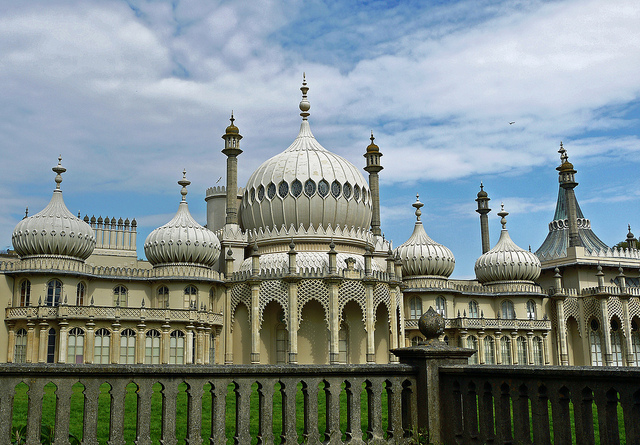
More trusts could be set up to run council-owned “heritage assets” along the lines of the Royal Pavilion and Museums Trust or the Saltdean Lido, subject to the approval of senior councillors.
The idea is one of 15 proposals put forward by Brighton and Hove City Council’s Place Overview and Scrutiny Committee.
The proposals are expected to go before the council’s cabinet in the autumn after calls for better care of historic features including the seafront shelters and the pavements in Brunswick Square.
Public concern about the state of the Madeira Terraces led to a crowdfunder that raised £500,000 after years of neglect in the council’s ownership.
And Hedley Swain, chief executive of the Royal Pavilion and Museums Trust, told a task and finish group: “The Royal Pavilion hasn’t had any meaningful capital work or improvement for 40 years … in the next 10 years they will need to spend around £40 million to £50 million”.
Mr Swain gave his evidence in February, just over a month before staff went on strike as the trust, set up in 2020, wrestled with its own financial challenges.
A report to the council’s Place Overview and Scrutiny Committee said that heritage assets were often expensive to maintain and repair but the council had many other pressing calls on its budget.
The task and finish group also heard about the years of work by volunteers to reach a deal with the council to take over and restore the art deco Saltdean Lido.
The Place Overview and Scrutiny Committee’s task and finish group spent months taking evidence from people with experience locally and in places such as Bristol, Coventry and London.
It was set up after a motion passed by the full council last July calling for better protection of Brighton and Hove’s heritage and noting the reputational damage when historic items deteriorate.
The cross-party working group consisted of six councillors and a voluntary sector representative. It held seven evidence-gathering sessions from last December to March, hearing from 20 witnesses.
Labour councillor Amanda Evans, who chairs the Place Overview and Scrutiny Committee, said: “There are some heritage experts or interested parties who believe that the only thing you should do in Brighton and Hove is preserve the Regency architecture in aspic and that’s all you should ever do.
“I’ve always thought this city is in grave danger of becoming a pastiche of itself if you do that. The old and the new can happily co-exist.
“Once upon a time the Pavilion would have been thought of as a monstrous carbuncle, to quote King Charles long ago, and so would Embassy Court or the Lido in Saltdean – or any other modern building would have once been thought of as a terrible thing.”
The task and finish group’s report focused on understanding the barriers to looking after heritage assets and exploring how the council could find funding when its finances were limited.
The report was presented to the committee at Hove Town Hall yesterday (Wednesday 22 July). It said: “There are high costs involved in maintaining heritage assets which can make them unaffordable to custodians.
“This is further impeded by strict planning policies and the effects of climate change.
“There is a lack of funding available and national pots like the National Lottery are becoming increasingly competitive.
“It is difficult to restore assets to a reasonable standard from which they can explore financially sustainable models.
“There is a strong level of public interest in heritage with residents and community groups keen to help.
“It would make sense for the council to harness this and find new ways to work collaboratively for the benefit of the city.”
The 15 recommendations due to go before the council’s cabinet are
- Review signage and wayfinding in partnership with community groups
- Review council-owned heritage assets with consideration given to trust models to allow community groups to take ownership or management
- Consider support for community groups to develop plans or strategies for heritage assets
- Consider support for community groups to create art and heritage trails
- Consider support for joint ticketing between larger heritage assets such as the Royal Pavilion and smaller assets such as the Regency Town House
- Explore alternative funding where people can choose to give their support to specific heritage assets
- Support community-led maintenance
- Introduce a code of conduct or service agreement between the council and community groups working in partnership
- Create a network of community groups to provide advice and mentorship to other community groups that want to look after a heritage asset
- Lobby the government for a review and streamlining of planning requirements for routine maintenance of listed buildings
- Work with Historic England to ask the government for more preventative funding for historic structures
- Add a paragraph to the Heritage Strategy to commit to open and honest conversations about commemorating difficult periods in the past
- Ensure the Heritage Strategy protects and restores a full range of Brighton and Hove’s history so that heritage is not “frozen in time”
- Consider adding Brunswick Square’s pavements to the local list
- Support installing a sculpture in the Royal Pavilion Gardens to commemorate the Indian soldiers of the First World War
Brighton and Hove Independent councillor Bridget Fishleigh asked about the specific nature of the call to support a sculpture in Pavilion Gardens. It was one of two specific recommendations.
Councillor Fishleigh said: “That was a bit random in all the reports and all rather specific and I wondered where that’s come from because I don’t think it fits in with the design of the Regency Gardens that’s about to take place with the lottery grant.”
Councillor Evans said that one of the witnesses who gave evidence to the task and finish group was a trustee of the Pavilion and the Chattri Memorial Trust.
The witness, Davinder Dhillon, put forward the idea to raise awareness of the way the Royal Pavilion was turned into a hospital for Indian soldiers during the First World War.
The 15 recommendations are expected to go before a meeting of the council’s cabinet in the autumn.






Sounds like a cop out and recipe for disaster to avoid taking responsiblity for the city’s heritage. The Council no longer seems to want to do its job of running and keeping up the city properly.
Maybe, but there’s certainly a lot of benefits to not being the council when it comes to a charitable trust, like different recourses to funding opportunities, and not having to follow council policy which can be prohibitive, and you have a dedicated team, that is purely focused on that heritage site, rather than a much broader remit that may come into conflict with itself.