
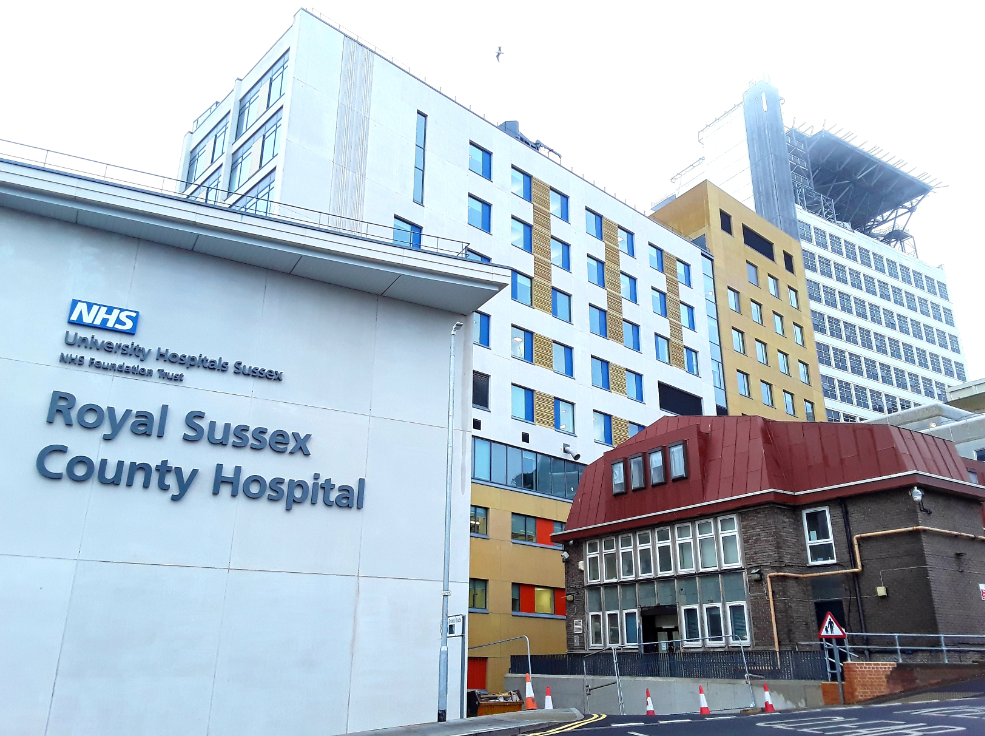
Bruised and bloody, the man in the wheelchair waited patiently on New Year’s Eve while the concerned desk staff at the Royal Sussex A&E department took his details. He’d had a fall in his kitchen.
Like me and like the young man with a curious rash, an older woman who’d also toppled over at home, the builder who’d mashed up his hand at work and the worried-looking middle-aged man with blood in his stools, he was in need of help from the NHS.
My journey to A&E started early that day. Short of breath and with a tightness in my chest overnight, I was seen at short notice by my GP at the Havens Health Centre in Peacehaven at 9.30am.
I had a heavy cold and, I suspected, a chest infection. A short course of antibiotics would be the answer.
The young GP examined me thoroughly, took my blood pressure and sent me downstairs for an ECG, which showed irregularities in my heartbeat.
I’d had a couple of chest infections before but never with the pressure in my chest. She prescribed the antibiotics but suggested strongly I went for more tests at A&E.
It wasn’t what I really wanted to hear but I took her advice. I have a heart condition for which I take a smorgasbord of pills prescribed by another GP ten years ago who thankfully spotted the condition during a regular health check.
Thanks to him, I’ve never had a heart incident. But A&E on New Year’s Eve …
I threaded my way through the waiting ambulances at midday to find A&E calm and quiet with about 20 adults waiting to be seen. I checked in and was assessed by the reassuring triage nurse. He sent me back to my seat by the door.
The new year’s rush hour had yet to start although a reassuring fly-past of doctors, nurses and paramedics in their colour-coded scrubs passed through the doors.
A couple of coppers put their heads in to find their services were not needed.
After a short wait a health care assistant took my blood pressure, pulse and temperature.
She also found a vein in my left arm first time and filled several small glass phials with samples of my blood (nearly an armful). Assessment of the blood samples, she said, would take about 90 minutes.
I was called only 40 minutes into my book. After more questions in a small treatment room lit by the bright winter sun a young consultant sent me for a chest x-ray and wired me up for an ultrasound heart scan.
A thorough physical examination followed. The doctor confirmed the heart issues for which the pills battle on my behalf were stable.
He prescribed stronger antibiotics for the chest infection, which turned out to be the villain of the piece, and sent me home with the advice to return to my GP at a later date to see if all was OK. I was home by 4pm.
I experienced the NHS at its very best. However, many people I know have endured a very different experience of long waiting times and an absence of doctors at the Royal Sussex and other hospitals recently.
Those taken ill at the weekend appear to suffer most when, it seems, consultants are in short supply.
Indeed, The Times recently took up this issue, warning its reader: “Don’t get sick. It’s the weekend. The scarcity of senior hospital doctors, especially on Sundays, endangers lives.”
The general scarcity of doctors is incomprehensible. According to the BMA, 20,000 newly qualified doctors cannot get jobs because of a lack of training places to take them to the next stage of their careers in what is still an underfunded NHS.
One doctor told me: “The whole situation is madness We are taking qualified doctors from developing countries where their skills are desperately needed while home-grown doctors can’t get jobs and many are leaving for countries like Australia where their pay and conditions are better.”
Health Secretary Wes Streeting needs to sort all this out. Couldn’t consultants work a shift system at weekends, like bus drivers? And can’t money be found for training places?
If these issues are not resolved, a weakened NHS will be easy picking for Nigel Farage who wants to replace it with a US-style insurance based system should he become Prime Minister.
His prescription would be very bad for the health of the nation, if the US experience is anything to go by.
Nearly one in four US adults are underinsured, facing high out-of-pocket costs and deductibles that force many to skip needed care or take on medical debt, according to research by the US Commonwealth Fund.
It also revealed that up to a third of people with chronic conditions like heart failure and diabetes skip medication doses or don’t fill their prescriptions because of the cost.
About 26 million Americans have no health care at all while, from 2001 to 2022, US health care companies spent 95 per cent of their income, $2.6 trillion dollars, on shareholder payouts.
We should all think very carefully about Dr Farage’s plan for the NHS, if we believe in patients before profit. Would it guarantee treatment for the bloodied and bruised man in the wheelchair?
Bill Randall was the first Green leader of Brighton and Hove City Council and the first Green mayor of Brighton and Hove.








I have 2 different experiences in Sussex County A&E. On a Monday evening I took my daughter who had been violently ill after suspected/most likely spiking. A&E Minors was rammed. standing room only. We were triaged quickly where we gave all details we had and had bloods/urine taken quickly. But after a 4 hour ‘stand’ in that tiny waiting room (there wasn’t even any floor space), saddened by elderly in their pyjamas with various ailments, self harmers impatiently flinging their bloodied arms around.. some people puking in the corner into tiny carboard cups, leave your dignity at the door, security called several times.. you get the picture. We were then given an estimated 8 hour wait to see a doctor. We discharged. A few months later, I found my self in the same A&E early hours, with much reluctance, after the above experience and found myself to be the only patient at the time, was seen and treated very quickly, although I witnessed the waiting room fill quite quickly. what saddens me, is the amount of money spent on that hospital but there has been no attention to the aging A&E area (regardless of DRs/Consultants on duty), the new main reception area is the size of a football pitch, but the place we often find ourselves in more frequently is A&E is dire. My lounge is bigger than that waiting area, and I live in a very small house. One nurse told me, don’t go in on a Monday evening as that is the worst shift due to things and lack of help after the weekend.
I asked why A&E was not included in the first wave of new build. Was told new A&E in the pipeline. Should have been a priority.
It would also be the most disruptive, I’d imagine. A reception area, less so.
From the HLG meetings, we know that the A&E areas are due to have a major overhaul, and I completely agree with you, they very much need it. An MTC with only four resus beds for your most critically ill is…bold.
There’s a strong element from my professional career, that a lot of patients could be discharged at home if the right systems were in place and with capacity. The Urgent Community Response Team, for example, between 2019-2013 made 775,000 contacts with patients, potentially avoiding that many hospital admissions.
There’s a lot of opportunity for preventative care within the community. A stitch in time saves 999.
Shocking hospital … no standards , no basic needs met . Third world hospital standards and treatment
Have you ever been to a third world hospital? Because, they are nothing alike.
Are they better? Hard to believe they could be worse
I want to make an anonymous post for obvious reasons. But I feel I can only relate my experience of that A&E department if I do it this way. I am an elderly man.
I was advised to go to the A&E department by a clinician. When I arrived, it was busy, but the waiting room was not full.
I was having severe pain in my lower back and leg, and I presented as having obvious problems in walking and sitting. I was triaged by a man who, when he was examining me, I was saying ouch to signify which movements hurt. I didn’t feel I was being particularly dramatic; I just wanted him to know precisely where the pain was. I was taken aback when he said that I sounded like his wife. I can’t interpret the meaning behind that.
I was told to wait in the waiting room, and whilst I was waiting, the walking wounded were coming in, being seen, and walking out. I could not understand why I was still there in quite severe pain.
When it came to my turn to be called by a doctor, I was examined, but there was no obvious diagnosis. The doctor seemed very distracted because they were having one of their ‘changeovers’, if that’s the correct term. And they left with me in my underpants with the door open for all to see. I had to call out for somebody to close the door for me to get dressed.
I was later diagnosed with sciatica and was sent for injections into my spine.
I suspect your sciatic pain was triaged as fairly low priority, which would explain why you had to wait a while. I’m curious sir, were you in A&E or MTU?
The NHS is not underfunded – it just excersises its independence to choose to spend unwisley. If anything needs ‘nationalising’ it is the NHS.
A year after referral for liver disease I got an initial appointment, only for that to be cancelled and postponed till February. It will be a miracle if that’s not cancelled.