
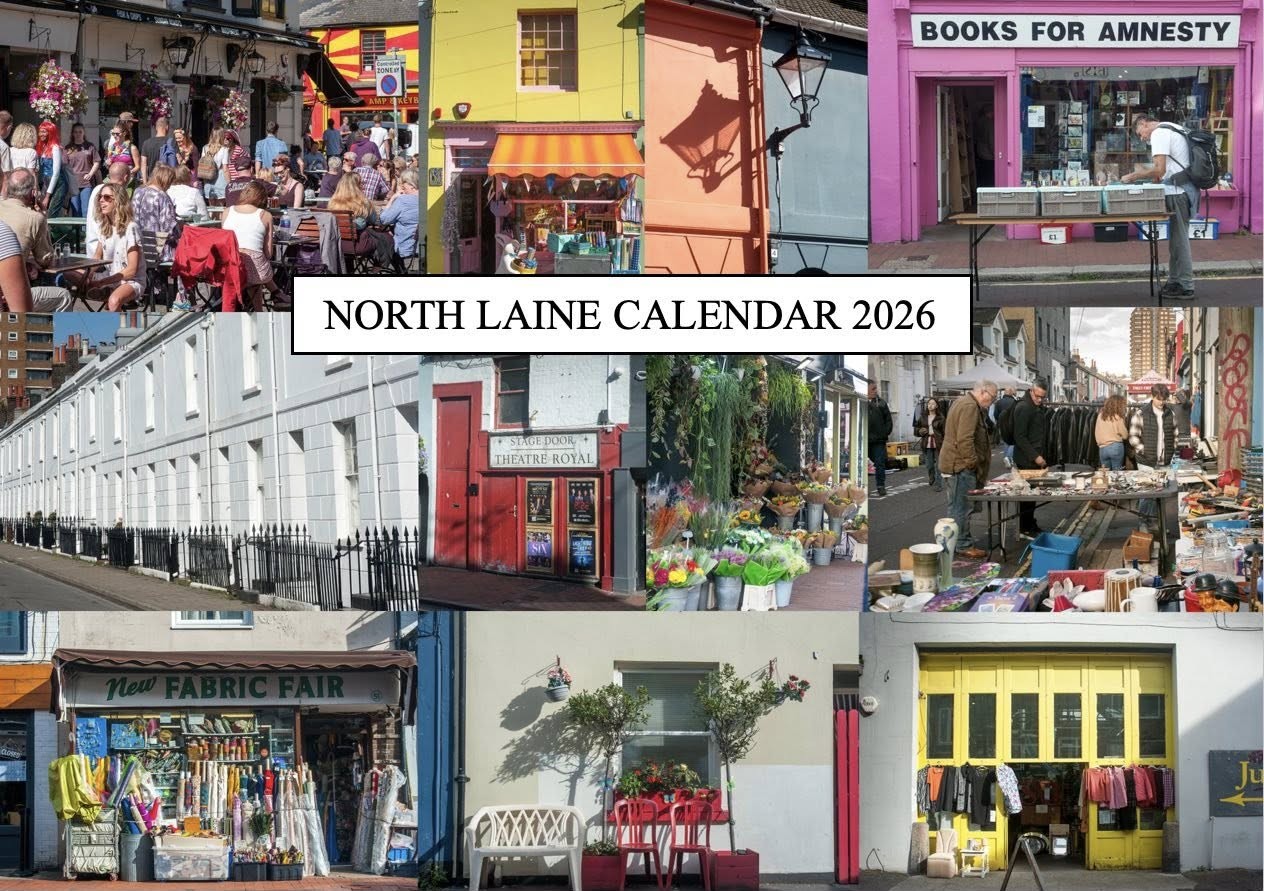
North Laine is Brighton’s most vibrant quarter: a tourist hotspot, a popular place to live, a conservation area and a bohemian, cultural centre of independent shops, pubs, entertainment venues, art galleries and cafés.
But, five decades ago, it was a sadly rundown and semi-derelict district of central Brighton, having recently been in danger of several of its early Victorian terraced residential streets being demolished by a bulldozer and replaced by an ugly Birmingham-style concrete car flyover.
Fortunately, this brutal proposal was rejected after several years by councillors following residents’ objections, otherwise the heart of the thriving area we now know as North Laine would have been decimated to become an aerial pathway to a giant car park.
The area was ultimately saved by a visionary Brighton planning officer, Ken Fines, who championed the district amid detractors who called it “tatty”. A local paper report famously highlighted a tree growing out of the bedroom in an empty and derelict house.
Crucially, the North Laine, with its terraced workman’s cottages became a conservation area in 1977. But its regeneration was also due to the efforts of angry locals who formed a campaigning close community.
They were determined to lobby the council and the powers that be to improve the state of their neglected neighbourhood.
They set up what became the North Laine Community Association (NLCA) after 100 neighbours, from pensioners to radical students and aspirational young couples, attended a public meeting at a boys’ club in Upper Gardner Street in January 1976. Shortly afterwards, the North Laine Runner community magazine was started.
A report from that meeting stormed: “What has happened in central Brighton is an outrage. It is time people in the area got together to change their future by co-operative action.”
The area wasn’t known as North Laine until 1976 when a long-forgotten historic field name for that area of Brighton was reclaimed by Fines. His personal importance to North Laine is honoured with a blue plaque on one of the community’s landmark businesses, Infinity Foods, in North Road,
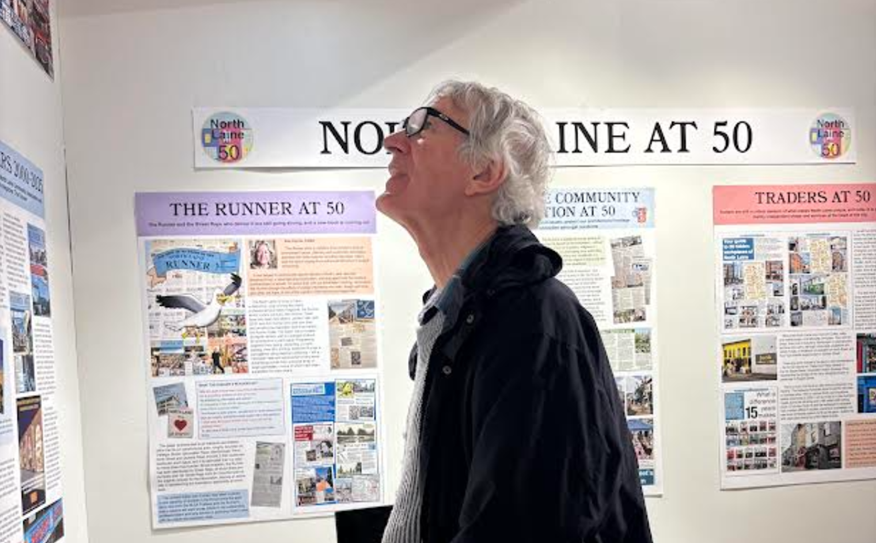
Now, the NLCA and the North Laine Runner are marking their landmark 50th anniversaries with a year of celebrations, starting with a major history exhibition, North Laine at 50, in the Jubilee Street library. It runs until next Saturday (31 January).
The anniversary celebrations continue on Tuesday (27 January) with a 50th anniversary party for North Laine locals and guests in the Brighton Toy and Model Museum in Trafalgar Street.
The event also marks the launch and sale of a new book, The Best of 50 Years of the North Laine Runner, drawn from NLCA’s much-admired community magazine which is distributed free to residents and started in February 1976.
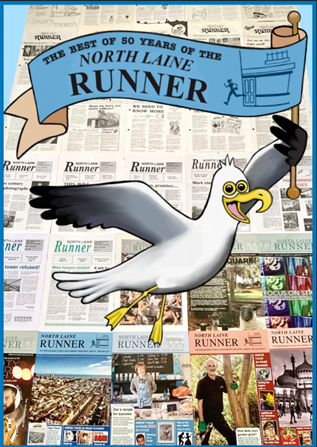
The book, edited by Kim Curran, is a curated compendium of the best and most interesting articles from the past half century of the Runner which, remarkably, has had only two editors in its half century – Kim since 2016 and, before her, Jackie Fuller who did the job for an incredible 40 years.
Kim, a past chair of NLCA who has been involved since 1977, said: “We’ve managed to produce this magazine voluntarily every two months for 50 years and that’s a major achievement.
“There’s a rich variety of material to draw on – dramatic events and fascinating and interesting characters in this bohemian area, including actors, artists, academics, entertainers and musicians,
“It’s also a record of everyday Brighton life over the years and about stories and campaigns from our past – a real social history. It is written by the people of North Laine for the people of North Laine.”
The book’s articles and illustrations have largely been lifted from Runners as they appeared at the time including the magazine’s current humorous cartoon strip Swoop! drawn by artist Nikki Brown.
There’s a scattering of famous faces, such as Anita Roddick, who began her Body Shop empire in a tiny “hippy” outlet in North Laine’s Kensington Gardens in 1976.
Others include theatre critic Jack Tinker, impresario David Land, theatrical agent Peggy Ramsay and comic Romesh Ranganathan who has appeared in the annual fundraising North Laine comedy nights at Komedia.
And what about the Texan cowboy rodeo entertainer Tex Macleod who ran a boarding house in North Laine’s Tidy Street and the female Cold War Russian spy recruiter Edith Tudor Hart who ran a shop in Bond Street? All these fascinating characters lived in or had links to North Laine.
Kim feels the appeal of the book is not limited to North Laine residents: “I’m sure it will have a wider interest. North Laine is right in the centre of Brighton and includes such major city institutions as the Royal Pavilion, the Dome and the Theatre Royal.
“Everything is on our doorsteps. We are also an inner-city area dealing with issues such as graffiti and tagging, crime, the encroachment of Airbnbs in residential areas, drugs and anti-social behaviour.
“But the community spirit shines and, as most streets are terraced, it’s an area where you get to know your neighbours and we all get together at regular NLCA social events. It’s a real village.”
Meanwhile, the ambitious and colourful North Laine at 50 exhibition features giant images in the windows facing Jubilee Square and inside the library – and an illustrated timeline in the foyer charting North Laine from Georgian market gardens to the coming of the railway and industrialisation, through decline, demolition and threatened obliteration to its regeneration through the modern day and the work of the NLCA.
Curator Sue Delafons, a NLCA trustee, said: “The exhibition is about North Laine history from the mid-18th century till today, with the focal point being the crisis and turnaround 50 years ago when it was granted conservation status – hence ‘North Laine at 50’ although its heritage is much older.
“I drew first for material from my own reading and walks and talks. The most outstanding source was the Runner itself. Other sources such as the Regency Society’s James Gray (archive picture) collection and (previous history book) The North Laine Book (2016) are acknowledged.
“The research and writing was time-consuming but straightforward. Much harder were the technical aspects. NLCA vice chair Peter Wingate-Saul organised hundreds of images. Also, thanks to printers Colourfast, particularly Ellie, who did a great job on layouts and formatting the Foyer panels.
“I think that newer or younger residents, and of course visitors, often do not realise how near North Laine came to destruction in the 1970s, so this is the major takeaway.
“I hope they will enjoy this fresh presentation and perspective and there will be the odd nugget to surprise them. My personal favourite is a female master farrier – Jane Ovendon – who ran her business during 1870 to 1890 in Marlborough Place.
“I have been overwhelmed by the interest from the visitors to the exhibition who have written such positive comments about it in our visitors’ book.”
She added: “North Laine is a crucible which fundamentally shaped modern Brighton – a melting pot of diverse elements. Many people I asked said simply ‘It’s the heart of the city’ just as the Runner is ‘the voice of North Laine’.
“It has millions of visitors and has proved surprisingly resilient but we need residents, traders, visitors and a council who recognise its unique character and value for the future.”
The North Laine at 50 exhibition runs during the Jubilee Library’s opening hours until next Saturday (31 January).
The Best of the North Laine Runner book launches at the association’s 50th anniversary party at the Toy and Model Museum in Trafalgar Street on Tuesday (27 January).
The book costs £10 will be on sale there afterwards and at the exhibition, along with other NLCA memorabilia such as calendars, as well as in selected shops – or contact info@northlaine.info or the North Laine Community Association website or Facebook site.








Thank goodness for those 1970s protesters. What would Brighton be without this vibrant and bohemian quarter? What happened to Birmingham city centre was awful. The heart of this once attractive city was ripped out for a concrete modernity so short-lived it looked out of date almost as soon as it was finished. No go areas in parts of the Bullring area sprang up soon after.
Fifty years ago – gosh! that would mean that they were members of the baby boom generation who, according to Mark Fry and his various iterations, have done nothing ever but destroy the planet since the Neolithic.
Shows what we can do against tories. Now just need shops to be affordable for those on uni credit
North Laine – the heart of Brighton. Good to know its history is being recorded.