
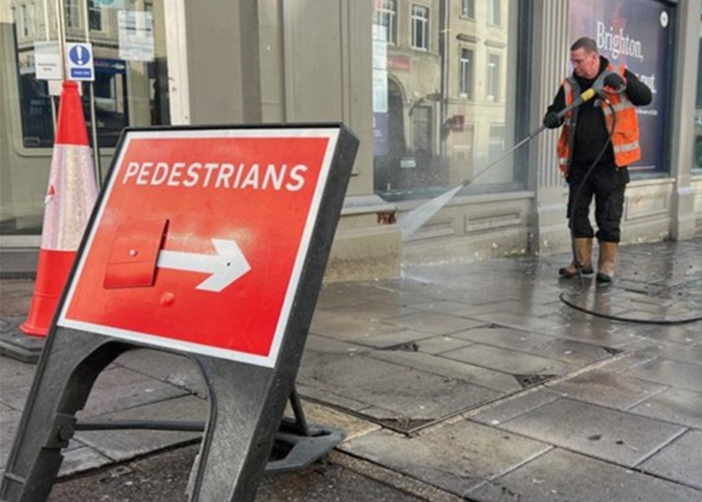
The streets of Brighton may not be paved with gold but a deep clean down one side of West Street burnished the route to and from the seafront.
Labour councillor Tim Rowkins said that a stretch of pavement had been partly transformed as workers scrubbed off the muck and dirt.
It now had a “rich golden brown” pavement, he said, while the other side was still thick with grime and chewing gum.
The overnight work had taken place as part of a pilot project, Councillor Rowkins told colleagues in a meeting at Hove Town Hall on Thursday (19 March).
And from May, contractors will extend the programme of overnight jet-washing and deep cleaning in the centre of Brighton in addition to the work of the council’s daytime team of street cleaners.
The decision to employ the contractors was taken by Brighton and Hove City Council’s cabinet after what was described in a report as “the Station to the Sea – Test and Learn Pilot”.
The deep cleaning will be funded with a £250,000-a-year budget for three years, with an initial focus on the “gateway” area from the railway station to the seafront.
The area includes the North Laine, The Lanes, Western Road and St James’s Street and could expand to other streets where needed.
The council is also “procuring” specialist equipment to remove graffiti and could set up its own commercial graffiti removal service to generate income.
Councillor Rowkins, the council’s cabinet member for environmental services and net zero, said that many people had called on the council to clean up the look and feel of the place.
Brighton and Hove welcomes about 12 million visitors a year but there have been complaints that too little was done to keep the busy streets clean.
In the past year, 40 new rubbish bins have been sited in the area, along with 10 cigarette bins, and with 57 new communal bins to come. Abandoned bikes have been removed and about a thousand stickers have been cleaned off hard surfaces.
Councillor Rowkins said: “A lot of these 12 million visitors turn up in the city on the train and often, if they’ve come from further inland, the first thing they want to do is go down to the beach.
“In my view, that initial experience of leaving the train station and walking down to the seafront, down Queen’s Road and West Street, has not always been a particularly pleasant one.
“I personally have a very ambitious vision of what that journey could be like at some point in the future but what we really wanted to do was to make a short-term highly visible impact.”
Labour councillor Birgit Miller, the councils’ cabinet member for culture, heritage and tourism, said that the hotels and hospitality businesses were excited by the improved cleaning plans.
The night-time cleaning budget is due to be reviewed after three years.