PATTI SMITH QUARTET – BRIGHTON DOME 12.5.26
With the recent by-elections and subsequent discourse on reprehensible Reform statements, it seems fitting that Patti Smith arrives at Brighton Dome for her fifth show at the Brighton Festival. From her roots as a CBGB punk poet to an award-winning memoirist, Patti Smith is a genuine cultural monolith and polymath, transcending music into a name you know, whether you’ve consciously sought her work or not. With this American luminary status, there is a lineage of responsibility to speak out against the far right, one that began with Pete Seeger and continues with collaborator Springsteen’s unabashedly anti-Trump tour. With another show tomorrow at The Corn Exchange billed as “an evening of words and poetry,” one thing is clear: more ears are paying attention to Smith’s words than ever.
With doors at 7:30 pm and Smith on at 8 with no support, a queue of mostly grey heads, young women and parental duos snakes around the block, trapping the 7:00 pm drinkers at The Mash Tun. There’s an additional sense of urgency with just half an hour between doors and Smith: is there enough time to get a pint and a decent spot?
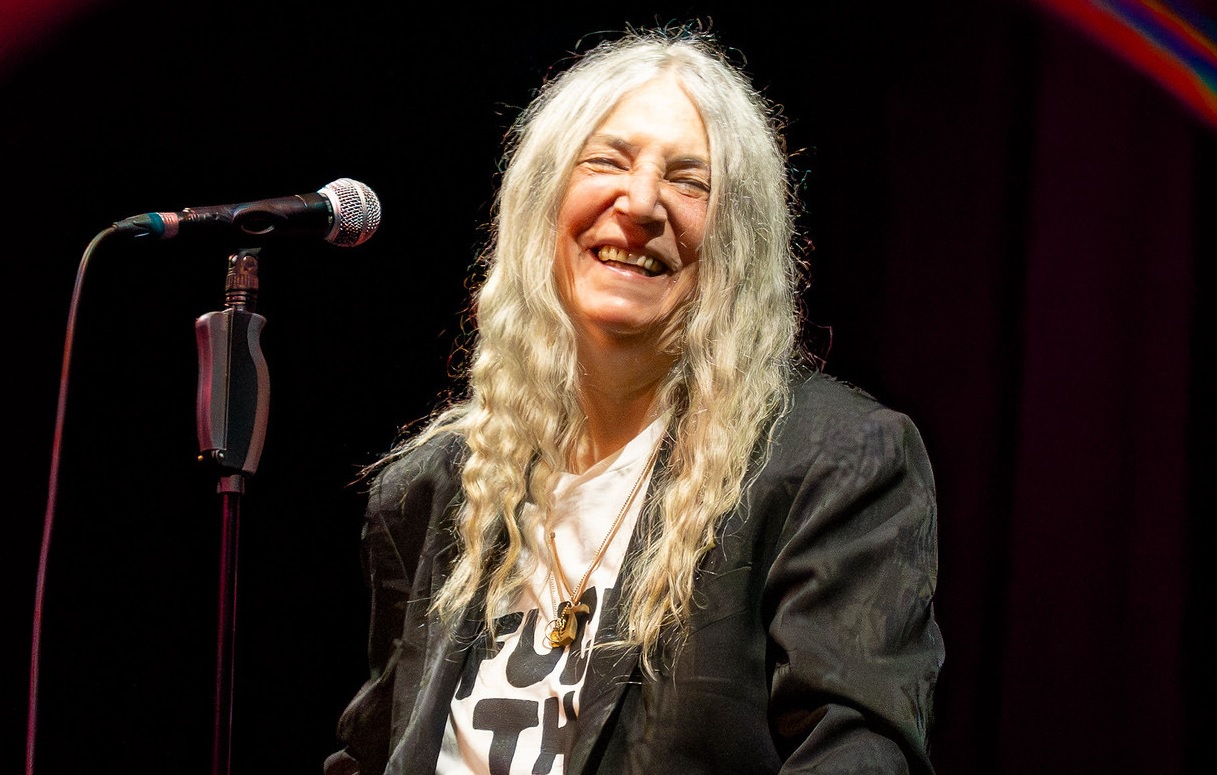
The answer is yes. Smith arrives 20 mins late, tea in hand, to an absolutely rapturous room, those in standing grateful they don’t have to play another game of ‘Where’s Wally’ with their friends up in seats. Almost prophetically, she steps directly beneath a spotlight that’s been waiting for her.
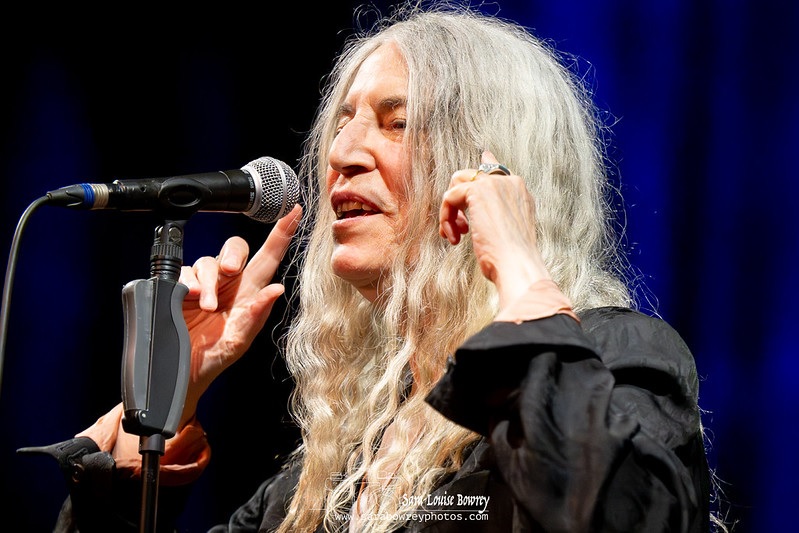
Opening with the twitchy Neil Young-via-Television longing of ‘Dancing Barefoot,’ Smith sways rhythmically as she showcases a voice that’s barely been touched by over 50 years of touring, drawing surprisingly strong harmonies of “oh god I fell for you” with Tony Shanahan.
Taking a moment to step out to wave while Jackson Smith (Patti’s son) solos, the crowd erupts yet again. “I thought I’d do this song,” Patti announces. “It’s a tribute to our merchandise.” After a false start, laughed off as an “experimental chord,” ‘Blakean Year’ is intensely snarled with a slight Lou Reed twang.
With 51 years since her first show, the only sign of her age is the appearance of reading glasses between tracks as she reads the setlist. As Shanahan moves onto keys, brooding bluesy notes ring out for ‘Revenge’; a track with the snarling spoken word refrain “I gave you a wristwatch baby/ you wouldn’t give me the time of day.” After rumbling into a biting conclusion, Smith explains the roots: “it’s not about anyone in particular… just men in general” to huge cheers.
In a Doors double whammy, Smith monologues about the roots of the track ‘Break It Up’ before a cover of ‘The Crystal Ship.’ Treated as a rhythmic backdrop, the focus is emphatically on fellow hippie laureate Jim Morrison’s words, with Patti’s fragile yet hypnotic vocals prescient. With her backing band swelling as she grows more distressed, it segues directly into ‘Break It Up’, handing the audience the keys to scream for the chorus while her son does a stellar job of imitating Tom Verlaine’s guitar work. Whilst the audience participation is the first sign Smith can’t quite handle the shouts of her youth, she’s self-aware enough to know her words are the star of the show, not punk antics.
Between tracks, Smith introduces their origins as part-legacy-storyteller show, part-gig; almost a preview to her more intimate second show. An extended monologue on Arthur Rimbaud, with ambient instrumentation, introduces the slower-paced ‘Nine’, only for it to later rein in another solo from her son and some surprisingly ballistic drumming from Rochford.
“Eight decades, it starts to get hard to get up” Patti laughs as she reaches for her tea between tracks. ‘Pissing In The River’ is a howling experience, slightly reduced from its recorded format yet still pleading, with “come back/come back” paving the way for a haunting conclusion, as Smith’s vocals descend into something primal and raw, as if her 1976 self is possessing her. “I wrote this when I was 28. I was aching then, and I’m aching now. Must be a Smith thing.”

“We worked this out on Sunday… we want to dedicate this to Fred Smith.” Shanahan announces as Smith takes a small break. ‘Kingdom Come’ – a Tom Verlaine cover – has suitably sharp guitar work from Jackson, punk-funk-driven bass from Shanahan, while he holds down lead vocals. It acts as an intermission of sorts, leaning into the setlist’s semi-improvisational feel, but with Patti’s absence finally letting them off the leash.
Arriving back from her break, Smith gives a knowing “Hi. We’re gonna try something”, Smith lets us in on the joke, after the entire band gathers, laughing around Rochford’s drum kit. After a false start, deep cut ‘Fireflies’ is given its live debut. With a walking rhythm to its gloomily sparse drums, it has the same foreboding feel of a Nick Cave track, with a countdown from ‘seven steps’ landing like a preacher’s spin on ‘Ten Green Bottles.’ With this sprawling epic, the quartet affirm their existence: this is far from a late-career cash/grab with Smith even stating, “this song will grow, but it will always have begun here.”
In a sharp turn away from macabre religious obsession, the ZZ Top-style riff of ‘Space Monkey’ lumbers in. While an utterly bonkers, almost feverish track – hand gestures included for the ‘banana’ lyric – it enthrals an audience so fervorous that Smith could individually insult each person in the room’s mother and still be applauded.
As Smith asks for the lights to come on, the room bursts with “we love you Patti” before the dual-acoustic guitar of ‘Ghost Dance.’ With soft harmonies of “we shall live again,” it is a light, almost campfire track with slight tribal percussion, allowing more communal sing-alongs. With another moment of audience participation, the audience is encouraged to “shake out the ghost” in a motion suspiciously close to choral jazz hands.
The riff of ‘The Entertainer’ rings out from Jackson Smith’s guitar as he vamps for time and attempts to annoy his mother; “He does that whenever I’m taking too long,” Patti smiles.
“In 2003, Tony [Shanahan] and I wrote this song for the Palestinians. We want to extend it to children in Iran and Lebanon,” Smith states in tonight’s first overt political statement, turning the lights green for the start of ‘Peaceable Kingdom.’ It is gorgeously poetic, tragic but hopeful; an honourable tribute to the life of activist Rachel Corrie.
“This song was written for Jackson’s father. Fred. Sonic. Smith” Smith announces before the iconically sultry piano chords of ‘Because The Night’ float through the air. The entire audience is enraptured, clapping and singing along to her only out-and-out hit with the passion of a gospel choir.

While the quartet leave the stage to cheers, these do not end: the audience is not content to leave the night where it is. Gone are chants of “one more song,” in their place are stomps and claps forming a rhythm that threatens the oak floors of Brighton Dome’s main area. Mercifully, at least for the council, they return to the stage with another family member, Jesse Smith, joining on keys.
“We wrote this song for people to use in times of trouble. These are definitely troubled times,” Patti introduces ‘People Have The Power.’ While remarkably prosaic and bordering on The Outfield levels of stadium New-Wave, its lyrics have an immensely rallying effect; channelling Pete Seeger in a statement of socialism that gets an entire room shouting “people have the power” while Smith replies “to vote” and various verbs in response. With by-elections last week and a prior mention of Palestine, Smith reminds us “Don’t forget it. Use your voice.”
Faking out a conclusion with one last shoutout to her band and one more “I love you,” Smith promises one more song if we can do her a favour. “We have a good friend… we were supposed to go to his birthday party, but we came here instead. We’re going to call him, and if he picks up, we’re going to sing Happy Birthday.” Fortunately, he does.
Keeping her promise, possibly the most iconic opening lyrics, “Jesus died for somebody’s sins/but not mine” are uttered. ‘Gloria: In Excelsis Deo’ ramps up into bounding, unbridled punk; while abiding by the concept of the big finish, Smith bounds around the stage in the same way she would’ve done at CBGB some 50 years ago.
Alternating between spoken word and singing, Patti Smith is a true storyteller, captivating throughout a set that bears the fingerprints of dearly departed collaborators. While her band are remarkably tight, they are emphatically a backdrop at times; this is no one’s fault, as Smith’s words could dwarf most musicians. For better or for worse, her turn-of-phrase is still remarkably prescient – the world may be on fire from the same matches as the 70s, but at least we have the same artist replying to the insanity. In one final statement, Patti Smith stresses: “Even if I have to slow down here or there, I promise I’ll always come back to Brighton.” With a voice practically unscathed from over 50 years of performing, you get the sense everyone here would keep coming back to see her for as long as she wants to play. Not many artists at 79 can inspire this level of feverish devotion, nor can match her stage presence; I can’t disagree with the audience’s sentiment.

Patti Smith Quartet:
Patti Smith – vocals, acoustic guitar
Jackson Smith – guitar
Tony Shanahan – bass, keyboards, backing vocals
Seb Rochford – drums
Oisín Murray – occasional bass and keys; alternating with Shanahan
Patti Smith Quartet setlist:
‘Dancing Barefoot’
‘Blakean Year’
‘Revenge’
‘Crystal Ship’ (The Doors cover)
‘Break It Up’
‘Nine’
‘Pissing In A River’
‘Kingdom Come’ (Tom Verlaine cover)
‘Fireflies’ (first time live)
‘Space Monkey’
‘Ghost Dance’
‘Peaceable Kingdom’
‘Because The Night’
(encore)
‘People Have The Power’
‘Gloria: In Excelsis Deo’