
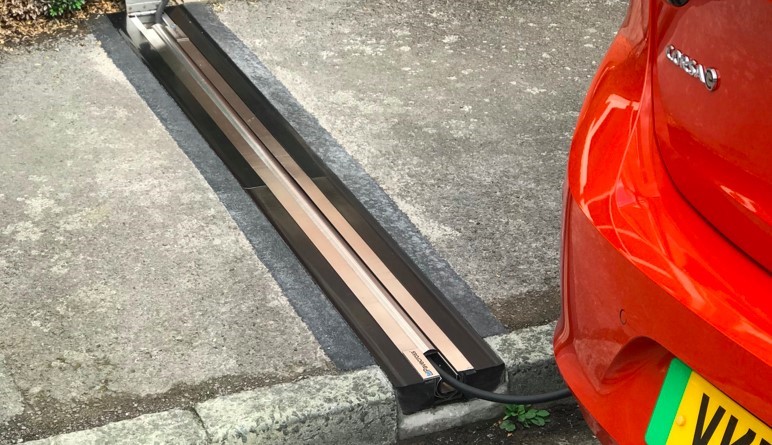
A pilot project will allow blue badge holders and taxi drivers to create pavement gullies next to their homes so they can charge their electric cars.
Brighton and Hove City Council cabinet backed the trial as part of a raft of measures to expand electric vehicle charging across the city.
During the cabinet meeting on Thursday 14 May, councillor Trevor Muten said the pilot would allow residents without a driveway to charge an electric vehicle from their home.
Priority will be given to blue badge holders using the Electric Vehicle Pavement Charging Grant. The council will work closely with Motability, which has a policy to transition its customers to electric vehicles (EVs).
There is £232,000 available from the Department for Transport through its EV Pavement Channel Grant to cover 193 gullies to run charging cables from homes to vehicles parked on the road.
The council also wants to encourage more taxi and private hire drivers to move towards electric vehicles.
The cabinet member for transport and city infrastructure said: “Brighton and Hove is not a city of driveways.
“Around two-thirds of households have no access to off-street parking, which means that without public charging, the transition to EVs simply would not be fair or practical.
“Many residents say they would like to transition to EV but feel living on a terrace, flat or home without a driveway is a prohibitive barrier to their environmental choice.
“We need to build infrastructure that removes this barrier and enables this choice.
“That is why this strategy focuses strongly on public, on-street and communal charging, that serve every community, not just rapid hubs.”
A report to the cabinet said this would not be suitable for all households but would be an alternative to public charging.
The report said more than half of the city’s households do not have off-street parking and would require public infrastructure to charge an electric vehicle.
There are 4,857 fully electric cars in the city, more than four per cent of all vehicles.
By 2040, electric vehicle ownership is projected to reach 82,000 vehicles.
There are currently 501 public charge points in the city with a further 1,650 to be installed in lamp posts in the next three years.
By 2040, the council aims to have 6,000 lamppost-based chargers installed across the city.
A further 1,000 fast charge points, 200 rapid chargers and at least two ultra-rapid charging hubs are also planned.
During the last year, the council has received more than 500 requests for charge points.
National Government policy is to ensure all new cars and vans sold are electric by 2035.
A public consultation carried out between June and August last year had 505 responses with more than half of the responders interested in using cross-pavement gullies.
Of those 70 per cent were willing to share charge points with others if the costs were shared.
Out of those responding, 471 had access to a vehicle – electric or otherwise – and 69 per cent of those had on-street parking only.
Three-quarters of the responders were willing to walk five minutes or less to access a charge point.
The biggest barrier to electric vehicle ownership was the lack of available home charging.
Seventy per cent of the responders said the cost of public charging, which is more than home charging, was “unfair”.
The council has secured £2.85 million to support further charging installations through the Local Electric Vehicle Infrastructure (LEVI) capital fund.







.. and then try and park outside your own house with the ‘gully’. I can seeing he neighbours fighting now!
I own an all electric car, registered disabled and have a blue badge. I live in a house which has double yellow lines on both sides of the street so you can’t park in it. I feel so ripped off at the prices you pay to charge at the council installed chargers , it’s more than double to what you would pay if you had the facility to charge at home and not much different in price to what you would pay to fill up at a pump. The only difference is it can take up to 22 hours on a slow charger and a matter of minutes at a pump! What does the council propose do for people who will never be able to charge at home? It costs around £33 to charge a car on a blink charger and £15 to charge at home, you pay 5% VAT to charge at home and 20% on a Public charger. How is this remotely appealing to make the switch to Electric? The council need to drastically bring their pricing down or at least for people in possession of a blue badge!
If you have a blue badge, you are likely in receipt of the higher rate of mobility PIP. This is designed to cover transport costs but often is just regarded as another income stream. Why should blue badge holders get another publicly-funded discount? Please explain your logic.
You sound like a horrible individual
Hate to ask, but given your circumstances, what possessed you to buy an all electric vehicle?
Didn’t you check the costs and practicality?
EVs have passed their peak and all the government perks to coerce drivers to buy or lease them are now being removed one by one. Moreover EV drivers find themselves in the same traffic jams as any other drivers so why have charge anxiety, range anxiety, batterylife anxiety, re-sale value anxiety and fire risk anxiety when there are simpler vehicles out there which are also supposed to be eco-friendly.
Quite a bit of ill-informed comment here – particularly from some who claim to drive EV’s. All mtorists receive subsidies already, by way of the tax payer picking up the costs of pollution (EV’s still produce tyre and break pollution), collisions, anti social behaviour, etc the list goes on…
… Many EV drivers receive substantial tax breaks. Large, heavy EV’s are more dangerous in collisions and cause more damage to roads. Perhaps a Japanese style system where you prove suitable parking before being able to buy a car.
To suggest that motorists are subsidised by non motorists takes some spectacular mental gymnastics.