
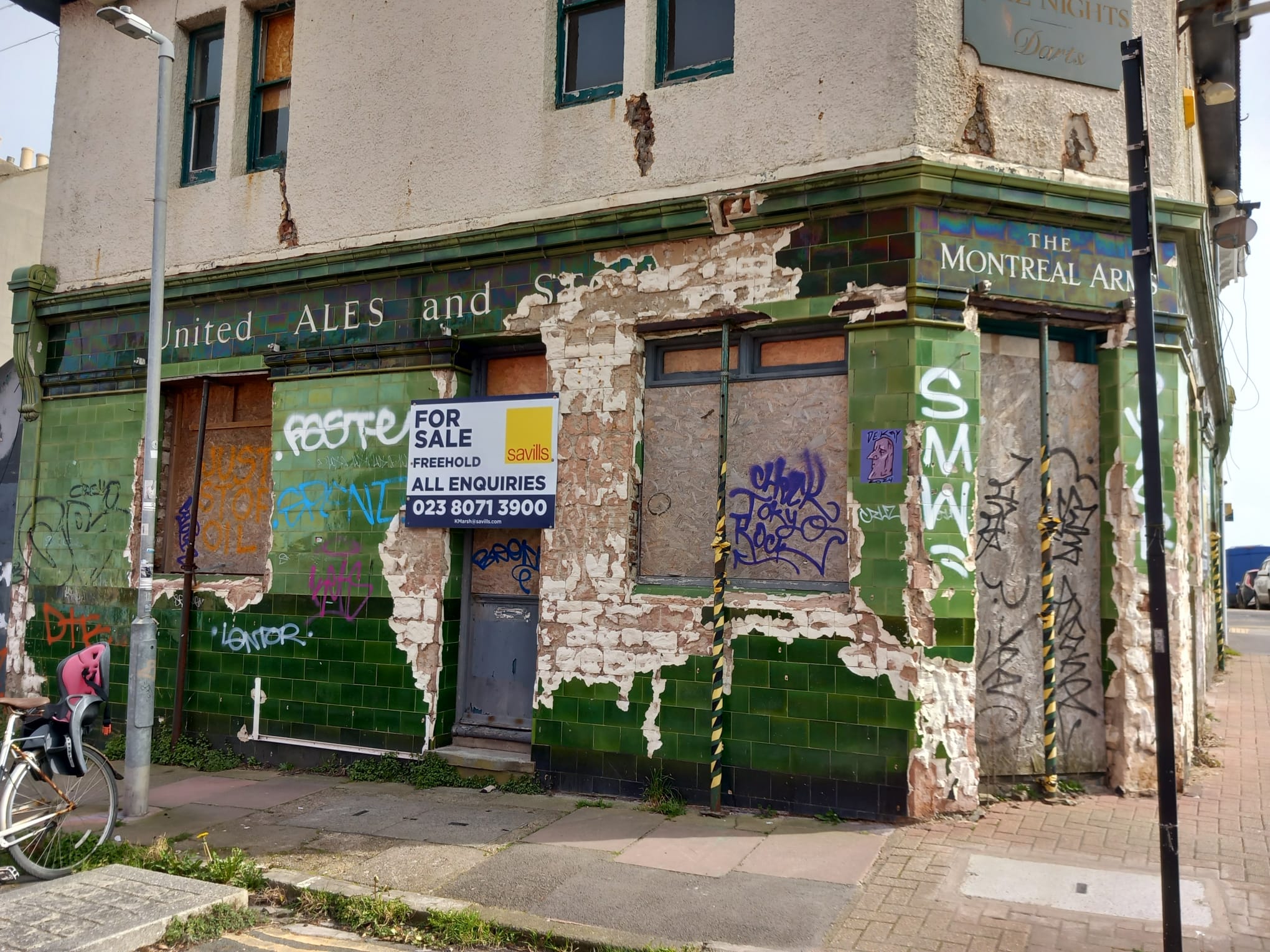
A Brighton neighbourhood has lost out on the chance to pause the sale of a “vandalised” pub after the council failed to advertise it.
The Montreal Arms was publicly put up for sale this month, three years after its owner hacked off its distinctive green tiles and started a lengthy ongoing planning battle.
In 2022, dozens of residents, forming an informal group called the Friends of the Montreal Arms, successfully applied to register it as an asset of community value (ACV).
This means if it’s put on the market, the community is given the chance to form an official organisation and pause the sale for six months to give it time to raise money to put in a bid.
The pub’s owner Charlie Southall told Brighton and Hove City Council he was putting it up for sale in December,
This triggered an interim moratorium period of six weeks in which any community group could register an interest in buying it, and request the six-month delay.
But Brighton and Hove News understands the council only informed one person from the Friends group, who for unknown reasons did not pass the news any further.
The council did not publicise the pending sale anywhere else – and so no expressions of interest were received.
Councillor Liz Loughran, chair of the planning committee: “We should also have advertised this intention to the wider community, but unfortunately in this instance, this was not done. We apologise for this as we are aware there is interest in this much-loved property.
“The asset of community value register is now being updated, and we made sure the nominator found out about the intention to sell on the very same day as the council did.
“We should have publicised this more widely, but I can confirm community groups are still able to submit bids for the property.”
Brighton and Hove News has contacted the resident it understands was informed of the sale of the pub in December, but has not received a response.








You couldn’t make it up – another balls up by the council.
After all that’s happened with this pub, it’s almost unbelievable the council could forget to let residents know about the building being up fo sale – it’s like they have no idea of their obligations under asset of community value legislation. Nothing surprises me anymore. Why didn’t the ward councillors at least let residents know, even if officers didn’t bother or forgot. Staggering!
You can make it up Bill, mainly by staggeringly not understanding what the actual obligations are.
Under the Localism Act, a council is only required to inform the owner, occupant, and ACV nominator of a potential sale. There is no requirement for them to inform the wider population.
The council are supposed to update their ACV register and they didn’t. Local authorities are also supposed to publicise the intended sale in the local community as well as informing the nominating body. The community can’t learn about proposed sales via telepathy. That’s why things like an ACV register exist, and why there is a requirement to publicise.
Not sure why you’re determined to stick up for the council on this one Benjamin – very odd.
It’s not so much sticking up for the council, it’s just the Localism Act is very clear on the obligations here. There is no explicit requirement in the Act to update the list when a notification of intent to sell is received. Same with The Assets of Community Value (England) Regulations 2012. However, I would agree that it is best practice rather than a legal requirement. Regulation 10 of the 2012 ACV Regulations states that publicising COULD be updating the list, issuing a public notice, OR contacting community groups.
I reject the premise that the council did not fulfil their legal obligations, but could they have done more? Absolutely.
Just quoting another comment “Section 97 of the localism act has a bit on “publicising receipt of of notice” where is says they need to make an entry into their ACV list and include things like the date they received the notice.”
So you’re actually mistaken on the obligations – it is written into the legislation. I’ve looked it up to triple check. It is clear.
Publicising receipt of notice under section 95(2)
(1)This section applies if a local authority receives notice under section 95(2) in respect of land included in the authority’s list of assets of community value.
(2)The authority must cause the entry in the list for the land to reveal—
(a)that notice under section 95(2) has been received in respect of the land,
(b)the date when the authority received the notice, and
(c)the ends of the initial moratorium period, the full moratorium period and the protected period that apply under section 95 as a result of the notice.
I don’t think that’s correct. The council also appears to have a statutory duty under section 97(4) of the Localism Act to publicise the proposed disposal in the locality. Otherwise, if the nominating party is indisposed (as in this case), it precludes other interested community groups from notifying the council of their wish to be a potential bidder.
It’s very interesting to go through this with you both, Bill and Jeffrey. It’s clear that there are some misunderstanding around the obligations, so let me try to clarify this further.
Bill, you’re absolutely right to highlight Section 97 of the Localism Act, which specifies the requirement to publicise the receipt of a notice about a proposed sale of an Asset of Community Value (ACV). This provision does indeed mandate that the council make an entry in the ACV list, including the date they received the notice and the relevant timelines for moratoriums, as outlined in Section 95.
However, the issue lies in the interpretation of how this needs to be done. While the legislation requires publicising the receipt of notice, it doesn’t explicitly state that the council must actively notify the wider community or engage in extensive outreach beyond updating the ACV list and publicising the receipt in a way that’s deemed appropriate by the council. What this usually means in practice is that the council must update the public record (the ACV list) and make the notice accessible for community groups and interested parties to view, which it does through its website.
Jeffrey, I also agree with you that the council has a duty to publicise the proposed disposal under Section 97(4), and this is key in ensuring that other community groups can potentially put forward bids if the nominating party is unavailable. That said, the obligation for publicising can be fulfilled through methods such as a public notice or some form of local communication, but again, it’s more about the interpretation of what counts as sufficient publicity.
So, to be clear, the council does have a legal obligation to publicise the receipt of the notice and update their ACV list, but it’s a bit of a grey area as to how much outreach they are legally required to do beyond that. Could the council have done more to actively inform the community? Absolutely. I would argue that the failure to do so speaks to a lack of proper engagement with the public, which could be seen as a missed opportunity, especially if the community wasn’t made aware in time to act on the proposed sale. I don’t think there has been a lost sale to the community personally, but I’m more than willing to stand corrected on this if a group had stepped forward.
It’s not a case of “sticking up for the council,” but rather understanding the nuances of the legislation. I’m all for better communication and transparency from the council, especially on issues that affect the community like this one. But in terms of legal obligations, the council has met its requirements.
To be clear Benjamin, the council did NOT update the ACV within the six-week period, and it did not publicise the sale in any way, shape or form. So they failed on the absolute basics of what the legislation requires, other than sending an email to one person from the nominating group – not just what you call the nuances.
Hi Jo,
I appreciate your point, but I still believe it’s important to distinguish between legal obligations and best practice. The Localism Act and the associated regulations are quite clear on the core requirements, and the law mandates that the ACV list must be updated immediately upon receipt of the notice. While the council might not have updated the ACV list within the six-week moratorium period (which would be a failure in terms of best practice), there’s no legal requirement for the list to be updated within that exact time frame. The key requirement is for the update to happen as soon as the notification is received, rather than by a specific deadline, although I’m sure we would all, as reasonable people, expect that to have happened within days.
Regarding publicising the sale, while it’s certainly good practice, and I’m fully in agreement with you on this point, to publicise it more widely to ensure the community is aware, the legislation doesn’t explicitly demand publicising the sale in a particular format. It says “publicising receipt of the notice” could include updating the list, issuing a public notice, or contacting community groups (the single email potentially covers this, unfortunately). However, there is no explicit legal requirement to issue a public notice, so I do think it’s important to be careful about what we expect as a legal obligation versus what we wish was best practice.
I fully agree that the council could have done more, but the distinction is important to avoid overstating the legal duties here. Where the council falls short in realistic practice, that’s something that should be addressed.
Incompetence on a grand scale from officers and councillors alike. Is there any other important decisions that we know nothing about. Perhaps the idiots should all be demoted, sacked or financially penalised for their lack of action and dereliction of duty?
Hardly. Realistically, anyone who was interested would have already known.
How would anyone have known Benjamin? Specifically during the six-week interim moratorium period? If only one or two people in the council’s planning department were aware, and they only told one person in the Friends of the Montreal Arms, who for all we know didn’t even see the email? The For Sale boards only went up last month, after that six weeks was up.
I have a strong professional interest in this – it’s the story which keeps on giving – and I didn’t have a clue. Nor did its immediate neighbours, nor did about a dozen other signatories to the ACV application that have got back to me. Are we not “really interested”?
I asked the council three times what their duties are in terms of advertising it more widely, and didn’t receive an answer. I’m still not 100% clear, but I do know that other local councils state they will proactively let the community know if a six-week interim moratorium is triggered, so if not a specific legal duty, it does seem clear it’s good practice to.
And while I agree with that it’s fairly unlikely any community group would have formed to take it on given the circumstances, don’t you think that should have been up to the local community to decide?
Benjy is a Council (Labour) apologist paid to spout pro-bhcc propaganda.
That’s a very good point you make there Jo.
The legislation is clear that the “eligible” ACV nominees are specifically mentioned as a requirement to being informed as directed in the Localism Act (2011), s95. From what you’ve said, it sounds like the signatories were individuals, rather than a constituted group – which means they wouldn’t need to be informed.
So, on the legal side of things at least, I can’t see a legal issue with the way it’s been done. But as best practice? I’m completely on board with your thoughts. Despite being legally sound, that shouldn’t detract from the principle that communities deserve every reasonable opportunity to explore their options. Moving forward, I think there’s a strong case for encouraging the council to adopt a more open and proactive approach in similar situations.
Care to explain where the perceived lack of action is? Because your insinuation is incorrect.
Once again BHCC are guilty of sheer ineptitude.
Perhaps the relevant officers were ‘working from home’.
But don’t worry – no-one at the Council is ever accountable for their failures.
Suck it up and pay yer Council Tax!
3 Labour cllrs in Hanover. And Labour running the council. You’d have thought at least one of the 3 would have thought it was worth passing on this news to residents
Does Hanover have an established TRA?
It does indeed. Various residents associations and groups, with the HEG Communities Forum acting as an umbrella for them all. So yes, the Labour councillors in HEG could very easily have informed the local community.
Councillors could have very well not known; however, it would have been within the spirit of the legislation for the council officers in charge of the ACV list to advertise the notice for sale more broadly.
Once again, Vespasian makes a sweeping statement that is disingenuously inept.
Under the Localism Act, a council is only required to inform the owner, occupant, and ACV nominator of a potential sale. There is no requirement for them to inform the wider population.
Hi Benjamin – the legislation clearly states that the council should put details of the sale on their ACV register, which they didn’t – so how you are drawing the conclusion they haven’t c**ked this up is is v odd – especially when you try to suggest you know the legislation inside out.
In case needed – Section 97 of the localism act has a bit on “publicising receipt of of notice” where is says they need to make an entry into their ACV list and include things like the date they received the notice. They do have a responsibility to do more than just notify the nominee, and they didn’t do it. It is a council failure and they did not adhere properly to the legislation and the requirements in it.
Hey Fletch, the ACV list is indeed updated with the required entries as dictated within the Localism Act. On this assertion you made, I believe the legislative requirements appear to have been met. There’s an omitted detail that is important in this situation to point out – not all nominees need to be informed, such as when the nominees are a group of individuals.
However, should they? Would that be in keeping with the spirit of the legislation? Absolutely.
Having said this, and to correct myself as Jo has rightly pointed out. The ACV list had not been updated since November, which it should have been “immediately” as a notice was received, typically within a few days.
Brighton council are a bunch of fools.
This administration is getting very good at apologising.
As opposed to the last that we’re really poor at owning up to their mistakes?
We need competence not apologies.
You didn’t get either with the previous, so however you want to incorrectly spin it, that’s an improvement.
Come on ben, you know that’s a fallacy. What-about-ism helps no one except to show you are a shill running defence for a council that has clearly fucked up.
Ah, I get called a lot of things, ad hominems mean nothing to me. My personal favourite was when Barry called me a Russian spy, ha. I’m just pointing out the flaw in the logic here:
Incompetence and never apologising, is better than incompetence but apologising.
Neither are great, but that doesn’t make sense, right?
On a slightly different angle, I can’t imagine that there are any groups who would even want this shambles of a building. Particularly not with the expensive damage that would be inherited, and how pubs are not great business ventures these days.
This bunch of Labour councillors are just hopeless. The seafront is rotting, bills keep going up, they want to bus kids (including Send children) from central Brighton to outlying schools. They constantly say there is no money but always find money for their capital projects. Our local councillors don’t stand up for local residents. They can’t even be bothered to follow up on the Montréal Arms.
This argument is riddled with sweeping generalisations and misrepresentations. Branding all Labour councillors as ‘hopeless’ based on selected grievances is a hasty generalisation that ignores any positive contributions they may have made. The claim that the council ‘always finds money for capital projects’ while saying there’s ‘no money’ misrepresents financial realities—revenue and capital budgets are separate and can’t simply be redirected at will. Suggesting that councillors either ‘stand up for local residents’ or do nothing is a false dilemma that ignores the complexities of governance. And throwing in the issue of SEND transport as an emotional hook without addressing the full context is an appeal to emotion, not a fair assessment. If we want real accountability, let’s deal in facts, not rhetorical shortcuts.
Generalisation or accurate summary. It’s obvious that you are pretty much alone thinking the councillors are doing a good job. I can’t be bothered replying to your patronising discussion on budgets but let me give you a few ‘facts’ about these councillors and send kids.
The recent changes to school admissions mean that around 50 children in my central catchment will be displaced to outer schools (councils own figures) of these around 20 per cent are likely to have Send needs (gov figures). These children will be forced into buses and away from their support groups, whilst similar children will be bussed from outer Brighton.
During the consultation I attended a council organised meeting for send parents, not a single Labour councillor could be bothered to attend. When voting on the changes not a single Labour councillor voted against the changes (they were ordered to support by their party) or spoke up for send kids in their local constituencies. Labour councillors do not have our backs. As a parent of a send kid, I have gone from being a Labour supporter to doing everything I can to ensure they will not get elected at the next council election. I hope others do the same.
The FACT is the council did not adhere to their legal requirements under section 97 of the Localism Act to update their ACV register with details.
This failure has led to residents losing the right to register an interest within the 6 week moratorium period. This is a whopping failure on the council’s part.
I dispute that, Fletch, we’ve been discussing it above in detail, but I believe the council did, in fact, adhere to their legal requirements around it, unless you’ve got a copy of the ACV list from December that doesn’t show the details that are currently on the most recent version?
Good lord Benjamin, from the quote in the story:
“We should also have advertised this intention to the wider community, but unfortunately in this instance, this was not done. We apologise for this as we are aware there is interest in this much-loved property.
“The asset of community value register is now being updated.”
I have a screengrab of the council website from 26 March which shows that the ACV register had not then been updated since November. I also have an email from the council to another interested party which states in black and white that they should have published a disposal notice, and didn’t (as well as stating they failed to update the ACV register)
Does that answer your questions?
I should try to read the article more carefully, especially after a few days. That does indeed answer my question. Thank you, Jo. Of course, the next prudent question here should be, are there any groups who wish to utilise their right to register an interest, and should the 6-week moratorium period be restarted because of this procedural error to allow their interests to be registered?
I’d be interested to know what due diligence was undertaken to ensure the contact details of the nominating party were up to date. Surely there’s a responsibility on the council to ensure the relevant party has received the notification? It would seem remiss to simply bang out an email to the first person on a three year old nomination form and consider it “job done”. Was there any attempt to establish prior contact? What response, if any, was received? Where a party cannot be contacted or simply ignores the notification, what’s the process for notifying other relevant parties?
In any case, where a notification of disposal under section 95(2) of the Localism Act is received, alongside responsibility under section 97(3) to provide written notice to the nominating party, there exists a concomitant duty under section 97(4) to “make arrangements for those matters to be publicised in the area where the land is situated”. That certainly doesn’t appear to have happened. Perhaps Benjamin has a take on that particular omission?
The moratorium clause specifically invites bids from “any community interest group” and is not restricted to the original nominating associates. If the proposed disposal is not more widely publicised under section 97(4) then only those contacted by the nominating party could make it known. In this case, it appears no-one was notified, and so, as the council appears to have ignored its duties under section 97(4), no potential bidders could be considered. I’d argue that this is a significant oversight given section 97(4) seems precisely designed to obviate any issue with section 97(3) where the nominating party was no longer available.
Did the council make any effort under section 97(4) to publicise the sale in the local area?
Aye, the “nominating party” has a definition which may explain it, Jeffery. Unconstituted groups, such as a group of individuals, appear to be excluded from the requirements of notification. Although, talking to a few people on here, I certainly agree with some of the others’ views that whilst it may followed the letter of the law, with some debating about the local area advertisement, it doesn’t really represent the spirit of it.
I did some reading around this, because it was interesting, thought I’d share:
This distinction seems to exist because the process of nominating an ACV is intended to benefit community-based organisations, rather than individuals acting alone. While individuals (or groups of individuals) can nominate assets for inclusion on the ACV list, they are not given the same rights to be notified about the sale as community groups or organisations are.
They need to apply for a tier 1 tribunal case.
Knock it down, build flats