
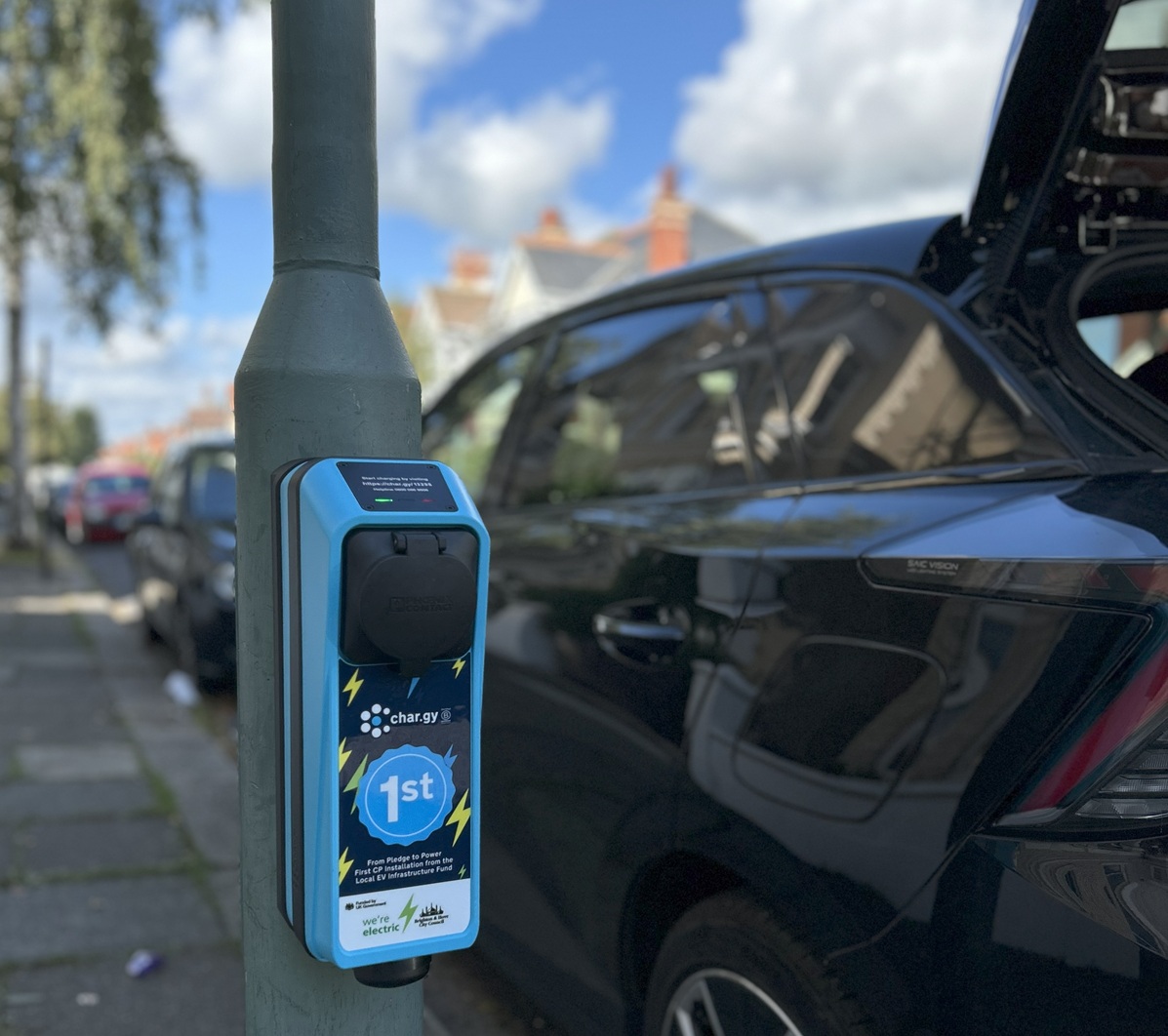
The first of Brighton and Hove’s newest wave of on-street electric vehicle (EV) charger has been installed as part of a project to fit more than 6,000 more around the city.
Chargepoint operator char.gy said it has started fitting more than 6,000 kerbside chargers for Brighton and Hove City Council (BHCC) after securing a £130 million contract.
The new charger in Lawrence Road, Hove, is the first to be installed, supported by the Government’s £381 million Local Electric Vehicle Infrastructure (Levi) funding.
The scheme supports local authorities in England to plan and deliver charging infrastructure for residents without off-street parking.
John Lewis, chief executive of char.gy, said: “Our focus is on providing reliable, affordable and convenient EV charging for the residents who need it right now, and we won’t be slowing down.
“This is a win for sustainability and for the local community.”
Trevor Muten, cabinet member for transport and city infrastructure at BHCC, said the local authority is “leading the way in providing our residents, visitors and businesses with the infrastructure needed for the growing number of electric vehicle users in the city”.
A DfT spokesperson said: “We’re powering up an EV revolution in the UK and delivering £381 million to install over 100,000 chargepoints across the country, including in Brighton and Hove, so that local people can confidently make the switch to electric.
“More chargepoints on our streets will make it easier and cheaper to own an electric vehicle, meaning people can charge up cheaply no matter where they live and no matter where they travel.”
A report published by public spending watchdog the National Audit Office in December 2024 found the rollout of public EV chargers was “on track” to meet the 300,000 the DfT estimates will be the minimum needed by 2030.
The Government has pledged to ban the sale of new petrol and diesel cars and vans from 2030.






They need to bring the price of charging down, it cost three time the amount to charge on one of these chargers than it does if you have the facility to charge at home and even more if you charge at service stations or at supermarkets, it really doesn’t work out that much less than petrol. If they really are serious about all of us switching to electric then they really need to at least half the cost of charging. We don’t all have the facility of charging at home!
This is because vat is charged at 20% for public charging. Fare charge is campaigning for vat on public charging to be reduced to 5% to be bring it in line with home charging. We live in hope but you can image the all the complaints from petrol heads
You can pay as little as 7p a kw at home and it’s over 37p a kw on one of these chargers. How can that be fare?
But many people can’t have their own chargers at their homes.
And if they did the cost of the equipment and installation needs to be taken into account when comparing the various rates charged.
And if say a supermarket installed chargers they’d also want to recover the cost of the installation.
Out of a £962m annual council budget, can Brighton and Hove News confirm that BHCC has committed up to a third of the budget on ev chargers??? They would seem to be out of control with our money. https://www.contractsfinder.service.gov.uk/notice/275af585-6fce-40f8-8256-2350890f2677?origin=SearchResults&p=1
More than likely just a typo.
You could email the contact on the page you link to and ask for clarification and a correction
But no the council isn’t spending a 1/3rd of it’s budget on EV chargers
The £381m figure is money being provided by central government to support councils across the country to deliver charging infrastructure. Brighton and Hove got £2.8m of that funding. The cost of installing these chargepoints is mainly met by the private sector, the companies putting the chargepoints in, which is why the cost to charge at a public chargepoint will be higher – those companies need to recover their investment.
With these chargers it seems it’s 59p per kwh to charge in the day and 39p at night, or about 20p per mile of driving which was about the same as my old 1.6 litre 2009 petrol car. If you want people who can’t have a home charger to spend the extra it costs to get an electric car over a petrol one you’ve got to make the public charging cheaper. If you charge at home it’s only costing you 7-10p per mile of driving so if you’re doing a lot of miles the savings quickly add up compared to petrol and if you have solar panels on your house you’re paying even less. Say your saving about 15+ pence per mile by using an electric car with home charging and solar panels on your house, that’s £1500+ per year if you’re just doing an average 10,000 miles a year
We are lucky enough to have space for a charging point at home (it cost a little over £1000 to install over a year ago). We had to change cars & our 2yr old Renault Zoe cost £10k, we could have a better car for the same price if we had stuck with diesel/petrol.
We are on an Octopus EV tariff and between 12.30pm-5.30pm it costs 7p/kWh, (it is more like 24p during the day). We therefore run the washing machine, dishwasher and water heater at night (ok if the neighbours can’t be disturbed). Octopus also offer free hours of electricity on some days (today it’s 12-1pm) & remind you to plug-in. I totally agree that the current unco-ordinated mishmash of on-street & public chargers on private land is a major disincentive to switching to an EV. Ed Milliband needs to make it a priority – cap the fees. When you are out and about, you can’t always ‘shop around’. EVs are the future, but no one in government seems to be taking control of sensible coordinated policy making & implementation.
I agree that the current charging fees are a disincentive to move to electric cars ( we have 2 and are dependent on on-street charging). It also needs to be considered that most people who do not have the ability to charge at home – apartments, shared homes etc are in lower income brackets . So is the cost of onstreet charging discriminationary ??