
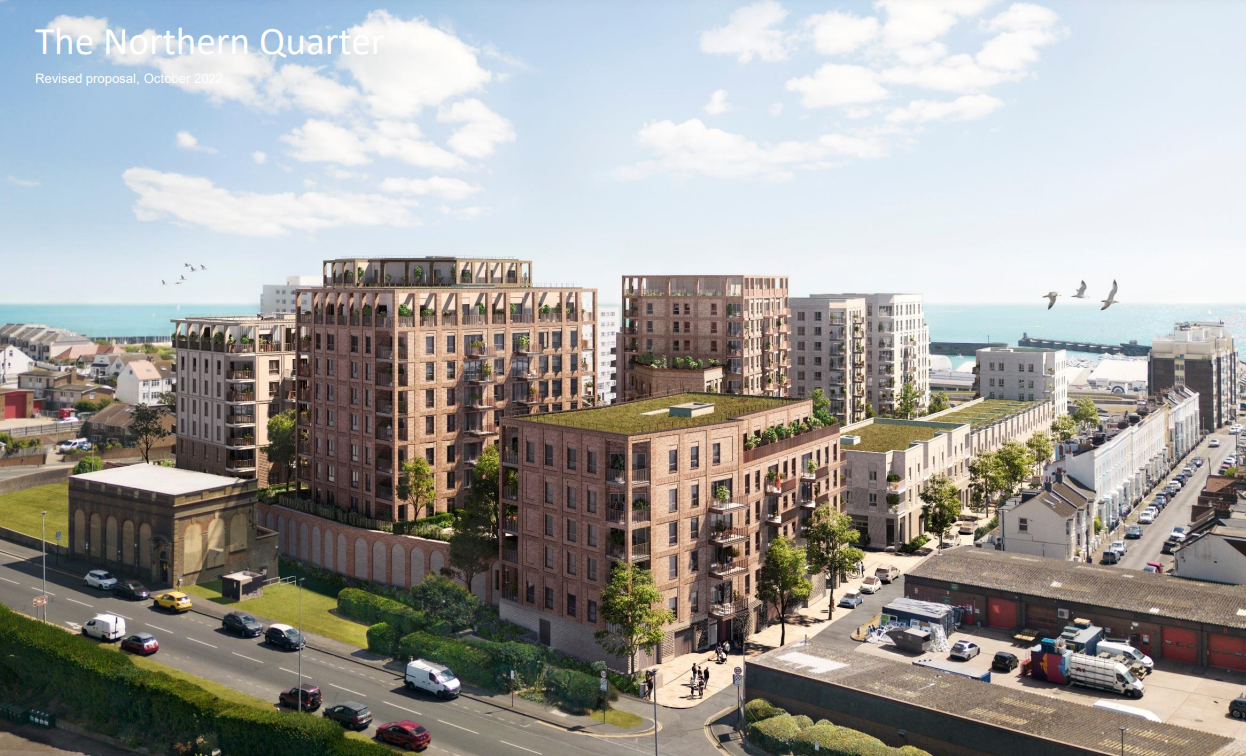
Housing and Planning Minister Matthew Pennycook has approved a £280 million scheme for 495 homes on the old gasworks site in east Brighton.
The council will also have to foot the bill for an appeal – expected to run to hundreds of thousands of pounds – after councillors turned down the application at a Planning Committee meeting last year.
The scheme could provide 195 jobs but the developer, St William, does not have to build any affordable housing because of the cost of remediating the site.
If funding can be found, St William has agreed with Brighton and Hove City Council that up to 198 “affordable” homes could be included in the scheme.
The planning application was turned down by Brighton and Hove City Council’s Planning Committee in May last year although officials had recommended granting permission subject to conditions.
St William appealed and a six-day public inquiry was held in March, with the decision reserved to the Secretary of State. At the time, it was Angela Rayner.
Three main issues were raised at the public inquiry at Brighton Town Hall – the effects of the scheme on the character and appearance of the local area, the effects on the area’s heritage and the living conditions for existing and future residents.
Those concerns included the potential harm to the setting of the neighbouring French Convalescent Home and the effect on the Regency splendour of the Kemp Town seafront terraces.
Today (Monday 22 September), the Planning Inspectorate said that St William could build nine blocks of flats up to 12 storeys high on a five-acre site bounded by the B2066 Roedean Road, Marina Way and Boundary Road.
The report by planning inspector Dominic Young concluded: “The benefits of the appeal scheme are collectively sufficient to outbalance the identified less than substantial harm to the significance of the French Convalescent Home.
“There are no protective policies which provide a strong reason for refusing the development proposed … the appeal should be allowed and planning permission granted.”
The council and the Brighton Gasworks Coalition, a community group that took part in the public inquiry, can appeal to the High Court. They have been given a six-week deadline if they wish to lodge an appeal.
This seems unlikely, with the government having ordered the council to pay St William’s appeal costs – believed to be a six-figure sum. The council’s own appeal costs were £160,000 before VAT, pushing the total closer to £200,000.
The Ministry of Housing, Communities and Local Government, said: “In planning inquiries, the parties are normally expected to meet their own expenses, and costs are awarded only on grounds of unreasonable behaviour resulting in unnecessary or wasted expense in the appeal process.
“The inspector recommended that a full award of costs is justified on the basis that the council prevented or delayed development which should clearly be permitted.
“The council failed to produce evidence to substantiate each reason for refusal on appeal, made vague, generalised or inaccurate assertions about a proposal’s impact and failed to determine similar cases in a consistent manner.
“And there were substantial procedural failings on the council’s part including an obstructive and untimely approach to the ‘statement of common ground’, the submission of a ‘statement of case’ which was bereft of meaningful detail and a failure to review its case promptly following a material change in national policy.
“Having considered all the available evidence, and having particular regard to the Planning Practice Guidance, the Secretary of State agrees with the inspector’s conclusions that unreasonable behaviour resulted in unnecessary or wasted expense and that a full award of costs is justified.
“Accordingly, he has decided that a full award of costs, as recommended by the inspector, is warranted on grounds of unreasonable behaviour on the part of Brighton and Hove City Council.”
St William said: “We welcome the Secretary of State’s decision which reflects the government’s commitment to unblock homebuilding and growth.
“The derelict Brighton Gasworks site is allocated for housing development but it still took over five years to achieve planning consent via appeal.
“The system has to work faster and this important decision makes that clear.”
Labour councillor Jacob Taylor, the deputy leader of the council, said: “It is disappointing to see this decision and I know local residents will be concerned.
“It is also unwelcome news that we will have to pay costs at a time when council finances are under pressure.
“We remain committed to supporting responsible development and working with communities to ensure future plans reflect the needs of the local area.”








It was a Gasworks, the Council were worried that a block of flats was a blot on the landscape, and now they pay for the appeal.
That’s not correct, Barry. Costs are only awarded against a council if it behaved unreasonably. The Inspectorate’s Report doesn’t suggest this is the case.
Yes it does, can you not read?
There’s been an update since two hours ago, JM. CDIR was published separately.
Stop get some help benj
Yep! I’m so upset. I, together with other residents, saved the flint boundary wall from being demolished. Boundary Road is unadopted so how does this work now?
It’s about time isn’t it? How much wasted money, time, just life did this take? It’s an abandoned brownfield site exactly where housing should go. It’s got great transport links, perfect. Stupid NIMBYs
And shock horror, another light shone on the ineptitude of the council
Nothing to do with the competency of the council, which the inspector’s own report makes clear, as Chris points out. You normally do better than this kind of rhetoric!
AGHAST put forward a very comprehensive and compelling case against the scheme, showing how the developer’s remediation proposals don’t fully protect residents from inhalation risks, with case studies from other gasworks sites. They also highlighted flaws in the developer’s Financial Viability Assessment, which is why, in my opinion, the council must at least insist on a late-stage review.
Crucially, they showed that so-called “affordable housing” here is anything but affordable. At 80% of market rent, a two-bed would still be around £1,600 a month, according to some rough maths at the current market rates in Brighton.
Far from being “stupid NIMBYs”, opposition to this scheme was based on health, economics and affordability, a strong evidence base for resisting a development that risks repeating the same mistakes already seen at the Marina.
AGHAST didn’t put forward a compelling case at all. It was NIMBYism at it’s finest and thankfully we now have a government that will bulldoze though such selfishness. About time
Correct.
Hardly, Dave. AGHAST brought in experts on contamination, health and viability, and the Inspector himself acknowledged. Waving all that away as “NIMBYism” is just low-effort noise, something I’ve seen plenty from Mark previously on this subject, which he should be better at, considering.
Get some help Benji
Correct. Great transport links, supermarket already there. Hospital down the road. Brownfield site, currently a blot on the landscape. Flats that are desperately needed yet, some NIMBYs somehow purswaded the councillors to not use common sense so yet more of our tax wasted…
Dumbness in action.
I believe there’s a few councillors live adjacent to the area so that maybe the issue, however it’s nice to see common sense prevail after what must be 5 years, no wonder the city is in a mess.
Did you get a chance to ever read the published reports by AHGAST? I think that might answer your question on perceived common sense. As ever, nuance plays an important role in why you can’t just apply nonsensical common sense.
It’s a shame that this is getting permission… 12 floor rowers in a period terraced houses neighbourhood.
It’s a high bar to cross for a costs order to be granted against one of the parties.
That they were is is the planning inspector saying “not only did you get this wrong your reasons were so wrong you need to be punished”
I’d take that reasoning a step further and say they weren’t wrong.
Reading some of the inspector’s wording here, they agree with many of the objections and that harm will occur, but the strength of their arguments is not enough to outweigh the potential benefit of the development.
I would be keen to see the council continue to pursue grant funding from Homes England, so that at least some of the housing can be made into, at least, LHA rates. To me, that’s the next logical play here.
What on earth are your comments about. The inspector awarded full costs, the council are completely incompetent. You’re upset about a block of needed flats, replacing a contaminated redundant gasworks. I can’t imagine what your life must entail day to day
The same as all of their cohort – me me me.
JM, what’s needed in Brighton is affordable housing, not just investment units. I’d gently point you at the underutilisation of the Marina developments. Just using some average maths, you need to be earning at least £60,000 to afford a one-bedroom here. Median Brighton household income is ~£36k.
Which is why, I’m hoping some grant funding is given to provide at least LHA rates, which puts the one bedrooms within reach.
Hi Benjamin,
You’ve made some interesting points, but overall I can’t agree with you.
I find it incredible that anyone could argue that the proposal does more harm to the surrounding buildings than a derelict, contamination ridden set of gasworks.
You said:
“Reading some of the inspector’s wording here, they agree with many of the objections and that harm will occur, but the strength of their arguments is not enough to outweigh the potential benefit of the development.”
In actual fact it’s not that the strength of their arguments did not outweigh the potential benefit, it’s that the inspector decided the potential benefits outweighed the potential harm. There is no perfection, especially in urban development. You can’t comply with every rule or every person’s opinion. It is a balance and a compromise in every single case. Here the developer showed the positives outweighed the negatives and the councils attempts to show they were wrong were simply not good enough. It is a very high bar to get costs, so the fact they did shows the extent of the unreasonable behaviour of the council. In the inspectors opinion, the council should have known the benefits outweighed the harm and their arguments trying to show it did not fell well short of the mark.
It’s a fair point! I think we’re actually close in how we see it. The inspector did say the benefits outweighed the harm, but at the same time accepted that harm exists and that some of the objections were valid. My only point was that councillors weren’t wrong to raise them, just that they just couldn’t carry enough weight in the final balance.
On the costs side, I take your point. That bar is high, and it reflects more on how the council presented its case than whether the harms were real. Which is why I’d still like to see effort go into grant funding, so at least some of these units can be delivered at rents pegged to local incomes.
The decision to award full costs feels harsh to me, it penalises the council, and by extension the people of Brighton, financially for trying to defend community concerns that the Inspector himself admitted carried *some* weight.
The Inspector treats community weight of objection as “irrelevant”, but local representations are a statutory material consideration (s.70(2) TCPA 1990, plus NPPF encourages “effective engagement”). Dismissing 1,700 objections as “quite wrong” risks undermining the democratic legitimacy of planning committees.
The Inspector effectively says, “only technical evidence matters, not public voice,” which is a very narrow interpretation of planning law. Public objections should form part of a committee’s legitimate judgment, particularly since the Inspector acknowledged harm.
In my opinion, the refusal may have been overturned, but it was not “clearly unjustified.” It was a defensible planning judgment that the Inspector simply disagreed with. Applying the “clearly unjustified” test here looks like an overreach. Using costs to penalise a difference in judgment, rather than truly unreasonable behaviour.
Hi Benjamin,
The councillors objected because they felt pressure to do so from residents – but the officers had already told them objecting could not be legally justified. So it was refused anyway, the council then had to cook up some lame reasoning for refusing it, the inspector saw straight through it and awarded costs. Thats what actually happened.
If you hadn’t guessed, I’m a developer (nothing to do with this site to be clear), and that is what ALWAYS happens in cases like this. So I’ll make a further prediction.
In the time that this has been going on, build cost inflation in the SE has been rampant, interest rates hugely risen and these flats are now going to need to go through the complete mess that is Gateway 2. House prices have flatlined.
So, this site is not going to be viable as is, purely because of the delay. As a result, this developer is now going to go back and remove the affordable requirement because it’ll be the only way to make this site work with the increased costs. They won’t do it immediately, but I’ll be amazed if they don’t do it at some point. If they can’t do that then they’ll reduce Cil or S106, whichever applies here.
So, far from this delay and total mess being good for the City, it’ll have made the flats even more out of reach. Thats on the council.
Also, the fact that there were 1700 comments tells you that there was engagement. And loads of it. If they were right to dismiss them or not depends on their validity. Obviously I’ve not read all those comments, but the inspector will have, and their decision was that those comments were not persuasive. That is absolutely not the same as saying they don’t matter.
Residents & councillors & developers need to engage in a reasonable fashion.
We need more housing to make it more “affordable”. There are sites where the benefit of development is a marginal benefit.
But if we seriously think that a development built to all the latest safety standards in one of the most expensive cities in the country (due primarily to lack of housing) is of less benefit than a contaminated old gasworks then where on earth do you think we should be building??
I do appreciate your perspective and the fact that you’re debating this in good faith. And you’re right that councillors were under huge pressure from residents, I’d argue that is what they were elected to do, represent their constituents, first and foremost! The inspector saying that was driven just by politics was deeply unfair.
On viability, I actually share your concern. What worries me is that the developer has already shaved off the main obligations: there’s no affordable housing, the site is in a nil-CIL zone, and the S106 package is very limited. I agree they may try to pull back even that. To me, we risk ending up with hundreds of flats that look good on paper but remain out of reach for local households.
I don’t dispute that this is a logical brownfield site. The real issue is whether redevelopment here was ever going to meet local housing need, or was destined to become another enclave of investor flats. There’s a perception…I’ll say perception to be charitable…that the offer for 40% affordable housing was in bad faith, knowing full well they would never deliver this; a common tactic seen in Brighton. If remediation costs make genuine affordability impossible, then it’s fair to ask whether such a scheme delivers anything meaningful for the city at all, and on that point, I think it is absolutely right to challenge.
Regarding engagement, I agree with you that comments matter. That’s why I take issue with the inspector’s own words: “It is quite wrong to suggest that the number of such objections is in any way relevant … there is a demographic trend in those who have the time and resources to attend inquiries and oppose development – often over 65, often homeowners.” To me, that effectively delegitimises 1,700 objections as unrepresentative, even though public representations are legally a material consideration, and demonstrates huge public interest.
I think how I’d answer your final question is this: looking at other countries in the world, it’s fair to say you can’t build your way out of an affordability crisis if what’s being built isn’t affordable to begin with, and not just on its own. It’s a whole other debate about progressive taxes and fair asset-based tax systems!
Not a suprise is it that the council made a total mess of it. The good news is the management from the housing department are now at city clean, hence why that’s now a total shambles lol.
So much for Labour’s more local control policy. Might as well cancel the plans for local mayors
More local control doesn’t mean obliterating the lives of every subsequent generation after these greedy selfish ladder pullers, most of which reside in the Marine Gate retirement building adjacent to the site who themselves occupy a property which was a blot on the landscape 100 years before these plans were presented.
It’s boomer hypocrisy, greed and self interest at it’s finest. They have wasted huge amounts of time being a burden (beyond the triple locked pensions, unfettered NHS access, bus passes and all the rest of it from this workshy cohort who gained unprecedented wealth as the most prosperous generation that ever lived, who think and feel absolutely nothing about wrecking the ability to gain a stable life, home and god forbid one day have a child of subsequent generations.
Quite frankly most of us want the state pension taken away from them as we will never get a pension and don’t even have a home to show for decades of full time work.
Absolutely the right decision by the state, and we should be seeking to recover the costs from the objectors. It’s not right we should be paying for their greed yet again.
Mark, over the months, it’s been clear your comments come more from resentment than reason. Once again, I am going to remind you that throwing around “boomer” insults isn’t sound planning policy. The fact that most people couldn’t even get enough as a Second Mortgage to afford these homes shows how irrelevant they are to tackling Brighton’s housing challenges.
Bitter? Please try to find something good in life for your own sake.
Triple Lock is a modern formula, before that ,,,, not a lot,
I’d say it actually proves the case for devolution. Local councillors heard the evidence and the weight of community objection, but the appeal system still overrode them on national housing delivery grounds. If we had stronger local powers over planning, funding and affordable housing policy, we’d be less likely to end up with developments that tick Whitehall boxes but don’t deliver what Brighton actually needs.
Five years ago, the far-right “think” tank Policy Exchange predictably declared that ‘councillors should have no say over deciding applications for new developments’. Dominic Young – the planning inspector later appointed for Brighton’s ghastly overdevelopment of the gasworks site, hard up against Marine Gate, probably the best planned and most attractive block of 20thC flats on the coast – jumped with joy. “Couldn’t agree more,” he commented. “Anyone who’s ever worked in the planning system realised this after 5mins.” (I quote his comment on Linkedin.) Irrespective of all the moaners about the quality of Brighton councillors, how can a man with such public and extreme views even be expected to be a fair and impartial reviewer of a new local development?
This would be a great place to house migrants rather than hotels!
Heh, all 45 of them? Yeah right. I’ll be interested to see how vacant these actually end up being, and I hope I’m proven wrong!
Brighton council planning staff recommended approval using their expertise. Councillors, with a labour majority, went against this advice and refused permission. This was appealed and the inspector and labour minister thought the permission should have been granted and thought so strongly enough they awarded costs.
I thought one of the benefits of having a labour council and the labour government would be that there will be some sort of cooperation. The reverse is true here and that’s costing us taxpayers.
I look forward to hearing from the councillors and their apology for spending our money, but I’m not holding my breath.
I echo Benjamin’s observations and sentiments, but I guess we now have to move on.
One question left unanswered is where will the air ambulance now land? A 12 story building is going to cause some air traffic problems.
You’re right, Chris. A decision has been made, and I don’t think there is much worth in appealing it further. My understanding is that the air ambulance is unlikely to be unaffected by the building; there are a few examples around the country.
Hi Benjamin, I can’t reply to your other comment directly as we’ve reached the maximum number of replies. So I’ll pick up on just a couple of things – you are basically now saying you don’t agree with the way the system works (or doesn’t), not so much this specific decision. I agree with that. It does not work.
Firstly, Councillors are the servants of two masters. This will always be an issue. They are elected to represent constituents (a large part of whom, as here, object to development), but also have to legally approve such schemes unless they can see officers made a definable error in recommending approval. Thats why they refused it for nonsense reasons, wasting everyone’s time and money. What should happen in schemes like this is that the applications should go straight to the inspector for a public enquiry and the councillors should marshal and represent their constituents as they feel best. That would enable councillors to do that part of their job, increase public engagement and reduce the time for such applications, if the Government would bolster the number of inspectors.
Secondly, housing in this country is expensive for a number of reasons. In particular I would point to:
Delays in the planning process (see this whole discussion)
Lack of density in secondary cities (we need to build taller, more often)
Failure to keep up with increasing population (to have the same number of homes to people as in Europe we need 4m more of them – https://www.centreforcities.org/housing/)
The huge cost of building (this then is down to falling numbers of construction workers, rising materials inflation and hugely increased regulation, e.g. Gateway).
We will not just build out of the crisis as is, I agree with you there. Help to Buy is false economics and makes matters worse in the long term. If you want a cheaper “product” (ie a house) you have to reduce the cost of manufacturing (ie building houses). There is plenty of fat in the system (as above) to be shed without reducing quality, but every day we make building houses more expensive by making the process more difficult. That is what needs to be reversed.
Wow another great use of my council tax
Great debate with mostly intelligent discussions apart from a few idiots as usual.
My only thought was , why doesn’t the “pollutor ” pay for remediation? I’m sure there was something in the privatisation of the Gas Board that addressed this point.
Excellent news. I shall be signing up to the usual Chinese and Middle Eastern estate agents pronto.
The planning committee members have form for wasting taxpayers’ money on appeals where they’ve rejected planning apps after officers recommended they were approved. “Hundreds of thousands” for this appeal. How much did taxpayers pay for the L3Harris appeal they lost too? Surely we should be able to recover these funds from councillors who ignore officers’ advice on totally spurious grounds?
A monster development completely out of character and out of scale for the area and ignoring serious health concerns. Residents and Councillors were quite right to oppose it. If you google their gasworks development in London “Residents near the Berkeley Southall Waterside (now “The Green Quarter”) development in London have reported experiencing adverse health effects, including breathing difficulties, eye problems, skin rashes, and headaches, since work began in 2016. These issues are linked to the release of toxic substances from the contaminated former gasworks site, despite ongoing remediation and regulatory compliance by the developer. A campaign group, Clean Air for Southall and Hayes, has highlighted these health concerns, leading to scientific studies and public concern over potential risks to community health.”
https://www.theguardian.com/business/2023/apr/27/scientists-to-investigate-health-fears-southall-west-london-development-green-quarter
Very interesting to read the debate on this. Given the announcement of today that planning approvals for new homes is at a record low the system is clearly broken.
This can be resolved if the CEO of BHCC and the leader take a joined up approach to ignore the current system and implement change to deliver, policy is only a guide therefor does not need to be adhered to.
This is what was done in Manchester and it was well recognised as being the catalyst for the delivery of many successful schemes.There needs to be a much more joined up approach with a public/private partnership to increase viability. If this does not happen delivery of new homes will continue to be way under target.
And that’s exactly where devolution comes in, in my mind. If BHCC had stronger powers over planning and funding, it could build the public/private partnerships you mention, but with safeguards to make sure viability doesn’t just mean fewer obligations. Manchester is an excellent example to show it can work, and in Brighton’s case, I’d want that joined-up approach to lock in affordability as well as delivery.
Benjamin,
You can’t just say we’ll ignore viability and therefore get more built. If you ignore viability you’ll get nothing built. Thats why viability exists. It allows developers to reduce contributions whilst building less dense developments.
If you want us to deliver affordable, Cil, S106 and so on, there are only two ways to do it: Build more on the same site (taller, more dense), or build in less expensive ways (simpler designs, pre-fab etc). Not much we can do on the last one currently though because regs are making building more expensive, not less. So the only option is denser developments, which is the primary thing the objectors are against generally.
Viability can also be increased by taking on a design and build process for social housing delivery. The current approach from BHCC does not work, design a building, get planning only to find out then unviable, hence the importance of a public/private partnership.
Framework contractors far too exspensive, in essence why a whole scale change to the system is needed. They have the sites to build on they just need a better delivery vehicle.🤞
On that note, I’m looking forward to hearing more about the council’s in-development ALMO. That could be that vehicle, moving forward.
Hi Benjamin,
This is the only way you will unlock truely affordable social rent homes in the City but with out joined up thinking they will not succeed.
Let us hope the people who can change this grasp this approach for the better of the City
I hope so too. I think you make good wisdom there, generally speaking.
It was open to the council for years to make a compulsory purchase. They did not do so. So for 5 years a private company has pursued planning permission on this eyesore of a site. Those 5 years will have added substantially to the developer’s costs which they will need to recoup through the pricing of the flats.
Little wonder there is a housing shortage. It is a pity that councillors themselves do not have to cover the cost of blatantly negligent decisions.
Its an ugly brownfield site that has contaminated land. it will cost a lot of money to build there hence the scale and lack of affordable housing to pay for it all and achieve a profit.
The more properties built in Brighton then the more there is…….if that means these are expensive then the older suddenly less trendy properties will drop in value – therefore creating new affordable property in the city elsewhere.
Also the standard adage applies – a property is worth what someone is willing to pay. A landlord cant afford for a property to be empty so they will reduce the price of rent to fill it. More properties means more choice and potentially lower rents.
Its also a site on bus routes and near a supermarket so parking is less of an issue – plus look at all the flats in Hove being built – no parking there so hardly a new phenonium.
I understand the building work will be noisy and potentially hazardous to health so some and they have my sympathy but long term it will be a nicer area with more life.
This is long overdue.
Next, where are all the flat in the marina that were supposed to be built after phase 1?
Just on the trickle-down point, because it is a good thing to debate. History shows investor-led new builds don’t usually make older stock more affordable. What tends to happen is a two-tier market: shiny new flats sold at premium prices alongside older stock that doesn’t actually fall in value because demand is still high. The Marina is a good example – lots of new homes built, but it hasn’t made Kemptown or Whitehawk any cheaper.
This is the fundamental problem with Councillors making Planning decisions.
The Planning framework is quasi-judicial. You can’t just oppose something because you or your constituents don’t like it. There need to be valid reasons under planning law.
So now the Council is picking up a huge bill because Acorn and a bunch of Nimbies lobbied their local councillors. And Councillors like Gill Williams seem too scared to tell Acorn to do one.
Planning is indeed quasi-judicial, but that doesn’t mean councillors can ignore the weight of public objections or valid concerns. AGHAST’s expert evidence on contamination, viability and heritage was substantial enough that the Inspector acknowledged harm would occur, but she just judged the benefits outweighed it.
The costs award was about how the case was argued, not because residents or groups like Acorn had no right to be heard. Public objections are legally a material consideration, so councillors weren’t wrong to factor them in, even if the Inspector ultimately disagreed with their weight.
495 homes, so there could well be upwards of 1000 people living on site.
So where are the extra millions of litres of water going to come from ?
So can Southern Water process the extra millions of litres of sewerage discharged from the site ?
So can the national grid supply the necessary electricity supply in KVA for the site ?
So where is the heating going to come from ? Surely not 495 gas combi boilers; that would be madness. CHP or maybe a Central boilerhouse (district heating) With the abundance of coal in this country; you just need to mine it; it would make sense to have a coal-fired district heating system to serve the site.
They are good points about infrastructure. I think coal is unlikely, given the direction of travel these days on the resource. It’s a good question to ask the developers! Write to them and find out! I’d genuinely like to know too.
Coal mining ?? you mean like Union controlled coal mining ?? as was it would have to be imported from Poland again because the strikes would cause 1 or 2 supply issues, then there’s the Union controlled transport who woukd still have to be paid because not their fault Unions block coal supply, try a calculation on 1 years supply of non delivered coal, see how many Billions that comes to,
Just celebrate the fact that Margaret Thatcher is still dead. “Just rejoice at that news”
Hooray for common sense, I live near the site and it’s pretty obvious that housing is so much better than the eyesore it is now.
It was always going to go ahead in the end and so the council should pay for being so inept just as they are with most other things.
I apologise in advance for the length of this comment!
On the gasworks:
The comments here have been a good but sometimes disturbing read. Good because for the most part the conversation is intelligent and not abusive. I never ever comment because online conversations are generally unnecessarily categorical with a ludicrous ping pong of black vs white with utterly no subtlety or true argument at all. So… why bother on this occasion?
I guess I thought there was a voice missing. I am one of those NIMBYs mentioned above and a baby boomer, now aged 61 and no longer working. I was only involved at the very outset with AGHAST although a serious health crisis and subsequent treatment prevented my greater or further engagement. I was diagnosed 2 years ago with stage 4 lung cancer. Approximately 20% of lung cancer patients on some counts have never smoked. Around 80% of that cohort are not generally diagnosed until stage 4 which is exactly my situation, and so pollution to me and the air we breathe has a very personal importance.
I went to the old St Mark’s primary and junior school beside the gasworks and when growing up I loved the gasometers and their ‘ups’ and ‘downs’ so slow you never saw it happening.
I don’t think I have met a single local person, and I include myself, who didn’t /doesn’t want to see the gasworks redeveloped.
The main concerns I supported were the valid pollution and contamination concerns which were highlighted and which were raised during and after a previous gasworks development involving the same developers. I know that among those involved with AGHAST there was at least one person with expertise on these matters. I think there may be a chance my already shortened life will be even shorter as a result of the inevitable airborne particle pollution so near to my home – I guess I’ll find out but never be able to prove it… which will suit everyone except my husband and 3 children.
However, for me, despite my own cancer, and the desire to see others protected against the inevitable dangers, the issues that really got to me was the number of dwellings proposed on the site and their affordability. Where will the doctors’ surgeries appear and the infrastructure? Who will buy and live in these buildings? Not my adult son nor my neighbours adult children living with them of that I am 100% certain.
I wish the money involved on the case had been put to a stand alone, and state funded removal of the gasworks, and a clean up (insofar as that is possible) of the site. Then any private housing builder given the contract for development could not have claimed that remedial works necessitated expensive housing totally pricing out genuinely affordable housing.
I know the government is broke and so are our councils across the country. But State-Private partnerships need to be based on need and logic and it would have made more sense had the government and council had a mechanism to jointly undertake the remediation work of our land in our town/countryside.
I fear the overly narrow demand for a ‘growth’ economy fed by upping building projects, to stabilise a state with years and years of underfunding and with high (but predominantly necessary) expenditure to cover, has shut the door on major state funded projects. Eh voila!
One narrowly chosen and rigidly applied economic priority trumps all others and we are where we are. In the end public/private engagement results in an all private solution because that’s all we can afford – until as happened with our trains and now our waterways the disaster is left at the door of the state to work out how to pick up the pieces. Twas ever thus. I have nothing more to offer on the planning fiasco that is the gasworks. However I would observe that I think the costs issue may (entirely wrongly) have had an ‘exemplary’ aspect to it. I doubt they want many more councils to pluck up the temerity to take their and their electors concerns to an appeal court given the uber policy requirement to build build build. Even the threat of a whacking costs order will pretty much deter all comers. The potential bias that is implied by previous comments regarding a key person who had power in the decision process is not much different from the revolving doors between regulators and industries that we see more generally – in water notably. Any courtroom judge would have had a duty to recuse her or himself. But in appeals beyond the courts only ‘policy’ will have power and those who are given it will be only to happy to use that if not corruptly, then with at least some contempt for anyone with the temerity to challenge the state. This of course was/is exactly what Trump wants. One of his early orders instructed executive officials (civil servants) that the law was what the President’s office said – rather than what the country’s judges said it was. So. A waste of money indeed in fighting that system. Our system is not any different without effective vetting of appointees and the enforced requirement for recusal.
On the tangential baby boomer ‘thing’ and NIMBYism: please humour me. I will make a separate post below. I think it isn’t tangential but an aspect of a much bigger nut that needs cracking for the sake of healthy debate and democracy. Don’t read it unless you have the capacity to understant why simplistic ‘categories’ need to be challenged. It is not just a point for this discussion but for all and any…
Thanks for sharing this; your perspective really cuts through. I think you’re right that almost everyone locally wants to see the site redeveloped, but the sticking points are exactly what you’ve described: affordability, health and infrastructure.
What you say about remediation is especially important. If the clean-up was directly dealt with, then developers couldn’t use the cost of it to argue away affordable housing. That seems a much fairer way to get both safe land and genuinely affordable homes.
And on affordability, I share your worry that what’s proposed won’t help our neighbours’ sons and daughters who are stuck living at home. Without stronger rules on rent levels and ownership, I genuinely feel that the new flats risk becoming investment products rather than homes.