
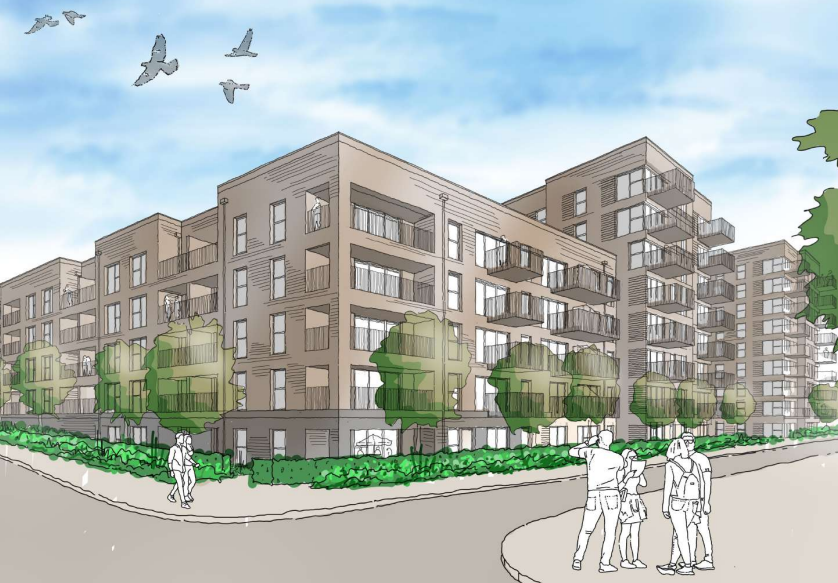
A request for a £2.6 million budget increase for new council flats planned for the former Sackville Road Trading Estate is due to go before the council’s cabinet next week.
The extra money is to cover the increased cost of the project to build 183 flats for social rents and 123 for shared ownership, according to a report going before Brighton and Hove City Council’s cabinet next week.
More than 300 flats are included in the scheme, with 40 per cent of them expected to be available for shared ownership through Hyde housing association.
The report said: “Projected costs for delivering the scheme have increased due to a number of issues including challenges in securing vacant possession of the site and changes to the design to respond to feedback in the planning process.
“This has included increasing the number of three and four-bed homes to respond to the need for more affordable family homes, larger window sizes in some flats and the introduction of play and food-growing areas.”
Negotiations with the contractor have increased costs because the scheme is considered high risk because the blocks of flats are up to ten storeys high.
Building Safety Regulator approval is required which is expected to take between 40 and 50 weeks once it is submitted next spring, adding to the costs of the £50 million project.
Planning permission was granted on Wednesday (5 November) for an application submitted by Homes for Brighton and Hove, a joint venture between the council and housing association Hyde.
The consent grants permission for 306 flats to be built on the site at the north end of the trading estate.
The extra £2.6 million could come from Housing Revenue Account borrowing – the fund made up of council tenants’ rents.
The initial £30 million budget was allocated as part of the Housing Revenue Account’s capital programme in June last year.
Grant funding is being sought from Homes England to support building the council flats for social rent.
The proposed blocks are between five and ten storeys high, with 109 one-bedroom flats, 137 two-bedroom flats, 58 with three bedrooms and two with four bedrooms.
The cabinet is due to meet at Hove Town Hall at 2pm on next Thursday (14 November). The meeting is scheduled to be webcast.








Just get on with it. The longer they wait and waste time the more it will cost to build. Thank god it’s in a private contractors hands as if the build was left to the council it would never get done.
No worries. If Brighton council succeed in taking over Peacehaven, they’ll have lots more money coming in to spend and can happily carry on getting their costings wrong
Peacehaven has a financial cliffedge when it comes to adult social care which it doesn’t seem to have a plan for at the moment, and would otherwise be facing massive cuts from ESCC. Quintessentially, LGR saves them from this situation.
Would be nice if the council was investing in all social council housing stock not this affordable housing with it’s partner Hyde? Which clearly will not be affordable for many on the council waiting list.
Social rents generally require a very heavy subsidy; so whilst not the best in terms of social housing, pragmatically, it’s more viable to see developments with Shared Ownership, LHA-rates, and Living Rent affordable models. Certainly not a perfect solution, but it provides homes at a lower than market rate.
Shared ownership is a trap. It should be scrapped. So many people already regret taking on shared ownership. You pay three separate charges: mortgage on your share, rent on the remaining share, and service charges. These combined costs can exceed what you’d pay for renting a similar property. Service charges can rise sharply and unpredictably, sometimes reaching hundreds of pounds per month. Additional fees apply for admin tasks like redecorating, getting a pet, or subletting. Staircasing (buying more shares) also incurs valuation, legal, and admin costs. Most shared ownership homes are leasehold, meaning you don’t own the land and must follow strict rules. You need permission for modifications, renovations, or even minor changes like flooring. Breaking lease terms can lead to eviction, and in some cases, forfeiture of your share. Despite only owning part of the property, you are usually responsible for 100% of maintenance and repair costs, which can be substantial. Buying extra shares is expensive because prices are based on current market value, not your original purchase price. Each step involves legal fees, valuation costs, and admin charges, making full ownership difficult for many. Selling a shared ownership property can be slow and complicated as you must find a buyer who qualifies for the scheme. The housing association often controls the sale process. Properties with short leases (under 80 years) are very hard to sell, and older homes may lose value instead of appreciating. The whole thing is legally complex. The agreements are intricate and vary between housing associations. Leasehold terms, ground rent, and service charges can change over time, adding uncertainty. STAY AWAY FROM SHARED OWNERSHIP.
I can’t argue with anything you said here, I think shared ownership, in its current form, often doesn’t deliver the stability or affordability it was designed to provide. For me, I don’t think it is the concept that’s the problem but the lack of consistency and regulation.
Personally, I would rather see reforms and tweaks to make things fairer. Things like capping service charge increases, standardising leases, the ability to convert to a different scheme, and strong legal routes to challenge unfairness. I think housing associations should also be required to maintain proper sinking funds so residents aren’t hit with sudden repair bills, through no fault of their own.
Full of great ideas like your affordable food for families. Still awaiting a definition on that from you .
Why is it fair for the neighbor to get up early and go to work and walk through the door in the evening shattered trying to pay mortgage and bills . And yet next door get to sleep in and want for nothing . No repair bills and help with rent etc .
Then complain about a lightbulb not working that costs £250 to be changed because that’s part of your service cost .
In the private sector it costs estimate £250,000 to raise a child until 18 yrs old .
20 % tax on income
20% vat tax on every thing you buy after with what’s left over .
20% child maintenance support wether you have 1 or 4 children with different mothers .
They have to share this equally.
So definitely incentive to have children with different mothers and more than 1 . And not go to work.
Otherwise it’s 60 % of your income
Affordable food is a good topic of discussion for affordability of living, because we have a lot of food banks running in the city, but there’s not a clear transition to get away from what is supposed to be an emergency resource, despite the reality that people rely on them on a weekly basis. Social supermarket models are the next step, in my opinion, charities like Brightstore.
For a definition, I’d refer to the UN benchmark. Food should cost no more than about 10–15% of disposable income. But it’s closer to 30% in Brighton, according to the Brighton & Hove Food Partnership.
On the substance of working vs benefits, I agree with you, welfare needs a total overhaul to make work pay. Unfortunately, the media narrative at the time poisoned that particular well, and we got a diluted version of it because of it.
I knew it be another waffle.
Affordable food is already grown in human waste.
Affordable food will mean the lowest and most horrific animal welfare.
Milk is very good for calfs and that’s it . Then we have halal meat almost in every supermarket.
When you go shopping a lot of what people put in there trolleys is not fresh . 90;% of the shop floor is unhealthy.
If you can’t afford to feed yourself then starting a family is not sustainable. Just like running a farm. You have to have a bit of common sense .
Affordable food is just junk food
Rember that when you moan about the price of food and then take your car to the garage and have it serviced and put the right fuel and oil in it .
The car gets better treated
Unfortunately, Rupert, your reply is a fine example of waffle. A mix of half-formed notions and irrelevant moralising. Perhaps once you’ve read a bit more about food affordability, we can have an intelligent adult conversation on the subject.
You weren’t raised on a dairy farm .
Recent service charge increases have largely been as a result of the implementation of the Building Safety Act. This is seldom mentioned in the media. There seems to be a political preference for scapegoating managing agents and freeholders despite the fact that the increased costs have been imposed by government.
I also think that both parties who share ownership should also share the service charge costs proportionally as each have an investment to protect.
It’s a really good point, and lends itself strongly to the argument that shared ownership as a concept needs further refining.
Surely the additional cost should have been included in the project estimates and part of the project contingency.
You can only estimate to a certain degree.
If you started to add in a cost for every possible risk then no scheme would ever get approved because the budget would be so big.
Ridiculous when the council is £420m in DEBT!!! 25 years ago 200,000 people lived in Brighton and Hove it’s now £310,000 that’s why there is not enough housing there is a limit on who can live here.
Ban all second homes would be a start.
BHCC is nearly broke!!!
Council borrowing isn’t the same as bad debt, Simon, it’s how councils fund long-term investment like new housing. You have to invest to progress.
Bear in mind there are several high cost projects underway at the moment, like the renewal of Whitehawk, as long as the debt can be serviced with, for example new renters, or reducing expensive emergency accommodations for cheaper in-house offers, it’s not a problem.
Whilst I don’t believe in banning outright second homes; I have a bigger problem with them being left empty, so I’m glad they are subject to a 100% markup on that council tax bill – reflecting the additional pressure that empty home is causing on homelessness care.
You weren’t raised on a dairy farm .