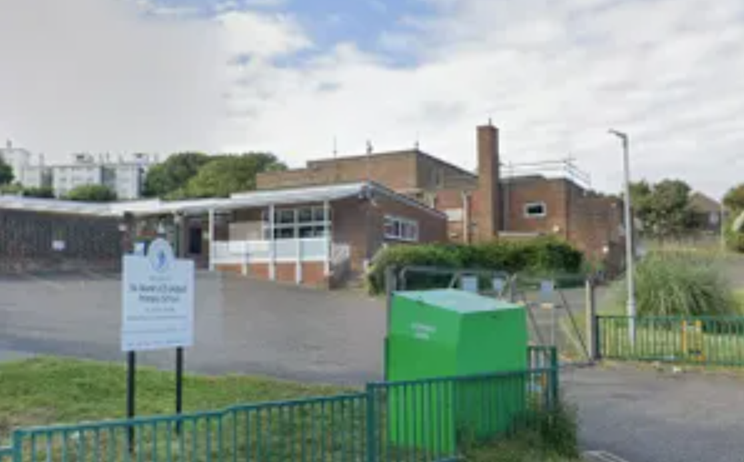
A Brighton primary school is to limit the number of children admitted to its Reception class to 15 for the next two years.
The change will mean that St Mark’s Church of England (CofE) Primary School, in Manor Road, can have mixed year group classes as it tries to rescue its finances.
Shrinking pupil numbers left the school with a deficit of about £150,000 at the end of the 2025-26 financial year which ended just over two months ago.
The change – for an intake of 15 instead of 30 in September this year and next year – has been approved by the Office of the Schools Adjudicator.
According to Brighton and Hove City Council records, since 2022 the school has allocated places to 14 to 16 pupils on national offer day – and currently has about 160 pupils on roll.
Just 13 families put St Mark’s down as their first preference for this coming September and a total of 16 pupils were offered places.
The school has been set up for 30 children to a year group – or about 210 in total – but with school funding based mainly on pupil numbers, the spare places are posing a growing financial challenge.
St Mark’s governors told the schools’ adjudicator, Robert Crawley, that their financial recovery plan included staff changes to teach four mixed-age classes.
From September, the proposed Reception and Year 1 group would have 26 children and the governors expect the school to have a total of 147 pupils.
The governors said: “Adopting this approach will help secure the long-term sustainability of St Mark’s, enabling it to continue serving the community as the only Church of England school in the locality.
“The proposed variation will enable the school to align Reception intake with the lower pupil numbers already seen across the rest of the school, supporting a transition towards the proposed four-class structure.”
St Mark’s has a “good” rating from Ofsted but has a high volume of children leaving and joining mid-year which the governors linked to parents working on short-term contracts at the nearby Royal Sussex County Hospital.
The council said that if more children than 15 listed the school as first preference, they would be offered a place at another school in the area.
Across the Brighton and Hove “East Planning Area”, which covers Whitehawk and Hanover, there was also spare capacity at other schools in the locality, with 104 places still available for this coming September 2026.
Dr Crawley said: “It was clear from the data provided by the school that the LA (local authority) has a picture of recent / projected demand in schools in its planning areas.
“In my view, the governing body at the school and the LA have clearly thought through how the financial shortfall in the school’s budget is to be addressed.”
He noted that the physical capacity of the school buildings remained the same, allowing for an increase in the published admission number (PAN) should there be a need to admit more children.
The adjudicator’s report said that Brighton and Hove had about 400 surplus school places in reception classes for this coming September because of the declining birth rate.
In May, Brunswick Primary School, which was once the biggest primary in Brighton and Hove, with an intake of 120, reduced its Reception admissions for the next two years to 60.
Three primary schools have closed in recent years and another – Middle Street – is due to close at the end of August.
The three to close were St Bartholomew’s, in Brighton, and St Peter’s, in Portslade, which closed in 2024, and St Joseph’s, in Hollingdean, which closed in 2025.
Since 2019, the council has been cutting the intake at larger schools to try to head off a crisis as birth rates drop and families move out of Brighton and Hove.
The 2021 census found 20 per cent fewer under-fives in the area compared with 2011.
Brighton and Hove City Council said: “The council is not responsible for setting this school’s admission arrangements. This change was requested by the governing board of St Mark’s Church of England Primary School.
“The proposal included using mixed-age teaching and the school has recently held information events for parents to ensure families were well informed about the proposals.
“The council is not actively considering any other proposals to move to a PAN (published admission number) of 15 but will work with any governing boards that wish to consider a change in PAN as part of their school’s strategic approach.”







At this rate, there will be no primary schools in Brighton and Hove.
Let’s predict the narrative: “Oh look, there is no demand for this school due to falling numbers and it’s not viable.” … Few months later…..Well look at that old school and it’s playing fields and the disused, neglected park. How many units can we cram on there and still make shed loads of money? We can build up to about 12 levels, as there is a precedent with flats around, we can put in a couple of swings to and East Brighton park is just down the road. It’s near the hospital so we can extort the health workers. There’s a gymn nearby that we can upgrade. Bus service to town centre and station (✓), supermarket nearby (✓), walking distance to beach and marina (✓), South Downs National Park up the road (✓) Factor in a bit of social housing and bump up the numbers, throw in a community room/hall and a couple of adapted living quarters. Even if the Council turn us down, we will win on appeal and get exorbitant costs. Nice little earner Rodders! Now what did I do with that box of brown envelopes?
Nice try, Ann. But please note this is a church of England school, so the land is not owned by the council. You’ll have to think of another story to fit your narrative.
I think you will find that although it is a church-assisted school, the land doesn’t belong to the CofE. It was built in the 70’s to replace the old St Marks School which is now the Bell Tower industrial estate at the bottom of Roedean Road. Before that it was meadow and playing fields and Manor Park.
There’s already a major surplus of school placements compared to children in Brighton, and looking at fertility rates being well under both locally, nationally, and globally, that’s like to continue being the case for the next decade. It’s the equivalent of saying you are predicting it is going to rain, when you’re already wet.
Benjamin, I usually look forward to your insight and comments on here but your analogy doesn’t hold water here!
No-one can predict the future but if we are to build the number of new homes expected then we will need school capacity. In the meantime we can improve the pupil to teacher ratio. At the moment we have one of the worst performing education systems in the G7. Not only would this allow more intensive tutoring but given the rapid rise of SEND pupils, we can kill two birds with one stone.
BHCC seem intent in dismantling the fabric of OUR city. Their recent record on school closures and lack of lobbying, resistance and fight from the local politicians is, on the most part, shameful. Look at the the Brighton General site and the King Alfred fiasco with loss of amenities and reduced capacity.
I understand that central government has a part to play but where is the vision and optimism? Where is the resolve? It’s not wonder that people are disillusioned with our representatives when all they can see is doom and gloom and the distance that creates. That void is then filled by chancers blaming all our woes on immigrants. All the time they are pocketing money and avoiding taxes. If you think that Labour inherited a shambolic economy just wait if, God forbid, good ol’ for rage, tice and the other robbers get in.
We need to stand up and be counted and condemning future generations to suffer because we have failed to invest in their futures by closing schools, selling off public land to profiteers and settling for mediocrity, is playing into the hands of the bigots and exploiters.
Let’s grow a collective backbone and stand up for what we know is right.
PS: apologies for the polemic rant but I haven’t had my meds yet 😁