When trees are felled, the council needs to be get better at telling people what’s happening and why, a councillor said.
A number of pests and diseases are damaging trees across Brighton and Hove and some are being chopped down as a precaution to save others.
Elm disease, zigzag sawfly, ash dieback, oak processionary moths and pathogens affecting horse chestnut trees are sweeping across the area, with hundreds of trees felled to public distress.
Labour councillor Alan Robins, Brighton and Hove City Council’s Cabinet member for sports, recreation and libraries, told members of the Place Overview and Scrutiny Committee that work to tackle elm disease was aimed at containing its rapid spread and preventing the loss of more trees.
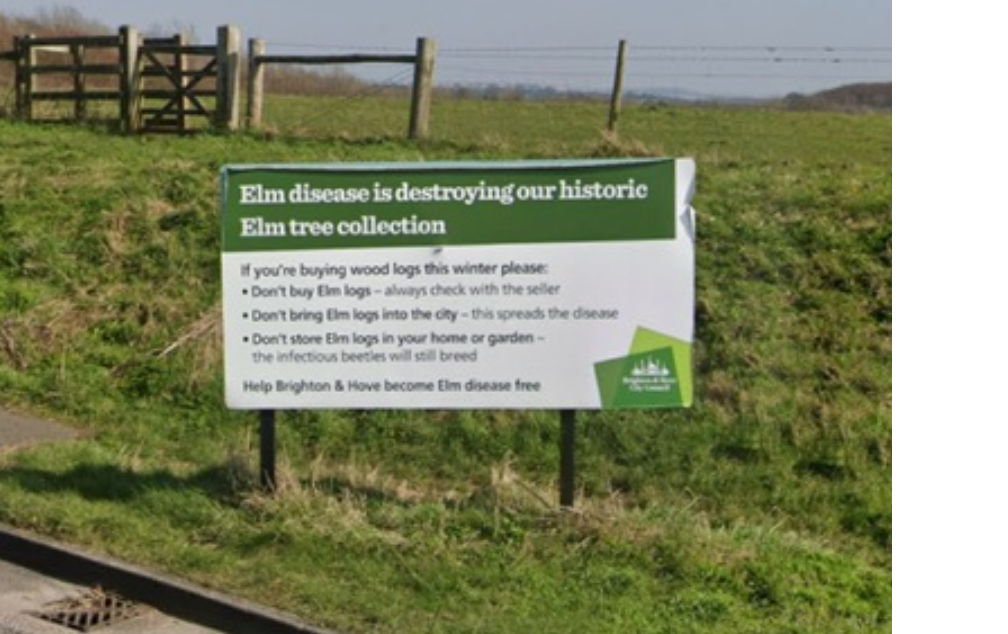
A third of the trees in Brighton and Hove – more than 3,000 – are elms. The disease, a fungus carried by elm bark beetles, is being fought with the largest inoculation programme in the country.
Replacing street elms is expected to cost £30 million over the next five years, according to a report to the committee which met at Hove Town Hall last week.
Ash dieback cannot currently be contained, with trees removed from woodland areas for safety reasons, particularly in Stanmer Park. Replanting is estimated to cost £18,000 a hectare over 10 years.
Green councillor Sue Shanks said that communication about why trees were coming down needed to be better because she had seen the word spread with shock through street WhatsApp groups.
Councillor Shanks said: “Residents just need to know why this tree is coming down – either putting things through people’s doors or a notice on the tree about why this is happening.
“(Otherwise) people contact their ward councillors asking: ‘Why are you cutting our trees down?’”
She was sceptical about the need to fell infected ash trees but accepted the necessity of removing diseased elms.
“Friends of” groups and ward councillors were told about the removal of street trees, she was told, and notices were already placed on trees.
Labour councillor Theresa Fowler, who represents Hollingdean and Fiveways, said that there had been “devastating” tree losses in her ward where diseased trees had to come down.
Councillor Fowler said that she had read about people being killed by falling tree branches in another part of the country which underlined for her why the infected trees had to go.
She wanted to know when trees would be planted and what varieties would go back into Hollingbury and Burstead woods.
Councillor Robins said that there was a cross-party woodland advisory group which included community groups.
He said: “Some are saying it looks devastating when all the trees were lost, with big holes, but now we’re seeing the sun creep in and we’re getting bluebells and primroses coming into the little copses.
“There is a big job to decide how we replant and not just a case of we’ve lost 40 trees so we’re going to put 40 new trees in. Some groups are coming forward with good ideas.”
A tree planting plan is under way this winter, including in Stanmer Park, other parks and in streets, with a budget of £164,000 to cover ash dieback.
The same amount has been budgeted for elm disease, the report to the committee said, although the budget is expected to overspend by £100,000 by the end of the year.
And £40,000 has been set aside to inoculate about 1,500 trees from elm disease.
Green councillor Ollie Sykes recalled how a school had left an infected log in a pile which he described as “contributing to the problem we have now” and asked whether the council could impose any sanction.
In 2015, a log pile at St Christopher’s School, in Church Road, Hove, was found to be the source of an outbreak of elm disease resulting in the loss of 23 trees in the area.
Councillor Sykes was told that it was unlikely any sanctions could be imposed on private residents but signs placed on main routes into Brighton and Hove reminded people that logs can carry the disease.





“Replacing street elms is expected to cost £30 million over the next five years” that works out to be £10,000 per tree. I like elms but that seems excessive
Yet apparently thousands of pounds worth of solid cedar planks were dumped in a skip rather than recycled when the council scrapped the designer long benches in New Road without public consent a few weeks ago, silently admitting this £1.75 million experiment, once hailed as the UK’s first shared space for pedestrians and vehicles back in 2007, was a failure. We have a council which knows the price of nothing and the value of nothing and pays lip service to sustainability.
https://www.gehlpeople.com/projects/new-road-streetscape-design/
It’s an interesting point Tom, and the Procurement Act 2023 doesn’t help matters much, as it means that councils usually end up having to choose “safer” options rather than the best deal. Potentially, devolution can provide some resolution here in the future, for example, instead of BHCC commissioning 500 trees a year at £10k each, the new MCCA could tender 5,000 and negotiate 30% savings, as well as developing more skills in-house, offsetting expenses like consultant fees.
The Procurement Act 2023 expands criteria beyond “safer” options
The quote claims the act makes councils choose “safer” over “best deal” options, but the new legislation is designed to do the opposite by encouraging broader considerations of value.
Another ai Google search passed off as your own Benji .
Stop it get some help
The trouble is that, when you look at it through a human lens, is that most procurement teams are still wired for audit safety, even with broader criteria, Rupert. I’m more than happy to discuss MAT and how, in practice, it still tends to encourage safer options rather than the best deal. That said, it’s definitely a step in the right direction. Hopefully, devolution will give the new MCCA the scale and flexibility to make those principles work as intended.
I took your previous comment and copied it out it in ai to prove your basically using ai to hound every person on every topic on every day .
Lmao
Oh Rupert…Informed thoughts ≠ AI usage.
For a Council with a unique UNESCO Biosphere status to defend and a stated local climate emergency declared in 2018 ‘chainsaw massacre’ comes to mind when it comes to their idea of tree husbandry. That is, if samplings are lucky enough to survive to maturity thanks to the council’s wanton neglect- sic the new Kingsway to the Sea park where hundreds of saplings have been negligently condemned to death. BH Trees can then look forward to an average lifespan of up to 30 years, if they are lucky, before a lack of root planing or trimming seals their fate. It is standard practice to hollow out the remaining stumps so no one can tell if trees were genuinely diseased or simply sacrificed because it was more expedient to get rid of the tree rather than treat it. Mature trees count for nothing in this city because the view is taken these miraculous oxygen-producing machines can always be replaced. Contrast this with the way trees are valued in most European cities with many, centuries old. Talk of sustainability is truly laughable as this council thinks nothing of cutting trees down at the slightest excuse.
if residents have to observe Tree Preservation Orders over each tree, it should be no different for the council. it should be the law that a second opinion is obtained from an independent tree surgeon before felling and the equivalent of a tree “Death Certificate” made publicly available to explain the exact reason for each tree being axed. Council fudgery and neglect on the subject of city trees – and holding residents to different standards than themselves – has gone on long enough.
I think the council has been quite clear about the need to fell trees, my main concern is that a replanting program gets under way and woodland not left to nature, to grow scrubby and to lose its diversity. Beech trees for example encourage spring flowers and discourage scrub.